

A Half Century of Ballistic Missile & Satellite Defense
From Nike Missiles on Chicago’s Lakefront to the New U.S. Space Force
William J. Bowe · The Cliff Dwellers · Chicago · February 26, 2020
Contents
Welcome and a Cold War Education 00:04
Why This Subject, and Why Now 02:01
Nike Missiles Around Chicago 04:40
Army Intelligence and Safeguard 08:30
The Short Life of Safeguard 10:50
The Pyramid of Nekoma, North Dakota 12:13
Inside Cheyenne Mountain 13:51
Johnston Atoll and a Bomb in Space 15:18
Terminated With Extreme Prejudice 19:19
Kwajalein: Missiles Into the Lagoon 21:19
Undercover on Kwajalein and Meck 23:54
Midcourse Kills and Giant Radars 29:33
Rail Missiles and Hypersonic Threats 31:26
The Space Force and Space Command 33:20
Space Command and the Spy Satellites 34:56
Nine Nuclear Powers, Fewer Warheads 36:21
War Moves Into Earth Orbit 37:54

Summary
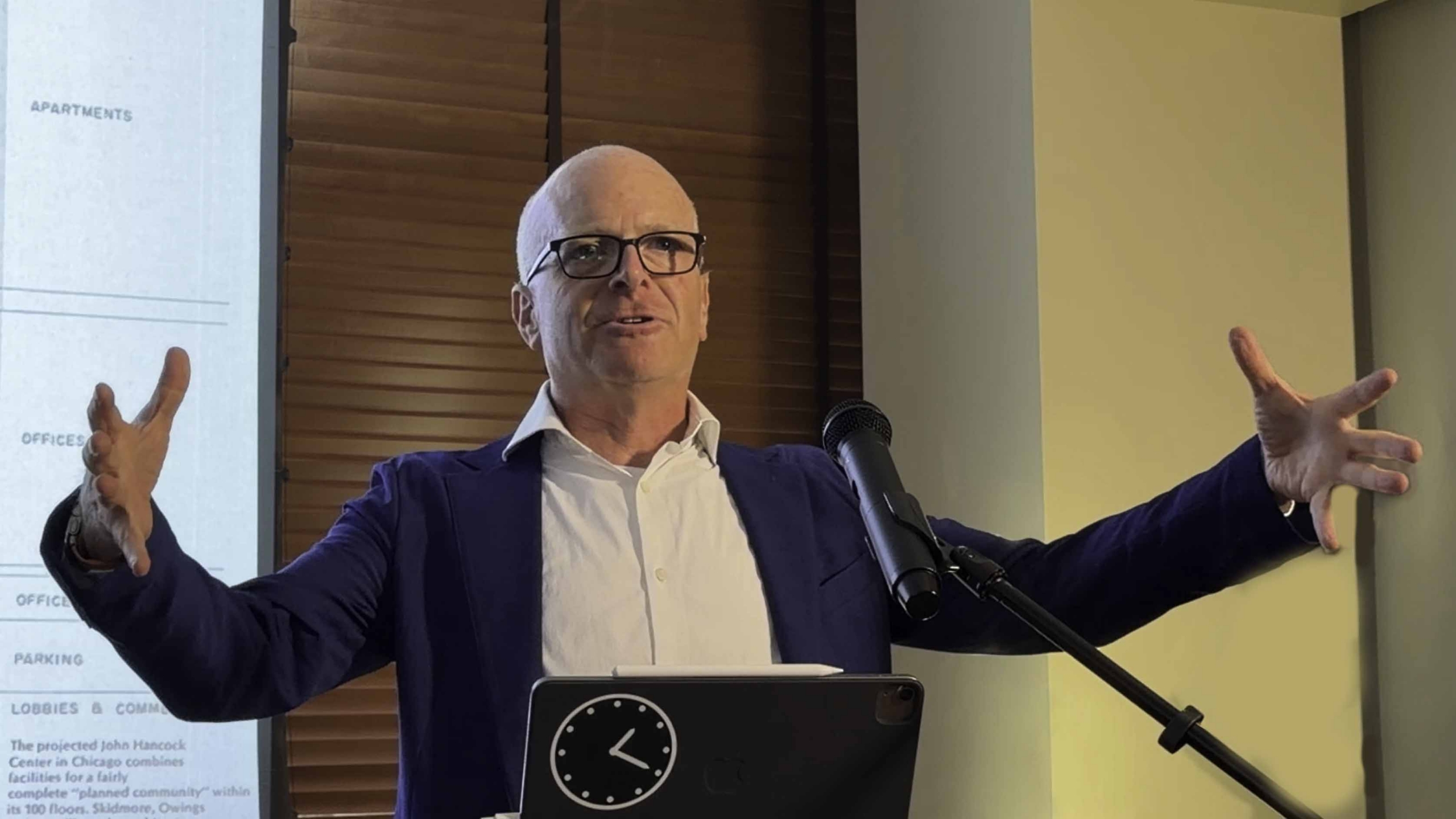
Editor’s Note: On the evening of February 26, 2020, members and guests of The Cliff Dwellers stayed on after dinner to hear William J. Bowe, a former president of the club and former Executive Vice President of Encyclopaedia Britannica, speak on “A Half Century of Ballistic Missile & Satellite Defense: From Nike Missiles on Chicago’s Lakefront to the New U.S. Space Force.”
Bowe opened with a lighthearted look at a subject he has followed since the 1950s. Nike missiles with nuclear warheads once stood ready at sites ringing Chicago, including Belmont Harbor and Jackson Park, as part of a nationwide Army defense against Soviet long-range bombers. He then turned to Nike’s successor, the ill-fated Safeguard anti-ballistic missile system. As an Army counterintelligence analyst at the Pentagon in the late 1960s, he assessed Safeguard’s counterespionage and counter-sabotage risks, work that took him to Redstone Arsenal, to NORAD’s command center inside Cheyenne Mountain, to Johnston Atoll, and to Kwajalein Atoll.
With slides and wry asides, he described the pyramid-shaped radar at Nekoma, North Dakota, the 1962 nuclear test in space above Johnston Atoll, test missiles fired from California into Kwajalein’s lagoon, and the research radars of Meck and Roi-Namur. He traced what followed: the 1972 ABM Treaty, Ronald Reagan’s “Star Wars,” the end of the Cold War, and the American withdrawal from the treaty in 2002.
The talk closed with the threats that have emerged since: rail-mounted and hypersonic missiles, and cyber, jamming, kinetic and laser weapons aimed at the satellites modern life depends on. Bowe explained how these pushed the United States to create the Space Force and Space Command. He ended with cautious optimism that the nuclear danger will be smaller by 2045, the hundredth anniversary of Hiroshima, and then took questions.
Transcript
Lightly edited for clarity and readability; false starts and repetitions have been removed, with the substance of each remark preserved. Click any section heading or slide to jump the video above to that point in the talk.
Welcome and a Cold War Education ▶ 00:04

Well, thank you. I think we’re ready to get started. That was a great meal that Chef Victor and the gang produced. And thank you all for coming. I’ve got some old clients here from when I was in private practice a long time ago, to say nothing of the regulars. Charlie, I see you back at the bar. Thanks for being here now rather than watching Snow White streaming on Disney Plus.
In the 1950s, I was curious, as maybe many of you were. In fact, let’s see the number of hands of people who remember the Nike missile sites. So that’s over half. Good, because if you told younger people today that we had nuclear weapons stored in our parks and harbors, they wouldn’t buy it. But I remember poking around the Belmont Harbor site a little bit.
In the early ’60s at college, I was a political science major. I took a course in international relations that focused on the nuclear competition between the US and the USSR in the first decade of the Cold War. It was very, very interesting. I remember the assigned reading included Henry Kissinger, then a Harvard professor. He was one of the few academics writing about that kind of thing then. As the Vietnam War grew apace in that period, I came back to Chicago and went to law school. And then, which is why we have this subject before us tonight, I had the most extraordinary and unexpected postgraduate education in anti-ballistic missile defense. And it was all thanks to the Army.
Why This Subject, and Why Now ▶ 02:01
I’ve kept my eye cocked on this area of life in the news in the decades since, but I was taken back to this subject last fall when I noticed something that was just striking. It may have struck you the same way: the President and the Congress actually agreed on something. After being thunderstruck, I read into it. And of course what they agreed on was the creation of the Space Force and the attendant Space Command.
Because the Army had given me this strange education, last fall was the half-century anniversary of my working on the Nike successor, the Safeguard Anti-Ballistic Missile System. It had taken me out to Kwajalein Atoll in the western Pacific, which was then the western terminus of the Pacific missile test range. I got into that quite deeply at the time, looking into counterespionage and counter-sabotage issues that affected the missile system that was then under development. It hadn’t been deployed.
So I’ll talk about the Nikes in Chicago. I’ll talk a little bit about the Safeguard system. I’ll throw in a little bit of Cold War history, and I’ll talk about what has been going on that leads us to this particular point in our history, where we have our military focused on space as a potential war theater that we need to deal with. And finally, I’ll close with a couple of comments about the Doomsday Clock and how it’s ticking.
When I was looking into this last fall, I found there had been so much going on that I knew nothing about. I came back to our past president, Eve Moran, and the head of our programming, Joan Pantsios, and said, “I think this might be interesting. What do you think?” They said, “Yes.” So that’s why we’re here, and should this little talk bore the peewaddle out of a lot of you, join me in blaming those two for getting us into this mess. I hope you find this whole subject as interesting and fascinating as I have over the years, albeit, of course, a worrisome matter to be talking about and thinking about.
Nike Missiles Around Chicago ▶ 04:40
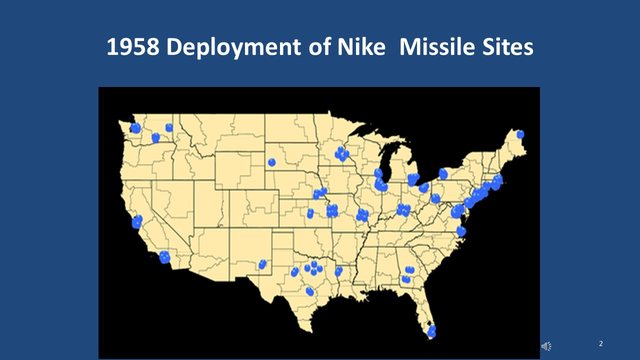
In the 1950s, as you see here, this was the national deployment of the Nike missile defenses. There were 40 defense areas, and there were 200 Nike batteries spread among these defense areas. The defense areas were chosen because of their perceived value to the Soviets in a Soviet nuclear bomber attack. So the targets included Chicago and other large cities, Air Force ICBM bases, dams and the like. Chicago was the largest of all of those sites in the US.

Now, those of you who remember a Nike site, see if you can find your suburban location on that map. On the top right is the site in Jackson Park, and below that is the Belmont Harbor launch site. The Belmont Harbor radars were located just to the north at Montrose Harbor, and former president Bill Getzoff told me the other day that when he was in the Illinois National Guard, he actually patrolled those radars. So thank you for your service, Bill. Knowing how good he would be on guard duty, I’m sure that at that particular time not one Vietnamese got across the perimeter fence.

The first Nike missiles were armed with enough conventional explosives to take out a single Soviet bomber. Then in 1958, since more is always better, nuclear warheads were put on the Nikes so that they could take out multiple bombers simultaneously. This is a short film clip from a film done for the Air Force. It’s about the Thor missile, which had been developed hurriedly in the 1950s and sent to Europe because our own ICBM force was not ready at the time. It gives you a sense of the threat environment as it was perceived then. This was serious stuff.
Film narrator: Let us recall the birth of Thor and, as a matter of fact, the reasons leading to its conception. Like most war babies, Thor was conceived by international tensions. When the Russian bear came out of hibernation with a hydrogen growl, we needed a big stick, and we needed it fast. We had already begun development of 5,000-mile intercontinental ballistic missiles. But while the ICBM program was proceeding favorably, operational availability was still years away. We did have the immediate deterrent force of the Strategic Air Command, but how long can our bombers alone hold the Russian bear in check?
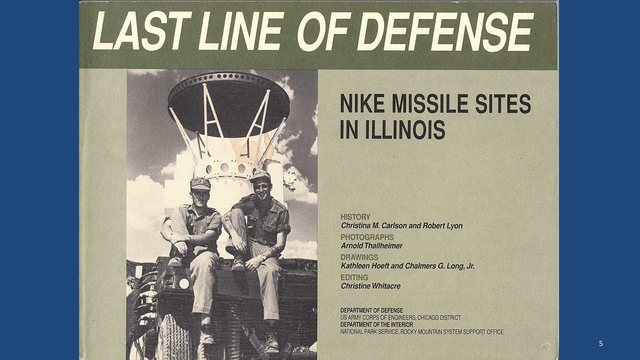
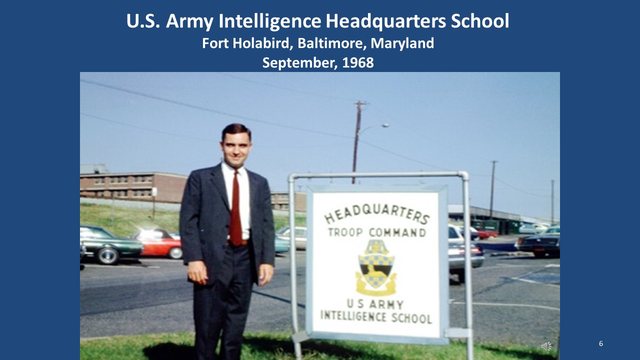
Bill Bowe: This history from the 1990s was prepared by the National Park Service, which inherited some of the Nike sites, and also by the Army Corps of Engineers, which had designed them. But by 1974 all of these were gone, so there’s no Cold War tourism for Nike sites left in Illinois. I had enlisted in 1968 in the Army’s Intelligence Branch.
Audience member: Who’s in that picture?
Bill Bowe: The slim Bill Bowe.
Audience member: What a hunk!
Army Intelligence and Safeguard ▶ 08:30
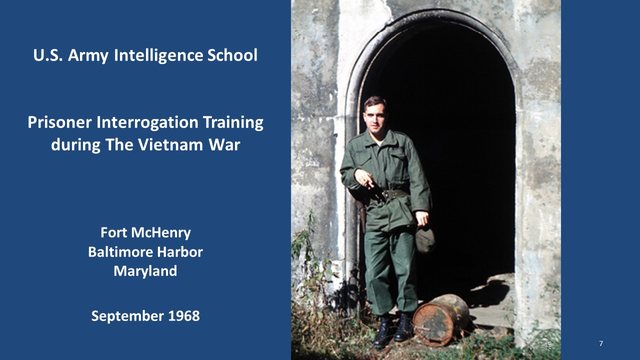
Bill Bowe: By the way, I’ll give you my telephone number afterwards. So I went through counterintelligence training at Fort Holabird in Baltimore, and not long ago at the members’ table I found out that Bob Newman here, who’s on our board, had gone through Fort Holabird at about the same time. So thank you for your service, Bob. With the Vietnam War continuing to heat up, many intelligence school graduates went to Vietnam, including Bob. This prisoner interrogation training we had reflected the reality of the Vietnam War going on at the time.
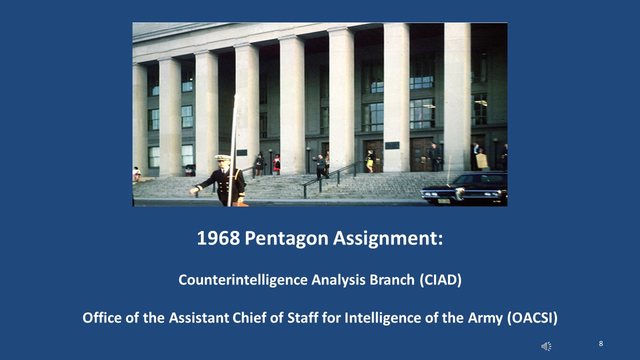
I was older than most of my intelligence school classmates and had been through college and law school and even had a year of practice. So I think that’s why I ended up assigned to the counterintelligence analysis branch of the Office of the Assistant Chief of Staff for Intelligence of the Army at the Pentagon. This kind of intelligence has to do with protecting your secrets and assets from those who would do them harm.
With the push on at the time to replace the Nike’s anti-aircraft capability with an ICBM missile defense, Safeguard was the highest priority. It was the Army’s ticket into the more modernized future technology. And therefore one of my first assignments was to assess the counterespionage and counter-sabotage aspects of the program’s development.
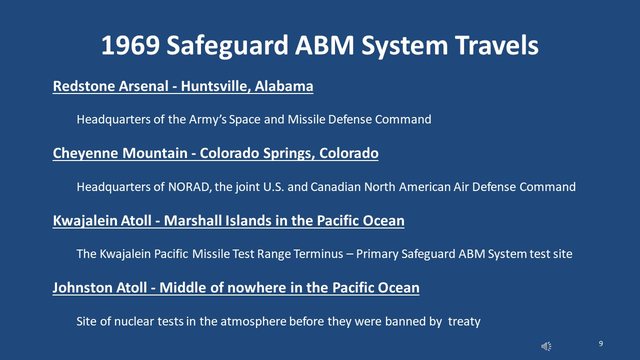
It was impossible for me to understand those issues unless I hit the road. So I went first to the Redstone Arsenal, where they were designing and managing the development of the system, and then out to Colorado Springs to the headquarters of NORAD. NORAD, of course, was operating what was then the air defense network into which Safeguard would have to fit. And I got out to Kwajalein Atoll, where they were using state-of-the-art interceptor missiles, radars and optics to work through the problems in this advanced system’s development. As it turned out, I also made an unplanned stop at Johnston Atoll in the Pacific.
The Short Life of Safeguard ▶ 10:50
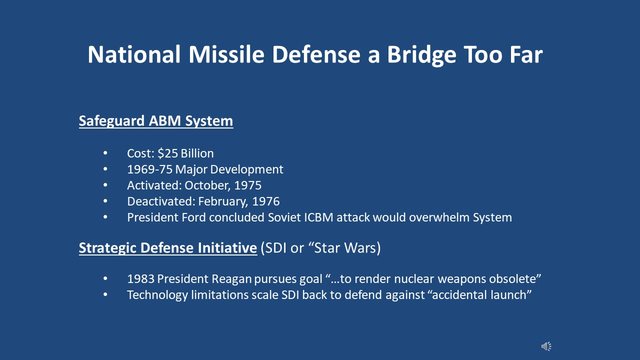
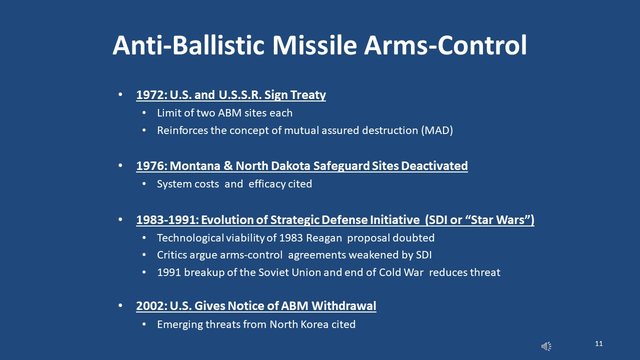
As you can see, the Safeguard ABM system didn’t last long after I worked on it in 1969. The efforts to develop a national missile defense afterwards never really went anywhere, in part due to arms control agreements and continuing technology limitations. Also, as time went on, there was a reluctance to upset, or potentially upset, the nuclear stalemate between the US and the USSR. After I left the Army in 1971, and before Safeguard was deployed, the Soviets and the US had already agreed to limit their ABM defenses to only two sites. And in 1976, both US sites had unilaterally closed.
In the 1980s, Reagan’s Strategic Defense Initiative, called Star Wars, produced no defensive weapons, although it did help trigger the USSR’s bankruptcy and ultimate dissolution in that part of the Cold War. The US withdrew from this treaty in 2002, and that was because there was a new player on the scene, one which we seem to be dealing with again today as well: North Korea.
The Pyramid of Nekoma, North Dakota ▶ 12:13
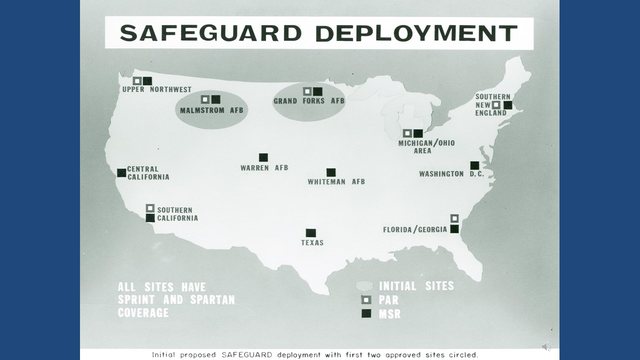
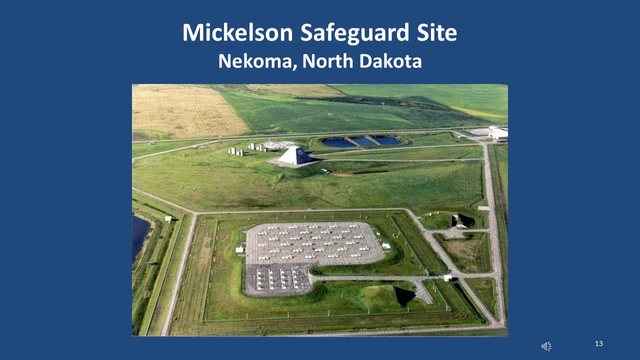

There were only two Safeguard sites ever built. One was in Montana, at an ICBM air base, and the other was in North Dakota. Now, if you can believe it, this is the North Dakota site, the Mickelsen Safeguard Complex in Nekoma, North Dakota, population 48. It is a Cold War tourist destination, folks. Today tourists drop by and take a look at the missile site radar up top, and below it you see the fields for the Spartan and Sprint missiles and their silos. And here’s a gaggle of tourists now. I’m sure you know just what they were thinking: “Why spend the money to see the Great Pyramids if you’ve got a pretty good pyramid here?”
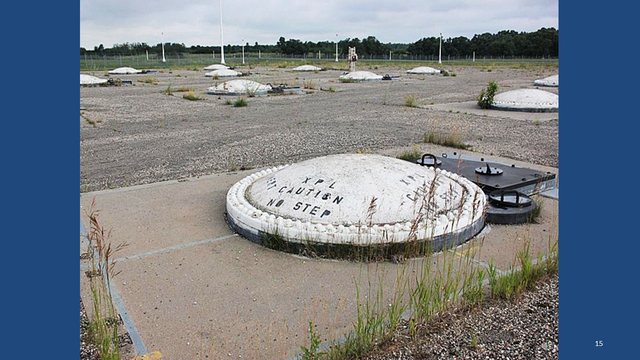
In ICBM defense, speed is of the essence, as you would expect. One way to speed things up would be not to have heavy metal hatches on the silos, but rather a Styrofoam hatch that the missile could just blow through quite quickly, with no waiting for it to open. And note the fence around this missile field. I was given pause about the Styrofoam action when my research turned up the fact that at an Air Force ICBM base, high schoolers had gotten over the perimeter fence. And what do you do then? You paint your high school class year on the silo.
Inside Cheyenne Mountain ▶ 13:51
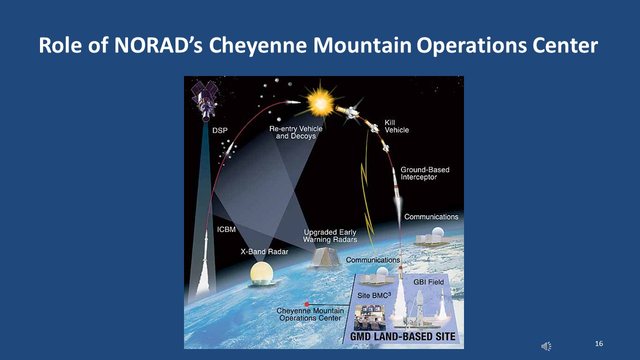

So, after being briefed on Safeguard basics at Redstone, it was off to Cheyenne Mountain. This slide depicts the complicated current role of the NORAD operations center in a battle to destroy incoming ICBMs. You access the NORAD headquarters by getting on a bus and driving deep into the mountain through a tunnel. You get out of the bus and you go through two blast-proof vault doors, and then you come into an enormous cavern that opens up before you.
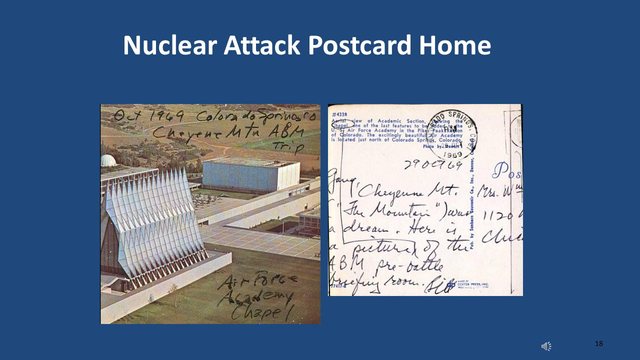
The cavern in the granite mountain is now filled with multi-story prefabricated office structures that sit on enormous I-beams. They and their utility connections are all spring-loaded, so when the Soviet ICBM hits the mountain, they’re “stirred and not shaken.” After I had this education about how Safeguard fit in, I sent my mother a postcard at home, and I told her that my pre-battle nuclear attack briefing had taken place, sensibly, at the Air Force Academy Chapel.
Johnston Atoll and a Bomb in Space ▶ 15:18
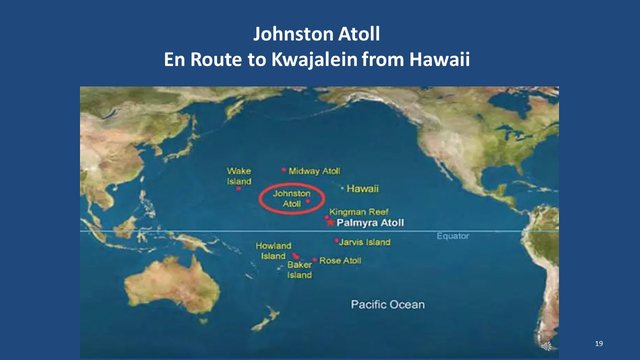
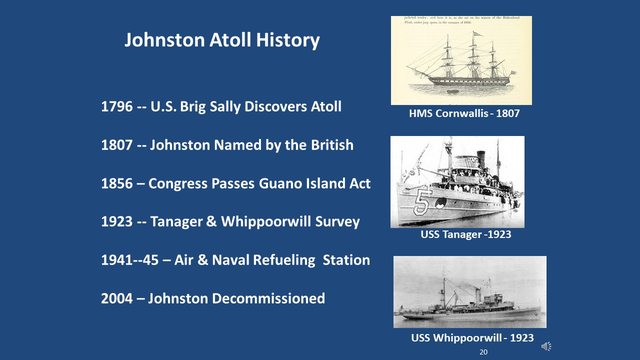
I then traveled to Honolulu to board a military flight to Kwajalein, and it stopped to refuel at Johnston Atoll, one of the strangest places I have ever been to in my life. A little bit of history: the Sally discovered the atoll while it was transiting the Pacific, and it ran aground there. The British captain of the Cornwallis, a few years later, modestly named the atoll after himself. Commercial development of the atoll’s substantial guano deposits began after Congress authorized it in the mid-19th century, and the Tanager and the Whippoorwill did scientific surveys in the early 20th century.
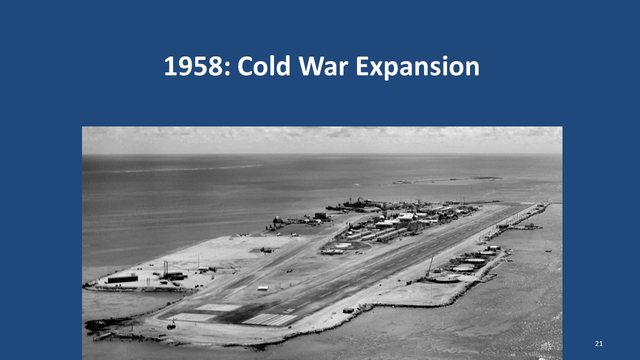
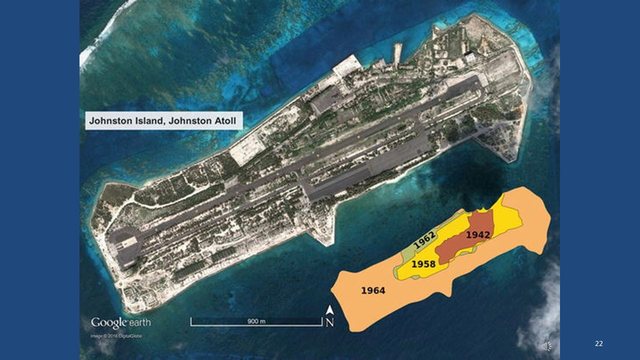
Not surprisingly, in the war in the Pacific during World War II, it was a Navy and Army Air Force refueling depot. Johnston was deactivated in 2004 and was briefly, and unsuccessfully, put on the market by the General Services Administration of the federal government as a resort property. The Cold War came to Johnston in a big way in 1958, when the first of a series of high-altitude nuclear detonations began. As you can see in this picture, Johnston is abandoned today. Note that the adjacent graphic shows that the man-made accretions at Johnston all occurred during the peak of the Cold War.
Audience member: Just a question about that. Where did they get the landfill material to build up this island?
Bill Bowe: Maybe they just saved some of the guano. That’s a good question. Can I get back to you?

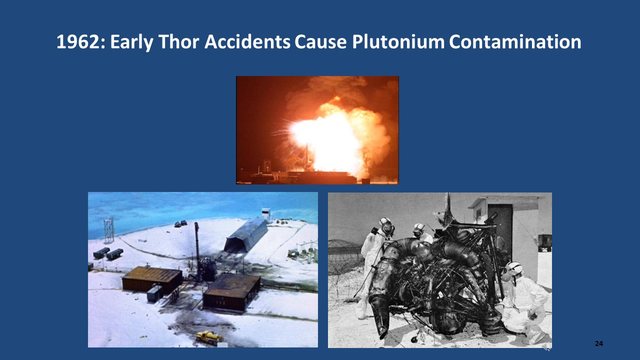
The Project Fishbowl test in 1962 was meant to find out what happens when you detonate a nuclear weapon in space. U.S. defense planners at the time were worried that Soviet satellites would be carrying a nuclear bomb in orbit and could release it at will on ICBMs in the U.S. or, God forbid, of course, on U.S. cities. These early unsuccessful test results were nothing, however, compared with the spectacular nuclear explosion that was soon set off in the upper atmosphere.
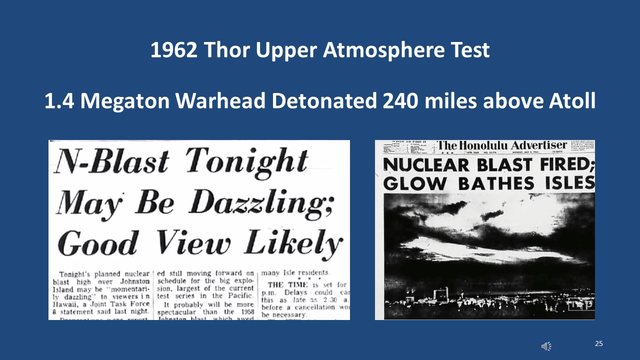

The first thing the blast produced was a startling artificial aurora borealis that could be seen all the way from New Zealand to Hawaii, and it lasted for minutes. And no one had expected the startling effects of the electromagnetic pulse. One conclusion was that some countries could have their entire electrical grid knocked out with a single detonation. The radiation impact on the Van Allen Belt and on satellites was not foreseen at all. The next year, right after the Cuban Missile Crisis, the nuclear treaty came along. The Limited Test Ban Treaty forbade atmospheric tests, tests underwater, and tests in space.
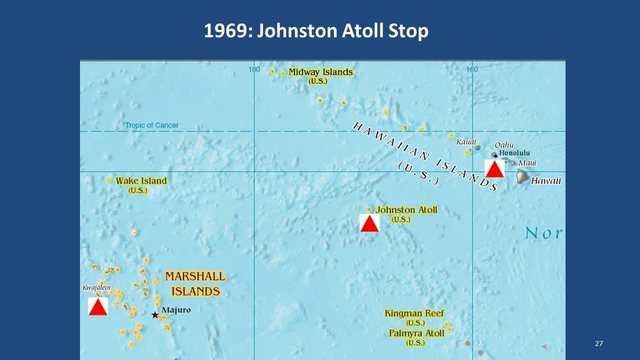
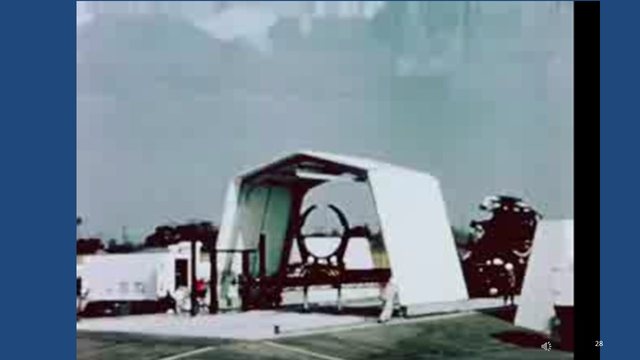
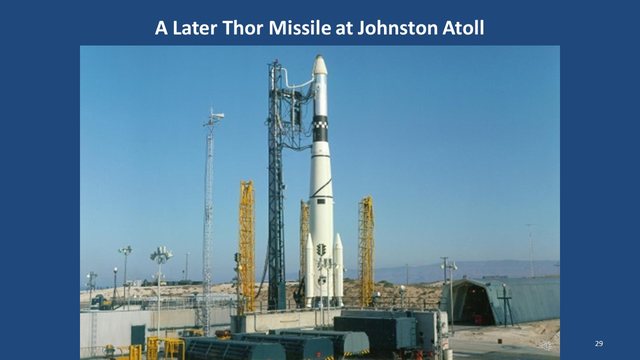
Six years after the Limited Test Ban Treaty was signed, what I thought was a direct flight from Honolulu to Kwajalein stopped at Johnston Atoll to refuel. As we were landing there, on either side of the runway I saw shelters like this, and outside of one a Thor missile was being worked on. I later found out, when I read the New York Times one day, that the Thor missiles were part of a secret anti-satellite weapon system authorized by President Johnson, with the capability indeed to shoot down any Soviet satellites carrying nuclear bombs.
Terminated With Extreme Prejudice ▶ 19:19
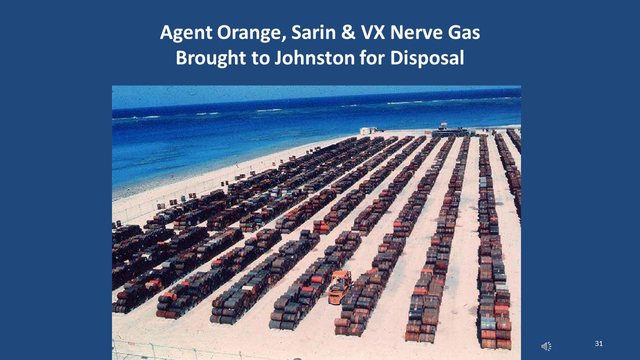
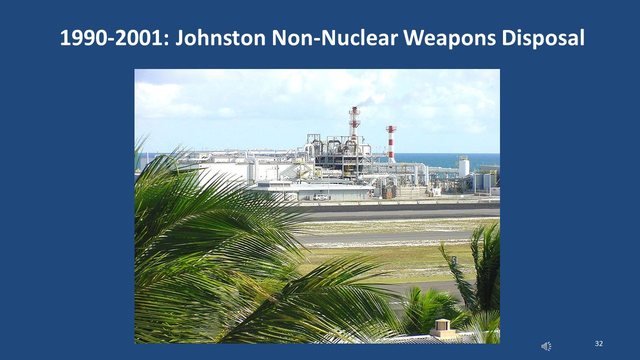
In the 1990s, after the Vietnam-era buildup had ended and Reagan’s Strategic Defense Initiative had helped finally bankrupt the USSR, vast stocks of aging chemical weapons were beginning to leak, which was a big problem. They were becoming unstable. Where are you going to fix this? Well, what a great thought: Johnston Atoll, of course. Johnston’s new mission became the destruction of the most deadly non-nuclear weapons in the U.S. arsenal. It took over a decade, but this was the furnace that got that job done.
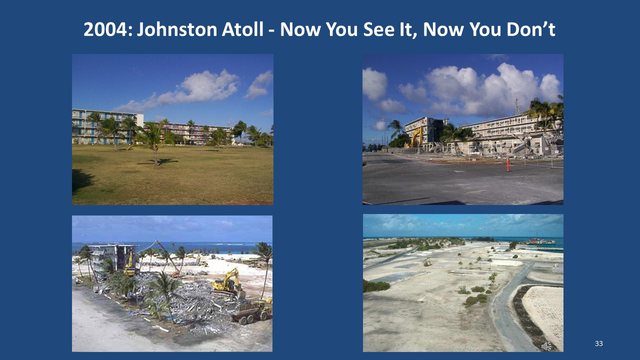
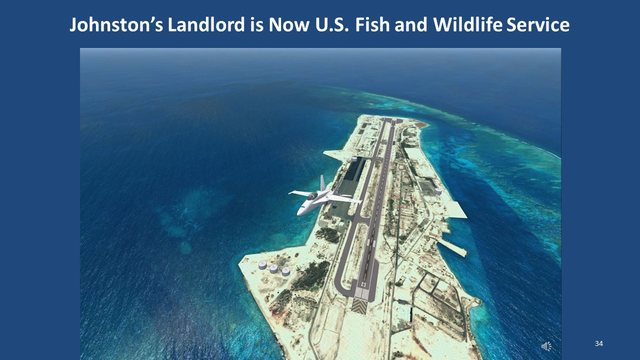
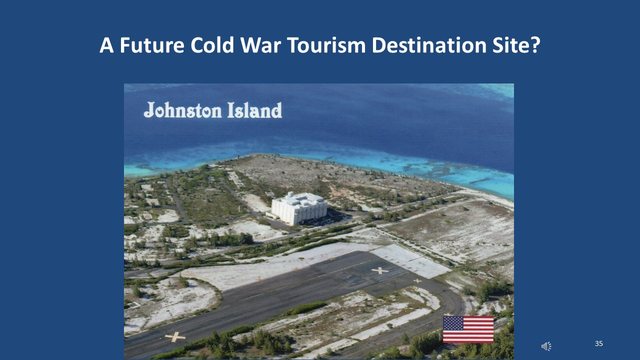
At its peak, over 1,200 military and military contractor personnel lived on Johnston. When the toxic weapons were gone, all of the housing and all of the other infrastructure was destroyed. Johnston wasn’t just decommissioned a decade and a half ago. It was terminated with extreme prejudice. Personally, I doubt that Johnston will ever become the busy Cold War tourist mecca that Nekoma has become. It’s even more remote. It wasn’t discovered until three centuries after Columbus, and then only because a ship headed elsewhere ran aground there.
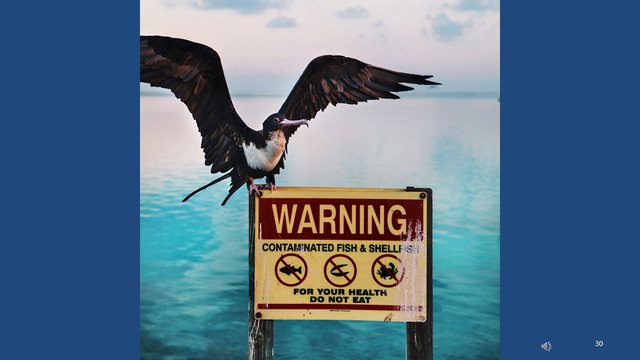
For most of its history, it’s been filled with bird crap, plutonium debris, and chemical weapons. It’s been run down and left vacant for years. It has virtually no significant wildlife; the largest of its big five is a coconut crab. It has plenty of fish, but you might die if you eat any. And let’s not forget that its previous tenant failed trying to sell it. Of course, on the plus side, if you want to think about it that way, it was once the site of the first and only artificial sunrise known to mankind.
Kwajalein: Missiles Into the Lagoon ▶ 21:19
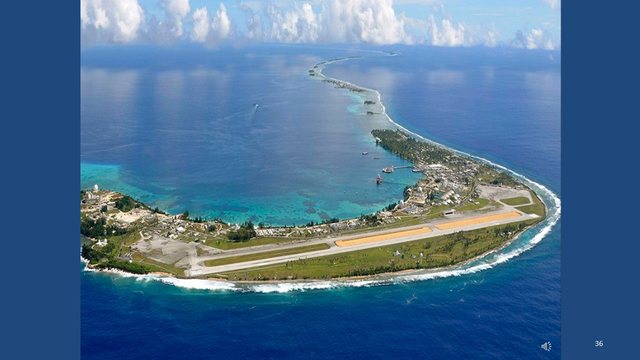
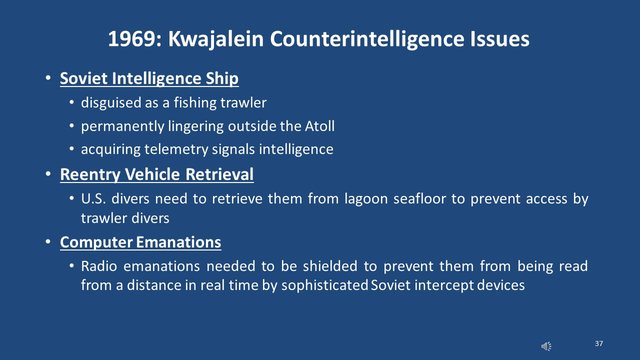
Kwajalein Atoll. Here’s Kwajalein Island, the largest of the 90 coral islets that surround the world’s largest lagoon. This is the southernmost island, with a little bit over a square mile. There are research and weapons system functions here and on nearby Meck and northern Roi-Namur Islands. There were local counterespionage threats of the day. The problem with computer emanations was a security issue that was not limited to Kwajalein and also had to be thought about on the mainland. And, of course, it’s pretty common to take care of that today.
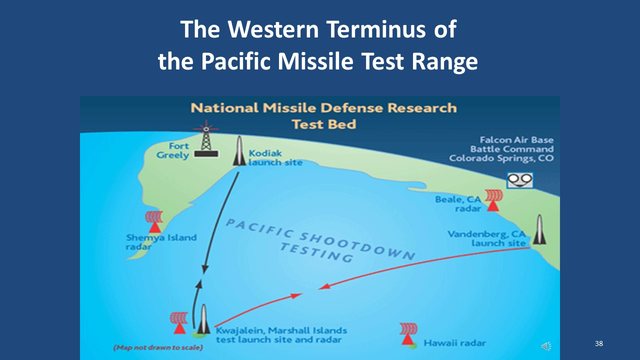
In 1969, a Minuteman missile, the ICBM of ours at the time, was yanked with its crew at random from their silos. They were trucked to Vandenberg Air Force Base near San Francisco. The warhead was taken off and an instrument package went in. It was programmed for somewhere in the middle of the Kwajalein lagoon, and when the re-entry vehicle dropped in, the splash was precisely fixed by radars and optics located around the atoll.
The purpose of all of that was to see how accurate the missile was. And the reason they wanted to know how accurate it was, was to see how much of a likelihood they had of taking out a hardened Soviet silo with a single ICBM. Of course, when you answer that question, you also have an idea of how well they’re going to do at some point in taking out your hardened silos.
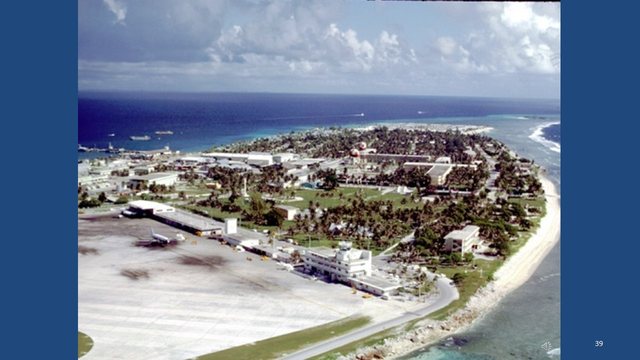
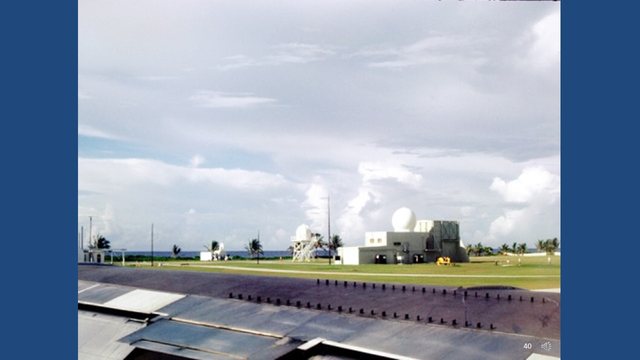
As I came in for a landing, I could see the Kwajalein airport terminal there in the foreground. With so little land to spare, multiple radars studded the truncated golf course adjacent, as you see here, to the runway. On a later round of golf with my minder, sirens and klaxons went off quite unexpectedly. I was told that I needed to get off the course immediately and take shelter. After briefly considering whether to soil myself before or after taking shelter, I just skedaddled. I never knew exactly whether those radars on the golf course were going to fry you, or whether a missile test gone bad would have debris conking you on the head.
Undercover on Kwajalein and Meck ▶ 23:54
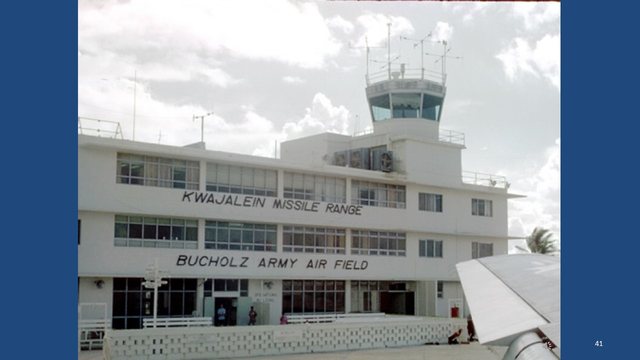
The terminal building was particularly busy during the rush hour, because the commuter planes there were taking day workers up to Meck and Roi-Namur and bringing them back in the evening. I had traveled to Kwajalein with false documentation as a Department of the Army civilian. This was to prevent my low rank as an enlisted man from interfering with my interviews and conversations with higher-ranking military personnel, MIT scientists, software engineers and other experts.
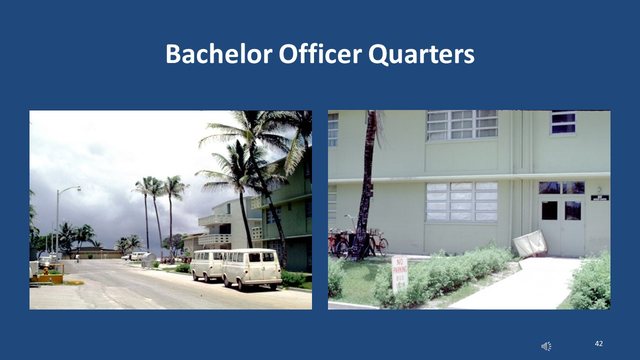
For my week’s stay I got an upgrade to the Bachelor Officers’ Quarters. And you’ll notice that my otherwise beautiful, upscale, upgraded ocean view was somewhat obstructed by aluminum foil. I was never sure if the foil was there to keep the sun out or to protect me from those radar beams that were all over the place. I’d planned to promptly conduct my interviews and then head back to Honolulu, but it was not to be. A congressional delegation had just arrived, a staff delegation, to look into a recent missile test failure and judge its impact.


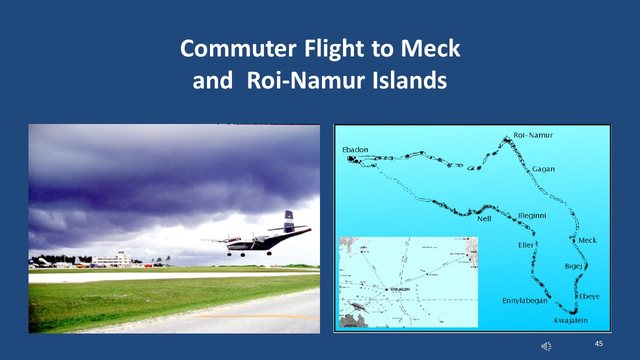
So my minder, who happened to be the base recreation officer, took me to the deserted pool, and I spent my days drinking beer there. If we’d had them back then, I would have been taking selfies instead of just talking to myself. It was lonely indeed. In the evenings I could go to the low-life, low-population, high-alcohol arena of the Yokwe Yuk Club. That club name in Marshallese translates roughly to “Aloha.” During my time-out period I could see from Kwajalein Harbor to the first of my destinations, the Missile Site Radar on nearby Meck. Then, when the congressional staff left, it was aloha for me too, and I was off on one of the commuter planes for my interviews.
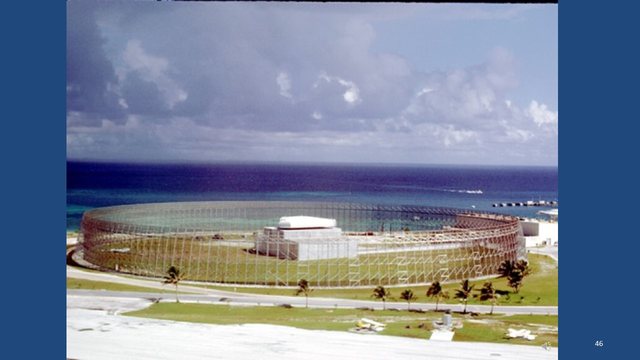
When this experimental radar failed to perform as it had been meant to, it was taken out of commission and repurposed into what is undoubtedly the most expensive golf driving range anyone will ever go to. My minder tried to get me to go inside. He told me it was safe. He said it had been unplugged and nobody was allowed to flip it back on. But frankly, I was having none of it. Who wants to go to an island paradise and again run the risk of being fried by stray radar beams?

This is a picture of the missile site construction on Meck. The radar requires, as you might imagine, massive computing capacity, all of which resides in that square structure underneath the radar itself. As I was taken for a tour of the computer area, its proud manager told me that there was more computing power in that room than existed on the planet in the mid-1950s. And for all I know, maybe he was telling the truth.
The Radars of Roi-Namur ▶ 27:19
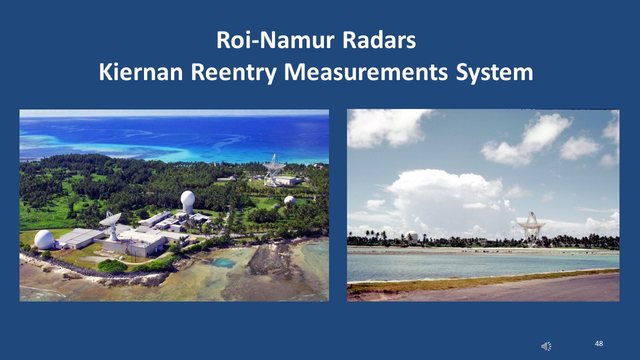
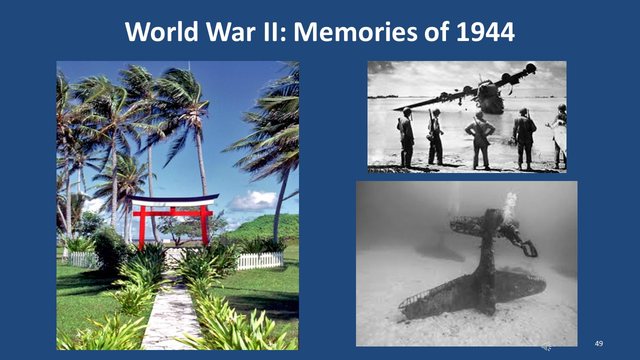
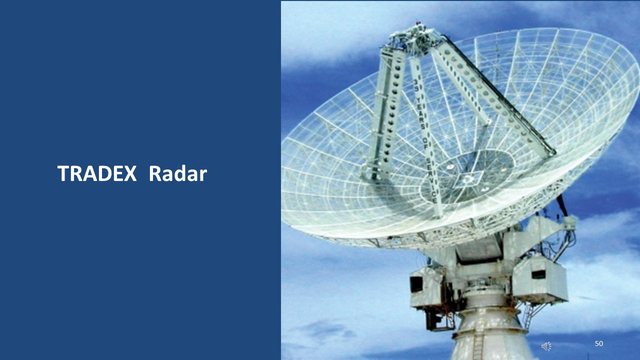
These radars on Roi-Namur are known as the Kiernan Reentry Measurement System. Before my interviews up there, I was taken to a cemetery honoring the Japanese war dead. The Marines landed at Roi-Namur in January of 1944 and took the entire atoll two weeks later. You can see the diver in the lower right there, looking at one of the wrecks in the lagoon. The Target Resolution and Discrimination Experiment, or TRADEX, became operational in 1962, which is when the MIT scientists from the Lincoln Laboratory arrived to work and live on Kwajalein.
Upgrades later permitted it to join the U.S. Space Surveillance Network and also to track foreign missile launches and low-earth and deep-space satellites. I would tell you how this and the other radars work, and it’s not just because it’s classified that I’m not going to. It’s because I never had the faintest idea how they worked.
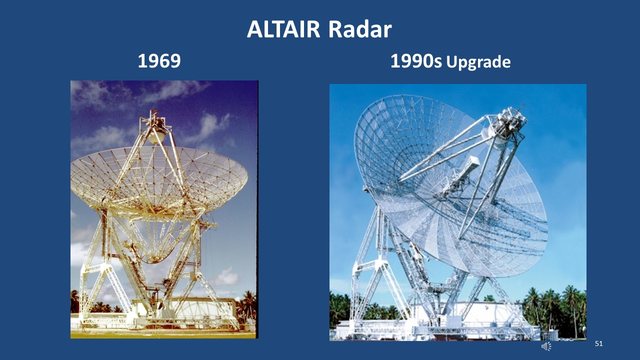
On the left is a photo I took of the ARPA Long-Range Tracking and Instrumentation Radar. It was designed to show how U.S. ICBMs would appear to Soviet anti-ballistic missiles. On the right is a more recent picture of the same radar, upgraded for the Space Surveillance Network, also by MIT.

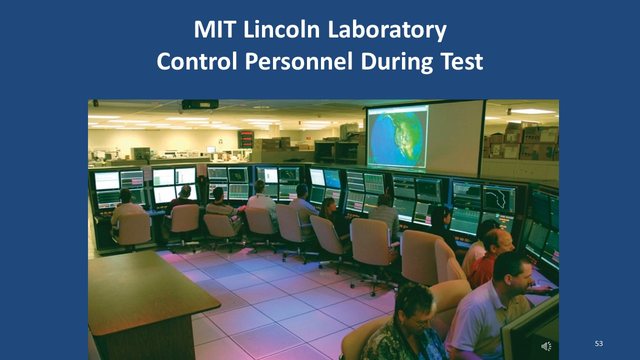
The radar on the left is capable of generating high-resolution images of near-Earth satellites. And on the right, the ARPA-Lincoln C-band Observables Radar was built with the objective of improving re-entry vehicle discrimination. Now, for an anti-ballistic missile radar to work properly, it’s got to be able to distinguish what’s the warhead coming back into the atmosphere and what are the decoys that are designed to help confuse a defensive radar. So that’s a pretty important function. Here are some of the MIT staff at the command and control center on what’s now called the Reagan Test Site.
Midcourse Kills and Giant Radars ▶ 29:33
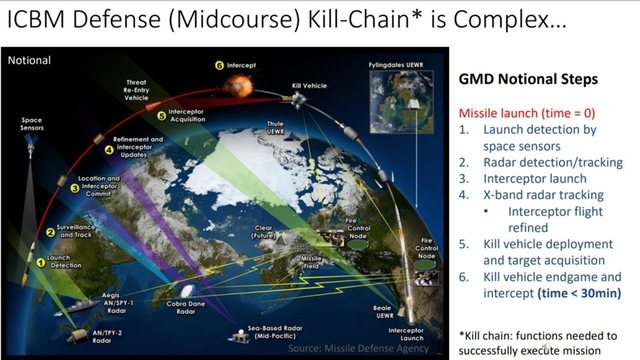
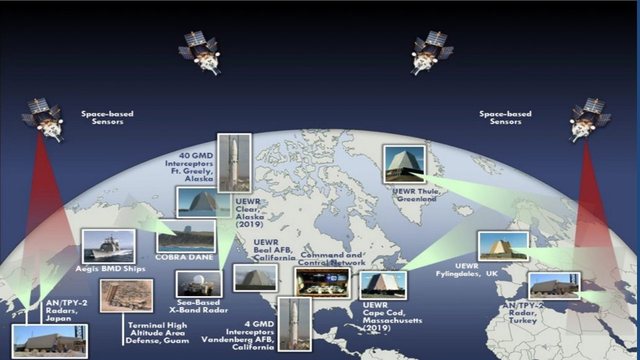
In 1969, the key rule to follow in killing a Soviet ICBM with a ground-based missile was: catch it midcourse. That rule really hasn’t changed to this day, when catching a North Korean missile midcourse is still the preferred way of doing it. This shows the enhanced role sea-based and space-based detectors now play in missile defense. At some point in the future, Navy ships near Japan may get the opportunity to take out a North Korean ICBM in the boost phase.
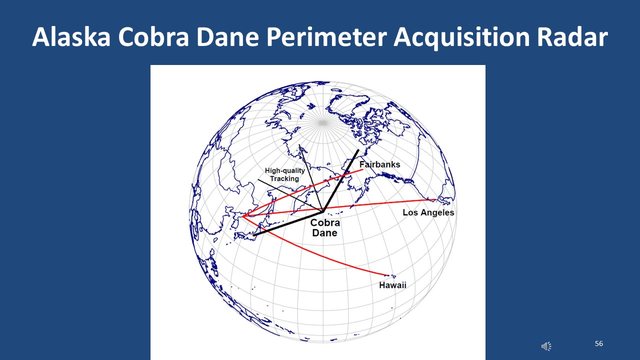
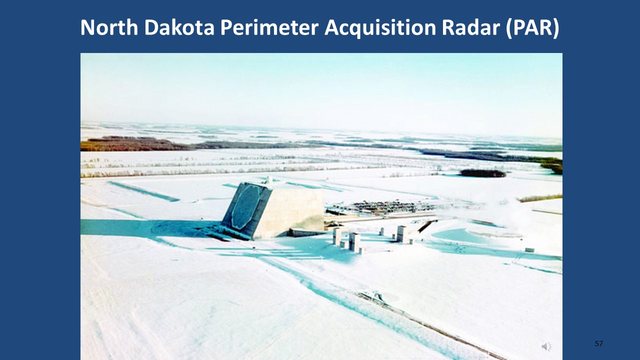
This Cobra Dane perimeter acquisition radar has an azimuth of 136 degrees, which makes it well suited, as well as well sited, to follow North Korea issues. Following the deactivation in 1976 in North Dakota, an upgraded perimeter acquisition radar was built at what is now Cavalier Air Force Station. They still scan for ICBMs, but they are also mapping and following all of the objects in Earth orbit, vast numbers today, ranging from astronaut gloves to debris and the like. This particular radar can track multiple objects the size of a basketball at a range of 2,000 miles.
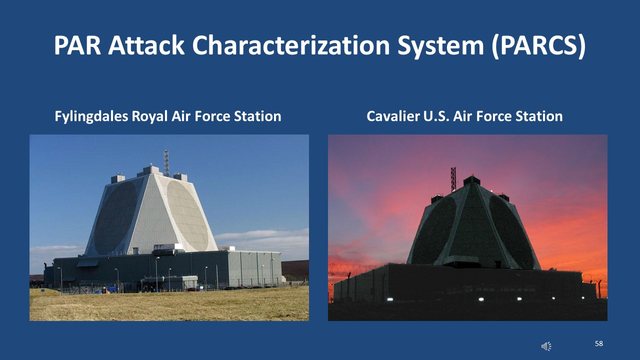
The radar on the left is a perimeter acquisition radar. The attack characterization system in the UK, the one on the right, analyzes more than 20,000 tracks a day, from giant satellites to space debris. PARCS are different from perimeter acquisition radars in that they’re able to predict with extreme accuracy where any particular object will be at any particular time.
Rail Missiles and Hypersonic Threats ▶ 31:26

Though both the U.S. and the Soviets thought during the Cold War about making their ICBMs harder to hit by having them rove around the country on trains, only the Soviets did so. Their missiles on trains were retired by 2005. Our director Andrew Fox recently returned from the Saint Petersburg train museum with the picture on the lower left there. Thank you for your service to the Cliff Dwellers. Amazingly, Russian media announced three years ago that, after testing, the currently silo- and truck-based ICBM on the right will be rail-mounted and deployed later this year. Well, we’ll see. If true, it strikes me as Russia answering a non-problem on the cheap, to look like it’s doing something.
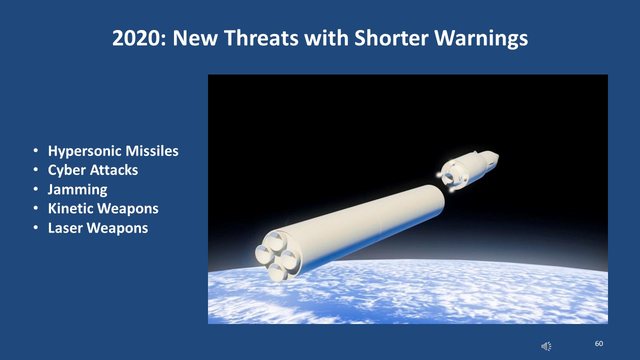
In a more modern twist on the retread of rail-mounted ICBMs, Russia said last December that its new Avangard hypersonic ICBM was operational. Its re-entry vehicle apparently has the advantage of being highly maneuverable as it closes in on its target. A Defense Intelligence Agency report from the fall says that the Chinese have a Mach 5 hypersonic missile.
New threats to U.S. space-based GPS, communications and missile launch satellites come from cyber and jamming attacks and from kinetic and laser weapons. A modern society such as ours is increasingly dependent on satellites for its normal functioning. It’s not surprising that serious thought is being given to the potential of being blinded, with your satellites taken out.
The Space Force and Space Command ▶ 33:20
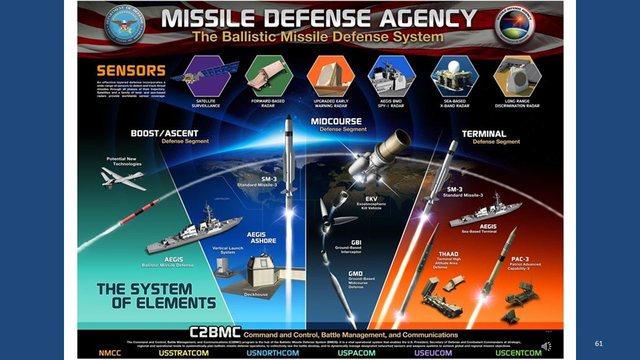
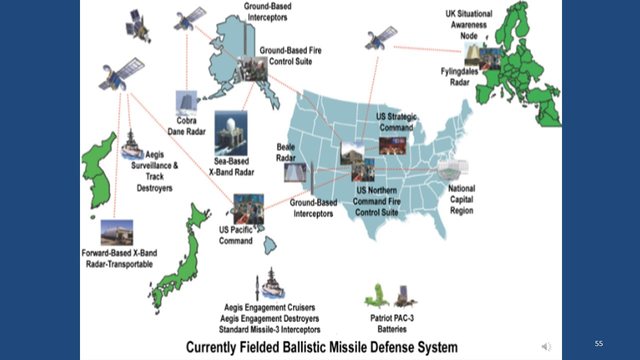
Just look at this wide array of sensors and anti-missile missiles on this chart from the Missile Defense Agency of the Department of Defense. While it reflects the command and control, battle management and communications challenges, it only hints at the very complex and expensive organizational structure that underlies our missile and now satellite defenses. This is really what has led to the major restructuring in space defenses that has given us the Space Force and Space Command.

A month ago you may have seen the new insignia of the Space Force. The 16,000 active-duty airmen and civilians who used to be in the former Air Force Space Command are now part of the Space Force. The Space Force and the Air Force both reside within the Department of the Air Force, just as the Marines and the Navy reside within the Department of the Navy.

The Space Command is the warfighting command unit for the space theater. It’s supported by two field organizations. The first has 70 Army, Navy and Air Force space units, and it’s worried about maintaining the integrity of GPS, navigation and communications satellites for not just us, but also allied commanders. The second field organization operates the classified National Space Defense Center. That’s where they look at potential threats and draw up options if satellites were to come under attack.
Space Command and the Spy Satellites ▶ 34:56

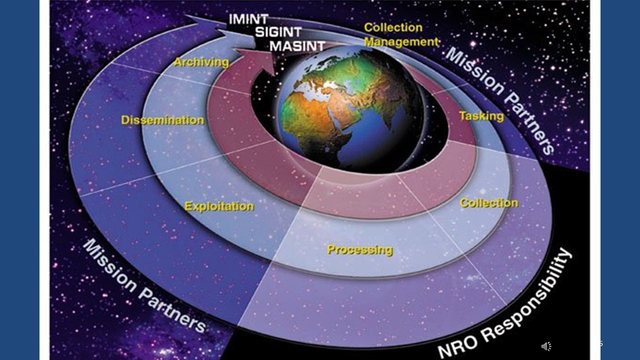
The U.S. Space Command has now taken its place as the newest of the 11 Department of Defense combatant commands. The Department of Defense’s clandestine National Reconnaissance Office runs most of the satellite and aerial programs. It controls the satellites that look at and survey world trouble spots, monitor the ebb and flow of nuclear arsenals, and provide the information needed for verifying various arms control agreements. And, if war in space ensues, the U.S. Space Command has the ability to order what are called defensive space operations.
At the top of the slide, you’ll see the words SIGINT, IMINT and MASINT. I knew the first two, signals intelligence and image intelligence. I had to look up MASINT. It’s the acronym for measurement and signature intelligence. And how does MASINT work, you ask? Well, I have to quote this precisely. It employs “a broad group of disciplines, including nuclear, optical, radio frequency, acoustics, seismic and materials sciences.” Wow. I can tell you as an expert that that is never going to be Merriam-Webster’s Word of the Year.
Nine Nuclear Powers, Fewer Warheads ▶ 36:21
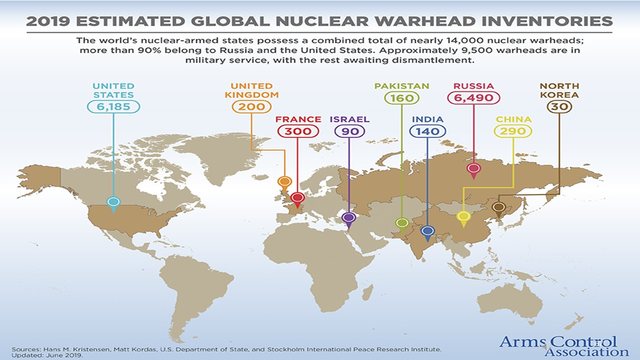
In the half century since I spent time in the Army working on missile defense issues, we’ve grown, of course, exponentially more dependent on satellites and other sensors in every aspect of our military operations. The landscape of nation-states with inventories of nuclear warheads has also changed substantially in recent decades. Today, we have nine nuclear powers, with Iran perhaps waiting in the wings as number 10. So far, the complexity and expense of acquiring nuclear weapons has kept it a game only of nation-states. All of the nation-states, of course, share a strong interest in keeping that the case.
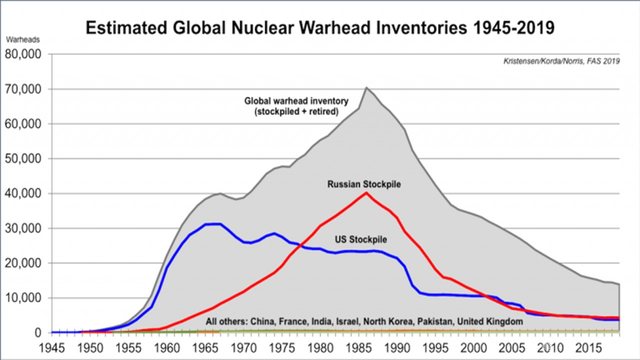
Now just look at the dramatic decline in the stockpiles of tactical and strategic nuclear weapons maintained by the U.S. and Russia. We had over 30,000, Russia over 40,000. And you can look at this chart another way and say, well, this perhaps is the global learning curve of learning to live with the bomb. Though the movement of war planning into space has its ominous overtones, it is also true that in this period the largest nuclear powers have retreated from the brink of war, as they came to a better understanding and a better appreciation of the collateral damage to their societies from unrestrained competition.
War Moves Into Earth Orbit ▶ 37:54
Well, there you have it. We’re now living in an age where the potential for war has moved from its traditional place on the Earth’s surface to Earth orbit. And no doubt in another 50 years it may move along to the Moon and Mars and beyond. I don’t know about you, but in thinking about this there has always been something otherworldly about it for me. But think about the subject we must. Even though it hasn’t been much in the public consciousness in the last several decades, it’s something that, of course, as citizens and humans we can’t really get away from.
Shortly after Hiroshima, there was a RAND Corporation fellow, Bernard Brodie, and what he did was write something that has proved, all these 75 years later, to be at the heart of the nuclear equation of today, and it’s been there all along. He said, “Everything about the atomic bomb is overshadowed by the twin facts that it exists and that its destructive power is fantastically great.” And because this whole realm is so complex, and so dangerous, and so expensive, and so intractable, it looks like future generations, such as ours, are going to have to just continue to keep grappling with the seriousness of all of this.
Cautious Optimism and First Question ▶ 39:29
So, as the last charts demonstrate, over this period most of the nations that could potentially have acquired nuclear weapons have chosen not to, and the leading nuclear nations have actually reduced the prevalence and likely use of the weapons. The older nuclear powers seem to have at least partially digested the strange non-utility of nuclear weapons. And it remains an open question whether the newer and incipient nuclear powers are also going to assess in a similar way the limited value of acquiring something that is so constricted in its use.
Personally, I’m optimistic that we’ll avoid a catastrophe in the next 25 years, as we move towards the hundredth anniversary of Hiroshima. My own belief is that the problem will at least be less dangerous and intractable then, in 2045, than it is now. But then, what do I know? So thank you for your attention. Bob?
Audience member: Is a defensive system practical, when we hear that it’s like shooting a bullet at a bullet?
Bill Bowe: That has remained the question, really, since Safeguard. The question is whether it is really practical to have any missile defense if you’re trying to shoot a bullet with a bullet. And the answer is that it remains under investigation. I happened to be watching TV this morning. You can see I was very bored: I stopped at C-SPAN. And what were they talking about? Well, our Secretary of Defense was being grilled by a House committee, and one of the things they were talking about was exactly this. There is another generation of anti-missile and missile defense, which seems broader than anything since Safeguard, with an East Coast site.
They’re seriously concerned, of course, about Iran now. These war planners are typically thinking 10, 20 or 30 years out, because their weapons systems have that kind of long, long life. Look at the B-52s; they’re still around. So the answer is maybe, but those who have the best idea about that—all of that would be classified. Up to this point, though, it’s been too iffy. Yes, Bob.
Q&A: Star Wars, Costs and a Drink ▶ 42:15
Audience member: I had a very good friend who was a relatively high-level consultant to the Pentagon on the radar systems in the 1980s and ’90s that were part of the Star Wars system. He disclosed that during the ’80s and the ’90s the radar systems were as key a part as the missiles themselves in attempting to shoot down incoming Russian missiles, and the radars were not capable. But that’s a different situation from the one most people are talking about today, when you’re talking about one or two missiles being fired by the North Koreans or the Iranians.
Bill Bowe: Absolutely. And one of the problems you touch on there is that it was cheaper for countries to throw their money into the offense than to try to build a defense. The offense has most of the time had an overcoming edge. The other thing about Star Wars was that it was based on Edward Teller’s idea. Late in his career he was running the Livermore Laboratory on the West Coast. They had lasers that, I’ve been reading recently, just weren’t up to the task. Getting a laser built with the power to deal with multiple incoming objects over enormous distances in space was just a bridge too far.
So there were technological limitations, and also this idea: they look and see that, with mutually assured destruction, we’ve stayed away from the destruction. Do you really want to be unbalancing what seems to have worked, in an odd way? A defensive system might make the other side think that you could ward off a first strike and dump your load on them anyway.
Then there is the other grand problem, of course: the other side taking out your ICBMs. There was always a solution to that from the beginning. You see them coming on the radar. We’ve all seen the movie with that. You see them coming. Well, simple: rather than have your ICBMs knocked out, you launch yours before they get hit. But no rational war planner ever wanted to leave the U.S. President with that kind of 10- or 15-minute choice to make. Yes, Larry.
Audience member: How much does this stuff cost?
Bill Bowe: Well, I think you saw the one slide, which is in 1970-ish dollars, more or less. I think the Safeguard system was about 25 billion dollars, and that was never really deployed. There were two test sites that may or may not have worked, but they were quickly found to be able to be limited by treaty, and they would have been overwhelmed anyway.
Audience member: At one point, one of your slides said that we had 6,500 nuclear tips. What would one of those cost?
Bill Bowe: I don’t know, but they might be in storage. It’s kind of a complicated numbers game. How many warheads are there? Well, there are those that are piled up awaiting their deactivation in accordance with the arms control agreements, and then there are those in reserve. And then you’ve got those that are sitting on the end of a missile and are ready to go instantly. So why don’t we break up, have a drink and talk about something more fun?