Chapter 6: Contemporary Chicago, 2001–Present
A New Century, A Different Skyline
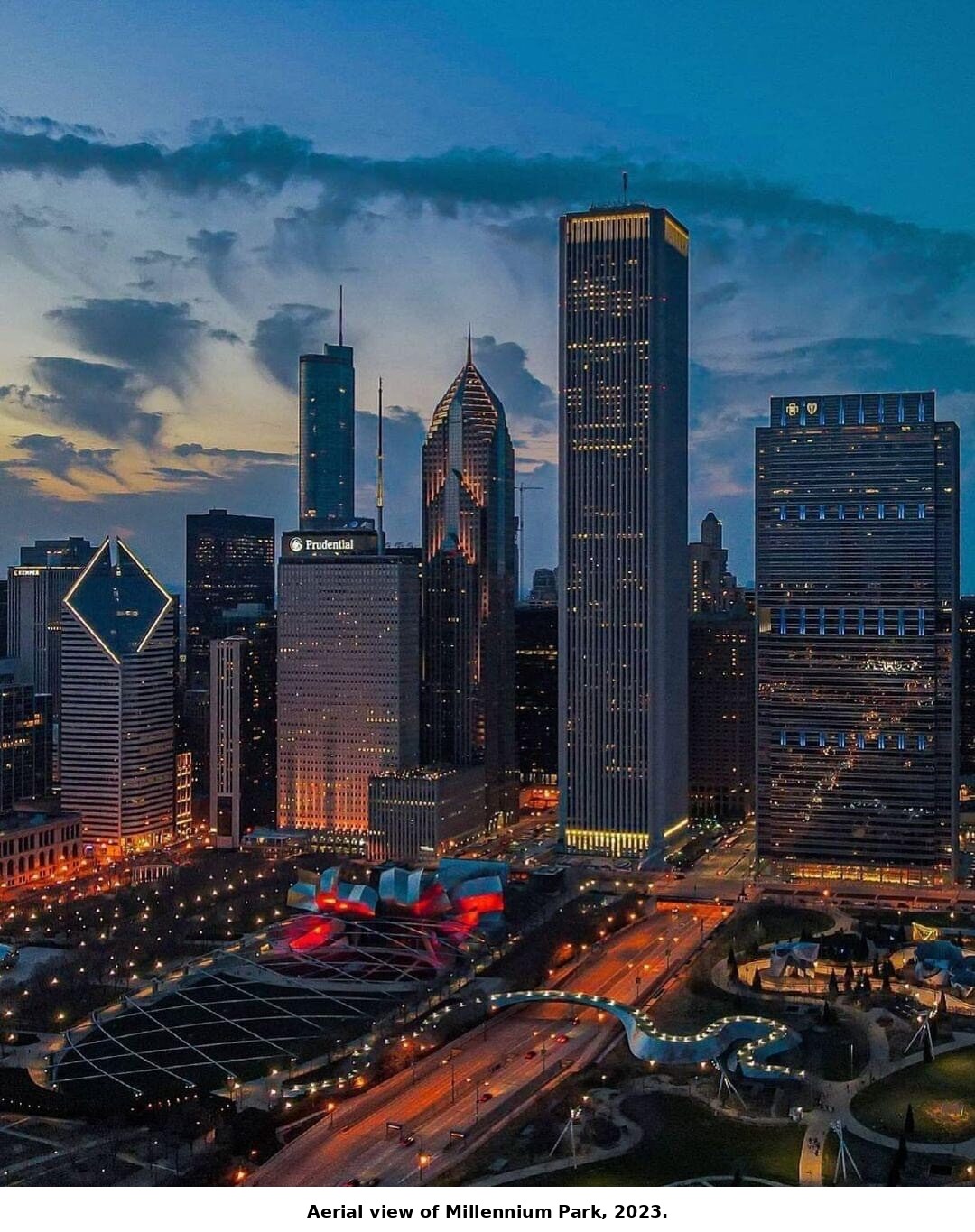
Chicago entered the twenty-first century as a city already reinvented several times, from marshy portage to railroad hub, from industrial powerhouse to post-industrial metropolis reaching for a new identity. The opening years of the 2000s gave that reinvention a physical centerpiece. On July 16, 2004, after construction delays that stretched years beyond schedule and a budget that ballooned past $475 million, Mayor Richard M. Daley presided over the dedication of Millennium Park. The park was built atop a tangle of old rail yards and parking lots at the northwest corner of Grant Park. Three days of opening festivities drew hundreds of thousands of visitors.
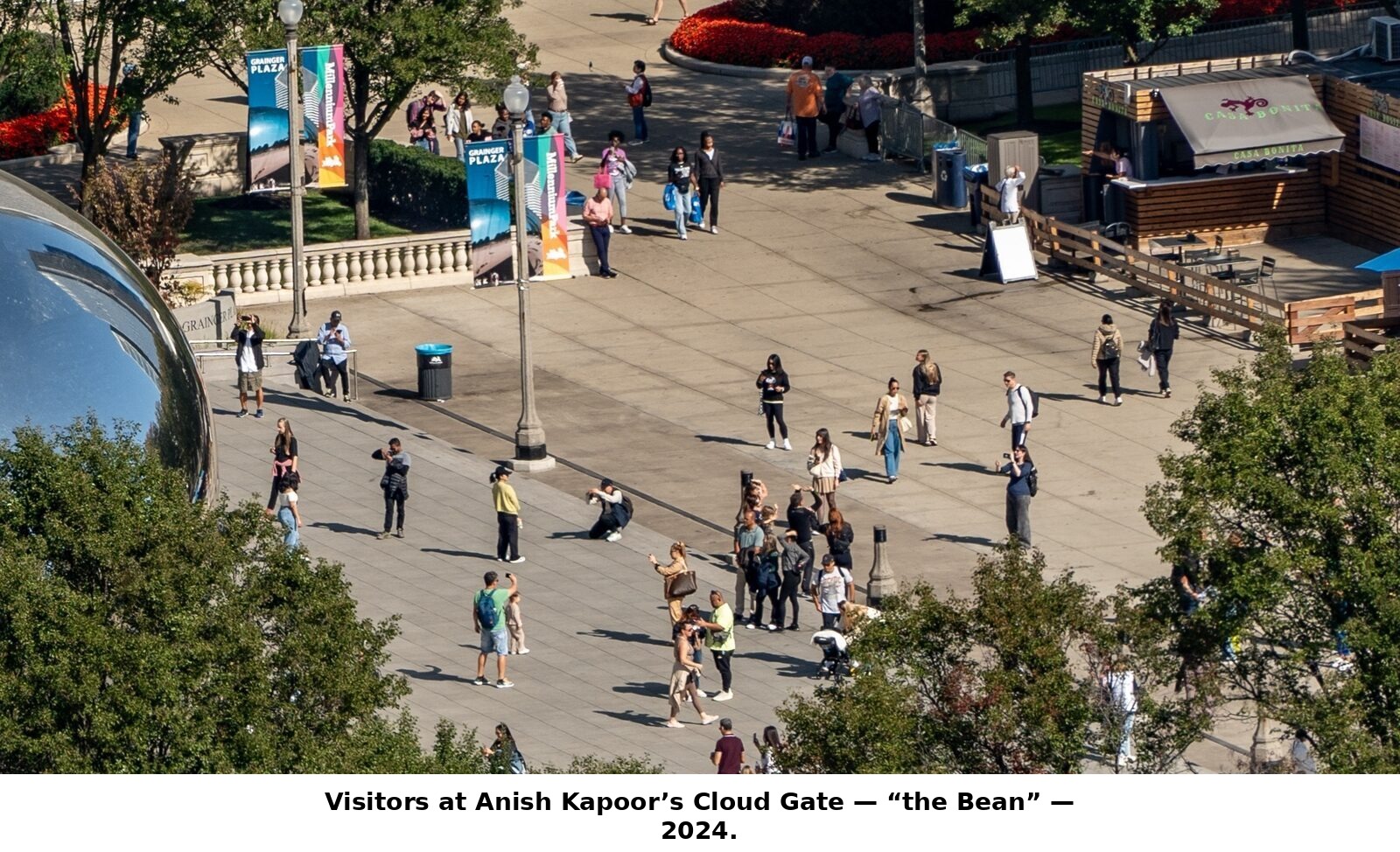
The park’s centerpiece sculpture, Anish Kapoor’s stainless-steel Cloud Gate, was still unfinished at the ribbon-cutting. Its welds were still unpolished, so its surface was covered for months while workers buffed away every seam. But Chicagoans had already claimed it as their own, nicknaming it “the Bean” long before its formal dedication in May 2006.
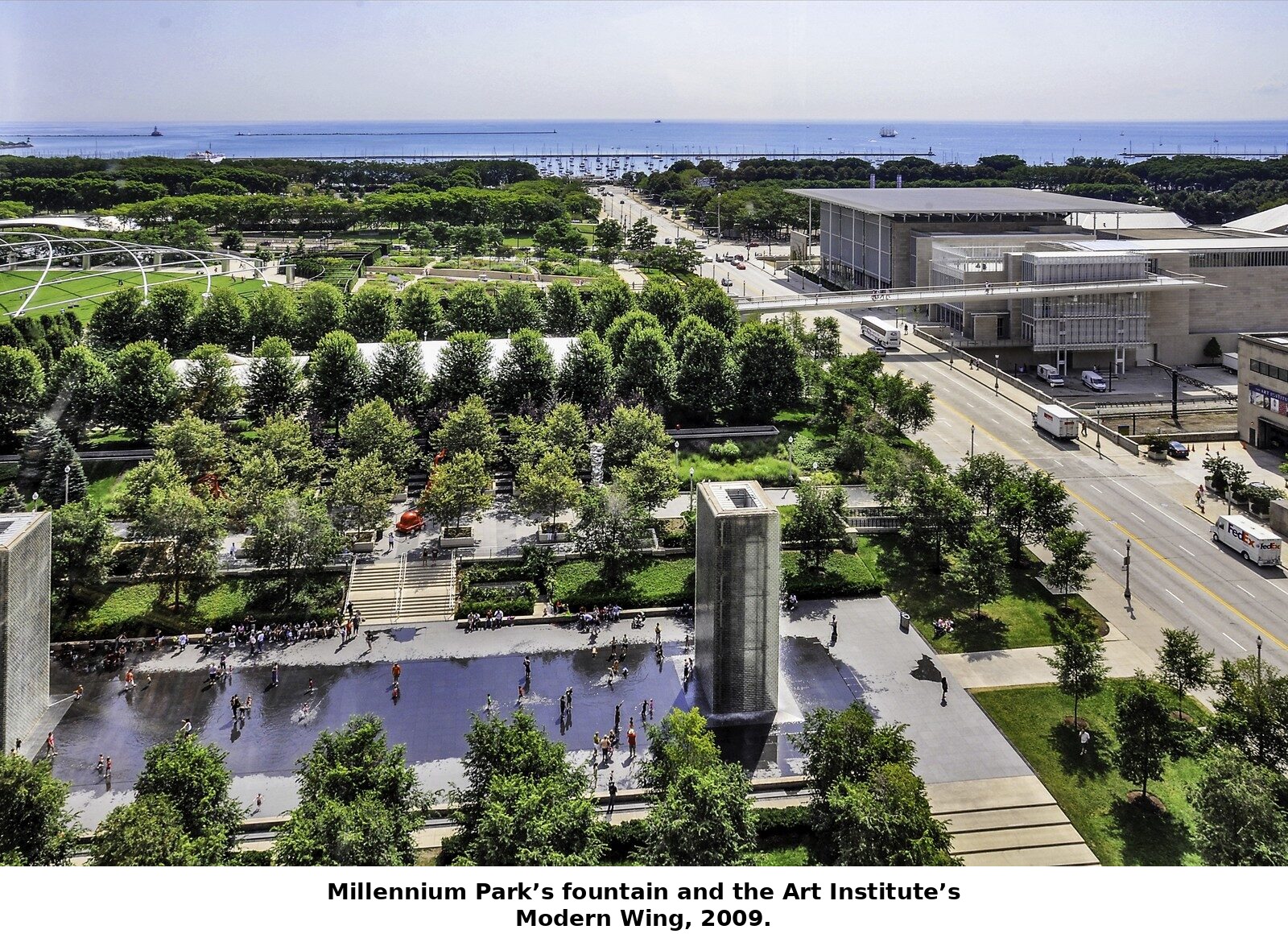
Millennium Park did more than add acreage to a lakefront of reclaimed land (see the Jazz Age chapter’s account of the park’s landfill origins). It reframed how Chicago wanted to be seen. Alongside Frank Gehry’s swooping band shell and the twin glass towers of the Crown Fountain, the park signaled a city investing in public space, contemporary art, and tourism as core civic strategy rather than afterthought.
It became one of the most-visited attractions in the Midwest, a backdrop for wedding photographers and skyline postcards alike. It also anchored a broader wave of Loop and Near North redevelopment, with luxury condominiums rising on former industrial parcels, a resurgent North Michigan Avenue, and a downtown residential population that grew sharply through the decade as young professionals and empty-nesters alike moved back into the center city. For a metropolis long defined by its factories and freight lines, the message of the 2000s was that culture, design, and public amenity could themselves be economic engines.
Chicago’s investment in civic sculpture extended a much older tradition into the new century. Richard Hunt, a Chicago native whose seven-decade career made him the nation’s most acclaimed sculptor working in welded abstract metal, kept adding major public commissions to his native city right up until his death in 2023, with additional works completed or planned for the DuSable Black History Museum, the Obama Presidential Center, and the Emmett and Mamie Till-Mobley House Museum in Woodlawn.
The Crash and the Long Climb Back
That optimism collided with reality in 2008. The national financial crisis, triggered by the collapse of the subprime mortgage market and the failure or near-failure of major banks, hit Chicago’s economy and its neighborhoods hard. Foreclosure rates spiked across the city, with the South and West Sides absorbing a disproportionate share of the damage as the preceding boom years unwound leaving vacant, boarded homes. Illinois and Cook County government finances, already strained by pension obligations built up over decades, grew more precarious as tax revenues fell. The city’s convention and tourism sector, still young in its Millennium Park–era confidence, slowed as travel budgets tightened nationwide.
Recovery came slowly and unevenly. Downtown and the North Side rebounded first, buoyed by continued residential investment, a growing tech and professional-services sector, and steady convention business at McCormick Place. But many South and West Side communities never fully recaptured the ground lost in the crash; vacant lots and shuttered storefronts in neighborhoods like Englewood, Austin, and Roseland became durable features of the urban landscape well into the 2010s, a visible marker of how unevenly the city’s fortunes had come to be distributed.
A Shifting, Shrinking, Reshuffling City

Underneath the skyline’s new silhouette, Chicago’s population was moving. The city’s total population, which had stabilized somewhat in the 1990s after decades of postwar decline, resumed shrinking in the 2000s and continued to lose residents through the 2010 and 2020 census counts. It dropped from roughly 2.9 million at the century’s turn toward a figure closer to 2.7 million by the 2020 count, before a modest uptick was recorded later in the decade. The losses were not evenly spread.
Black population loss was especially pronounced on the South and West Sides, driven by a combination of the demolition of high-rise public housing developments. The Chicago Housing Authority’s “Plan for Transformation,” tore down Cabrini-Green, the Robert Taylor Homes, and other troubled towers starting in the late 1990s and continuing through the 2000s. This was taking place alongside broader currents of Black out-migration to the Sun Belt and to suburbs, a reversal of the Great Migration patterns that had built those neighborhoods a century earlier.
Meanwhile the Loop, the Near North Side, and swaths of the North Side gained residents. The city’s Latino population grew substantially, especially on the Southwest Side and in neighborhoods like Little Village, Pilsen, and Albany Park, even as gentrification pushed some long-standing Latino communities further from the central city. By the 2020s, Chicago’s population was more evenly split among white, Black, and Latino residents than at almost any point in its history. This was true even as the neighborhood-level segregation that had shaped the city since the Great Migration remained stubbornly persistent, a pattern chronicled in detail by South Side–focused journalism and scholarship in these years.
Clout — The Rise and Fall of the Democratic Political Machine in Chicago

Before turning to the mayors who governed twenty-first-century Chicago, it is worth understanding the political system many of them inherited, adapted, or dismantled: the Democratic machine, and the peculiar Chicago currency known as clout. As historian Dominic A. Pacyga argues in his 2025 study Clout City: The Rise and Fall of the Chicago Political Machine, the machine was never simply a corrupt bureaucracy bolted onto city government, it grew out of the communal, largely Catholic and Jewish immigrant culture of neighborhoods like Bridgeport, on the South Side. There, the De La Salle Institute, a Christian Brothers high school founded in 1889, schooled generations of future ward bosses and mayors, including the Daleys, in loyalty, hierarchy, and obedience.
Pacyga describes a political structure that mirrored the Catholic Church itself, with the mayor and party chairman as pope, aldermen and ward committeemen as bishops, and precinct captains as parish priests. Each was expected to know every family on the block and to trade favors for votes. The saloon, the parish, the ward office, and at times the neighborhood gambling operation, all fed the same web of reciprocal obligation. It was what Pacyga calls a communal system in which “the priest, the rabbi, and the gangster” could all be, in their own ways, part of the machine.
The machine became a genuinely citywide force under Anton Cermak, a Czech immigrant elected mayor in 1931. He assembled a multiethnic coalition of Poles, Bohemians, Germans, and Jews to challenge the long Irish grip on Chicago politics. He briefly succeeded, until the assassin’s bullet intended for President-elect Franklin Roosevelt killed Cermak in Miami in 1933. Irish Bridgeport quickly reclaimed control, and the machine reached its fullest expression under Richard J. Daley, mayor from 1955 to 1976. He ran both City Hall and the Cook County Democratic Party simultaneously and treated patronage as a kind of civic ministry. This could entail writing letters to get a friend’s son into dental school, a constituent onto a public-housing waiting list, or a Christian Brother a passport. Alongside this was the far larger business of steering contracts, jobs, and zoning decisions. Pacyga calls Daley “Chicago’s patron saint of patronage and clout,” a phrase that captures how thoroughly the machine’s power rested on personal, neighborhood-level relationships rather than ideology.
That same communal foundation is what eventually gave way. The Second Vatican Council’s liberalization of the Catholic Church in the early 1960s loosened the tight parish loyalty that had anchored ward politics. Court-ordered reforms, culminating in decades of litigation that curtailed patronage hiring, stripped the machine of many of the jobs it had traded for votes. Postwar suburbanization drew the Catholic ethnic families who had built the machine out of the city entirely. Richard M. Daley’s more technocratic, “neoliberal” mayoralty after 1989, courted new constituencies including Chicago’s LGBTQ+ community even as it further reduced traditional patronage. This signaled how much the old system had already changed.
Pacyga dates the machine’s final collapse to 2023, with the corruption convictions of two of its last powerful figures, longtime alderman Edward M. Burke and Illinois House Speaker Michael J. Madigan. For others as well, it marked the end of clout as a self-sustaining communal system, even as its habits and ghosts continue to shape how Chicago is governed.
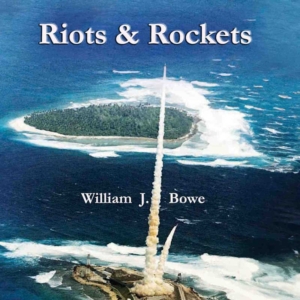
The personal, often chaotic texture of the machine’s decline is captured in attorney William J. Bowe’s memoir Riots & Rockets. Byrne’s improbable 1979 upset of machine-backed Mayor Michael Bilandic. His account recalls the public fury over the city’s bungled response to a paralyzing blizzard, in what briefly looked like a genuine break from the old Democratic organization Byrne’s campaign had run against.
But Bowe recounts how her mayoralty quickly became defined by volatility rather than reform. When a transition report she had commissioned from a panel of independent-minded advisers was finally leaked to the press in June 1980, after her administration had kept it under wraps for a year, Byrne’s response was telling. The answer to the resulting Chicago Tribune story didn’t engage the report’s findings. Instead, Mayor Byrne banned the paper’s reporters from City Hall, igniting a First Amendment uproar that dominated the city’s front pages for days. Bowe, who had helped draft part of the report and was summoned in the middle of the night to walk Tribune reporters through its hundreds of pages before the story broke, saw the episode as telling evidence of a mayor whose instinct for combative theater outpaced her capacity to govern. This was a pattern that, within three years, helped clear the way for Harold Washington’s historic 1983 victory.
Four Mayors, Four Chicagos
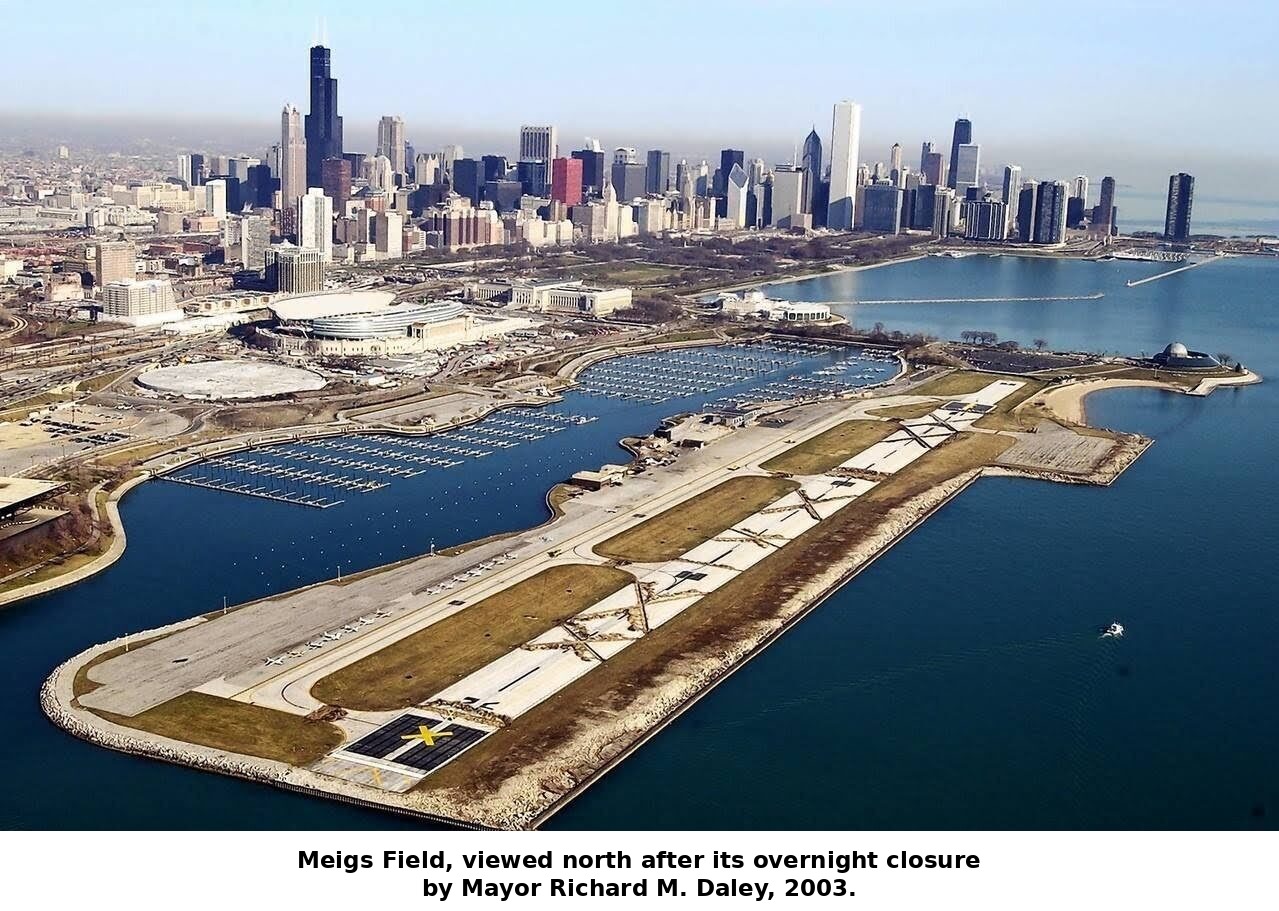
The era’s politics were dominated, in its first decade, by continuity. Richard M. Daley, son of the legendary Richard J. Daley, held the mayor’s office from 1989 until 2011, making his combined tenure the longest in the city’s history. His later years in office were defined by ambitious, sometimes controversial infrastructure and privatization deals. Alongside continued investment in parks and bike lanes, there was the 2008 long-term lease of the city’s parking meters. This generated an upfront payment, but locked in decades of steep rate increases. The parking meter deal became a byword for fiscal shortsightedness. Daley also pursued an unsuccessful bid to host the 2016 Summer Olympics.
Rahm Emanuel, formerly a congressman and Obama’s White House chief of staff, succeeded Daley in 2011 and served until 2019. His administration pushed a data-driven, business-friendly agenda. It expanded pre-kindergarten and full-day kindergarten, and oversaw continued downtown development. It was also marked by a painful seven-day teachers’ strike in 2012 over pay, evaluation, and school closings. The 2013 closure of roughly fifty public schools, concentrated overwhelmingly on the South and West Sides, hurt his popularity and Emanuel’s second term was overshadowed by the fallout from the police shooting of Laquan McDonald.
Lori Lightfoot, a former federal prosecutor and first-time officeholder, was elected in 2019 as the city’s first Black woman and first openly gay mayor. She won every one of the city’s fifty wards in the runoff. Her single term, running through 2023, was consumed substantially by the COVID-19 pandemic and its aftershocks. Her continued struggles over crime rates, and police reform led to public frustration and a third-place finish in her 2023 reelection bid. Brandon Johnson, a former teacher and organizer backed heavily by the Chicago Teachers Union, won that 2023 election and took office promising a more progressive approach to public safety, housing, and taxation. He inherited a city still working through the pandemic’s fiscal and social aftermath alongside a new wave of asylum-seekers arriving from the southern border that strained city shelter systems beginning in 2022 and 2023.
Violence, Policing, and a Reckoning
Gun violence remained one of the era’s most painful and most publicized themes. Chicago’s homicide rate, heavily concentrated in a relatively small number of South and West Side neighborhoods, drew persistent national attention and, at times, distorted characterizations of the city as a whole. Crime rates fluctuated across the two decades, falling in the mid-2000s and mid-2010s, and spiking sharply in 2016 and again during the pandemic years of 2020 and 2021. Street crime became a recurring flashpoint in mayoral politics and national debates over urban policy.
No single episode did more to reshape the era’s conversation about policing than the killing of Laquan McDonald, a seventeen-year-old shot sixteen times by a Chicago police officer in October 2014. City officials delayed the release of police dashcam video of the shooting for more than a year. When a judge ordered it released in November 2015, footage contradicted the official account, which ignited sustained protests and a crisis of public confidence in the police department and in Emanuel’s administration. Independent reporting, notably by journalist Jamie Kalven had raised early questions about the case before the video’s release.
The fallout included the firing of the police superintendent, a U.S. Department of Justice investigation that found a pattern of excessive force and civil-rights violations by the Chicago Police Department, and a subsequent federal consent decree mandating court-monitored reform. In 2018, the police officer was convicted of second-degree murder. The case became a national touchstone in the broader reckoning over police accountability that intensified through the following decade.
The Pandemic Interruption
COVID-19 reached Chicago in early 2020. The city, like the rest of the country, shut down much of its public life that March. Schools, restaurants, theaters, and offices closed or emptied, and the Loop’s normally dense sidewalks went quiet for months. The pandemic hit the city’s Black and Latino communities hardest in its early waves, exposing long-standing disparities in underlying chronic illness, while also devastating small businesses and cultural institutions that depended on foot traffic and live audiences. The killing of George Floyd in Minneapolis in May 2020 set off large protests in Chicago and other cities, accompanied by episodes of unrest and looting that further strained relations between residents and police in a year already marked by economic anxiety and isolation. Recovery from the pandemic proved uneven. Downtown office occupancy remained below pre-2020 levels for years afterward as remote and hybrid work reshaped commuting patterns, even as the city’s convention business, restaurants, and cultural venues gradually returned to something like their earlier vitality by the mid-2020s.
Still a Global City
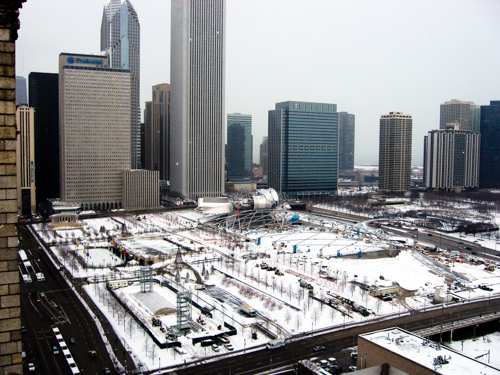
Through boom, bust, scandal, and pandemic, Chicago never relinquished its claim to global relevance. Its skyline continued to draw architecture enthusiasts from around the world, its status cemented by institutions like the Chicago Architecture Center and a biennial architecture exhibition launched in 2015. McCormick Place remained one of the largest convention facilities in North America, hosting trade shows that brought hundreds of thousands of visitors annually. O’Hare International Airport, despite periodic competition from other hubs, remained among the busiest airports in the world, reinforcing the city’s nineteenth-century role as a transportation crossroads in thoroughly modern form. Millennium Park, Navy Pier, and the lakefront museum campus continued to anchor a tourism economy that, by the 2020s, was again drawing tens of millions of visitors a year, even as the city’s neighborhoods away from the lake continued to wrestle with violence and poverty.
Chicago Hip-Hop, from Kanye to Drill
Chicago’s twenty-first-century music scene proved just as inventive as its blues and house pioneers had been. Kanye West, raised on the South Side and mentored early on by the producer No I.D., built a national reputation as a producer before breaking through as a rapper in his own right in the early 2000s. This opened the door for a wave of Chicago-identified hip-hop that ran from the socially conscious Common to the independent, mixtape-driven Chance the Rapper, whose 2016 album Coloring Book became the first streaming-only record to win a Grammy. A harder-edged, distinctly South Side sound emerged alongside it in the early 2010s. Drill music, a stripped-down, menacing style built around producers like Young Chop, broke nationally with Chief Keef’s 2012 single “I Don’t Like.” Chicago drill went on to shape hip-hop scenes as far away as New York and London, one more case of a genre incubated in the city’s neighborhoods reshaping music well beyond them.
Lollapalooza Comes Home, and a New Wing for the Art Institute
Chicago also became the permanent home of a festival that had once toured the country. Perry Farrell’s Lollapalooza, launched in 1991 as a traveling alternative-rock package tour, folded in 1997, but was revived in 2003. In 2005, its promoters resettled it for good in Grant Park, drawing 66,000 fans over two days to a lineup of some seventy acts. By 2016 it had grown into an annual four-day fixture on the lakefront that drew hundreds of thousands of visitors from around the world each summer, cementing Chicago’s claim on a festival culture that Lollapalooza itself had helped invent nationally in the first place.
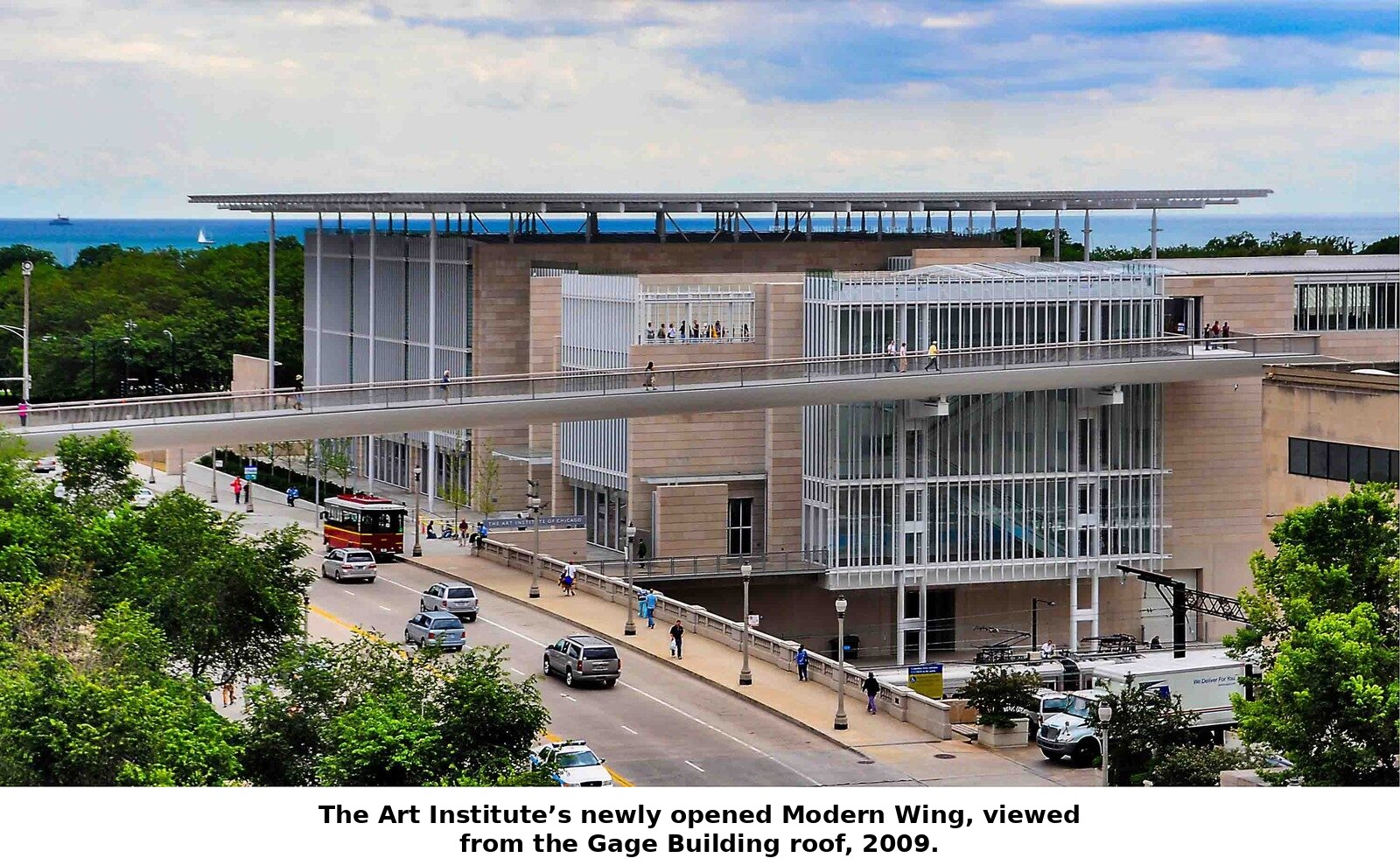
The Art Institute made its own twenty-first-century statement in May 2009, when it opened the Modern Wing, a 264,000-square-foot addition designed by the Italian architect Renzo Piano. Its glass walls were topped by an aluminum “flying carpet” sunshade, and connected to Millennium Park across the street by Piano’s Nichols Bridgeway. The largest expansion in the museum’s history, the Modern Wing made the Art Institute the second-largest art museum in the country and gave the institution founded in the ashes of the Great Fire a home for modern and contemporary art to match its historic collections.
A City Still Becoming Itself
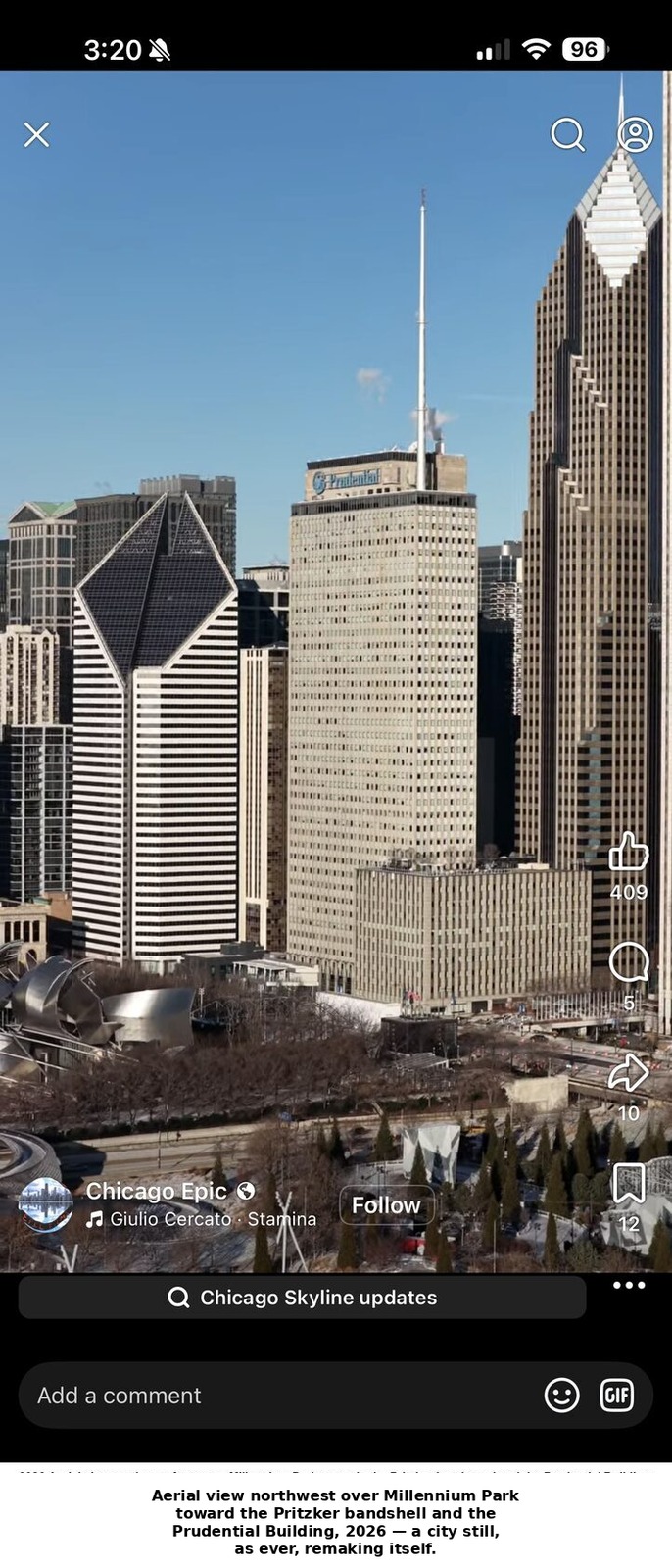
Looking back across the full arc of Chicago’s history, we can see it began as a portage between two watersheds, added a fort and a trading post, became a railroad boomtown, was incinerated and rebuilt within a generation, morphed into an industrial colossus fed by waves of migration from the American South and from across the globe, and developed into a sprawling, contested, endlessly self-revising metropolis of the twenty-first century. That’s a lot of change. But a single thread runs through all of it: Chicago has never stopped remaking itself in response to the same handful of forces that made it in the first place.
Geography, which once meant a short portage between the Great Lakes and the Mississippi watershed, now means a lakefront reimagined as parkland and a central location that still makes the city a hub for freight, finance, and flights. Migration, which built the Black Belt and Pilsen and Little Village and a dozen other neighborhoods, continues today in new forms, from international immigration to the ongoing redistribution of the city’s own residents block by block. And reinvention, the willingness, born partly of necessity and partly of ambition, to tear down and build anew, to fight over what the city owes its people and who gets to shape its future, remains as visible in a debate over school closings or a fight over a police consent decree as it was in the swift rebuilding after the Great Fire.
Chicago in the 2020s is not the city Jean Baptiste Point du Sable knew, nor the city of the Union Stock Yards, and certainly not the city of the 1968 convention or the Harold Washington years. But it is unmistakably their descendant: a place still arguing, still building, still proving that a marshy crossing between two water systems could become one of the world’s genuinely great cities.
Sources: Dominic A. Pacyga, Clout City: The Rise and Fall of the Chicago Political Machine (2025); William J. Bowe, Chapter 3, Riots & Rockets: A Dash of the Army, a Dose of Politics, and a Life in the Law (2024); Natalie Y. Moore, The South Side: A Portrait of Chicago and American Segregation (2016); Ben Austen, High-Risers: Cabrini-Green and the Fate of American Public Housing (2018); Larry Bennett, The Third City: Chicago and American Urbanism (2010); investigative reporting by Jamie Kalven and the Invisible Institute on the killing of Laquan McDonald; NPR, 50 Years of Hip-Hop History: Chicago (2023); Chicago Sun-Times, Looking Back at 20 Years of Lollapalooza in Chicago; The Art Institute of Chicago, The Modern Wing: Renzo Piano and the Art Institute of Chicago.
Photo Sources: 1852 South Allport Avenue, Pilsen — Photo by Lawrence Okrent, CD; “Scabby the Rat” outside City Hall — Photo by Jack W. Zimmerman, CD; 2003 Meigs Field — David Klobucar/Chicago Tribune; The Art Institute’s Modern Wing, Millennium Park’s Crown fountain and Millennium Park after a snowfall — William J. Bowe. Internet sources of other photos are not identified.