Bill Bowe Interviews Richard Reeder about His New Novel Sarasota
The Cliff Dwellers · Chicago · August 25, 2026
Summary
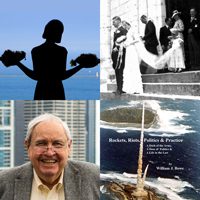
Bill Bowe
On the evening of August 25, 2026, Cliff Dwellers members and their guests gathered twenty-two floors above Michigan Avenue for a conversation between two of the club’s own. Bill Bowe interviewed longtime member Richard Reeder about Reeder’s new novel, Sarasota.
Club president Anne Sullivan opened the evening with a welcome to members and first-time visitors. She gave a brief history of the club, noting it was founded in 1907 for those who make art and those who appreciate it.
Bill Bowe then introduced Reeder as the man who led the club’s book club for more than a decade, with no less than a record 111 sessions.
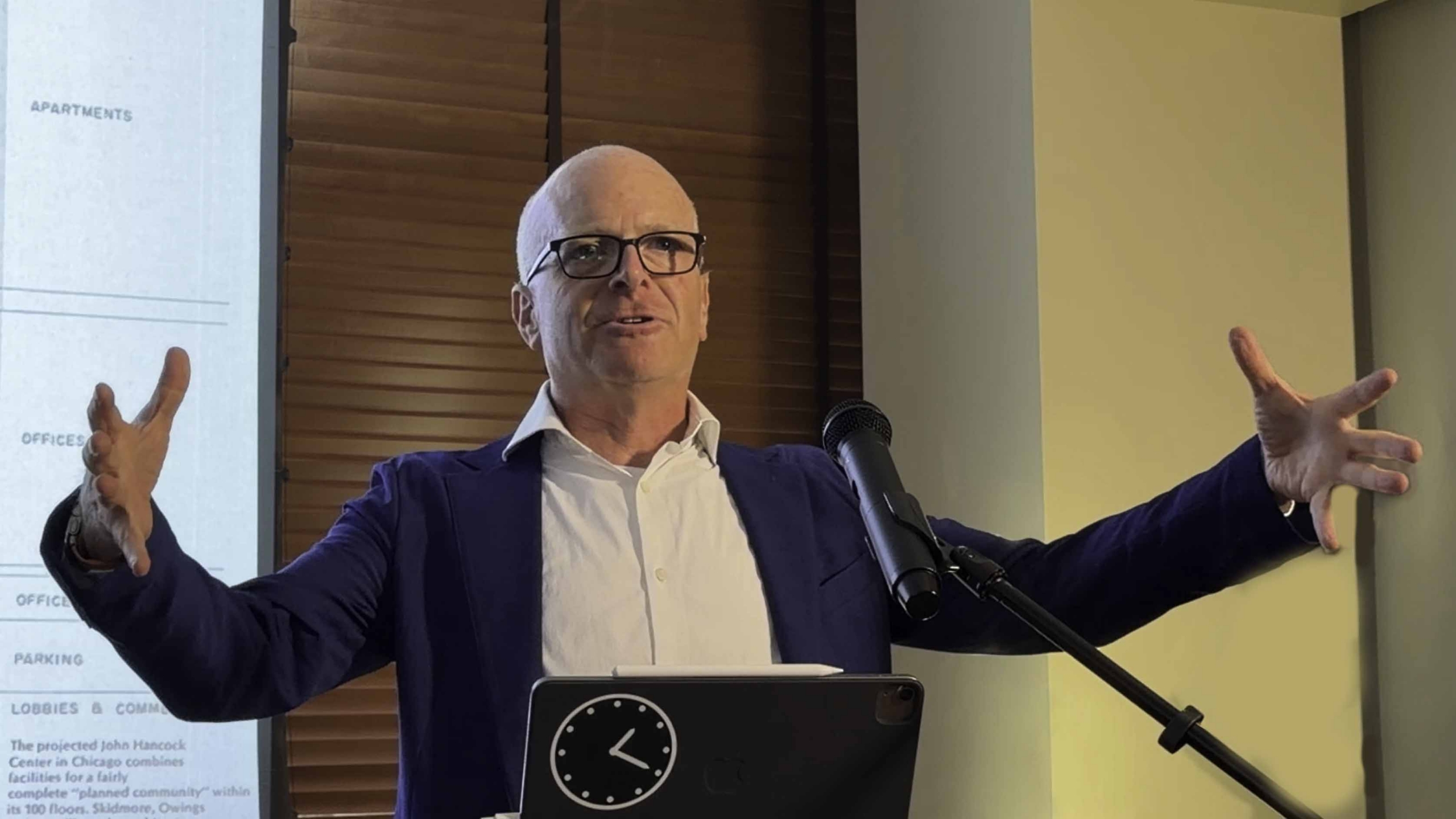
When Bowe asked Reeder to open the exchange by reading a brief excerpt from Sarasota, Reeder began by setting the historical context of the novel. He reported that Jackie Robinson integrated Major League Baseball in April 1947, but most clubs at the time still trained in a segregated Florida. There Black players were barred from the hotels that housed their white teammates, sleeping instead in boarding houses or, in one case Reeder recounts, a funeral home. He then read a passage set at Payne Park, the baseball field in Sarasota where the Chicago White Sox held Spring Training in 1961. There, his fictional protagonist, the young white journalist Bill Pennington, meets with the pioneering Black sportswriter Wendell Smith. Smith goes on to first point out how the segregated seating of the day for Blacks was situated behind the 500-foot center field fence.
The question-and-answer conversation that followed between Bowe and Reeder ranged widely. Bowe began by asking why Reeder chose 1961 and Florida for a story. Reeder explained nobody besides journalist Wendall Smith had ever recounted this history. Reeder also touched on John F. Kennedy’s 1960 Florida primary campaign and the two-faced politics that disillusion his idealistic protagonist. He also focuses on the persistence of segregation around Southern military bases long after Truman’s 1948 executive order desegregating the Armed Forces. He explained this caused Black players subject to the draft in the 1950s, such as Willie Mays, years of their prime playing time away from the game.

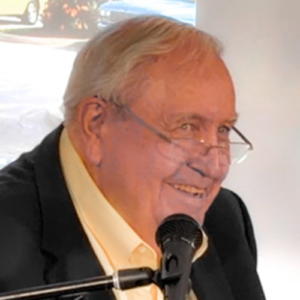
Richard Reeder
Real figures move through the novel, including White Sox general manager Ed Short, owner Arthur Allyn Jr., Wendell Smith himself, and above all Bill Veeck. Reeder explained he watched as a teenager from his uncles’ season-ticket seats and portrays Veeck as a decent man, and a quiet, self-effacing civil rights leader.
Audience questions drew out explanations of Jackie Robinson’s 1960 endorsement of Richard Nixon and the interracial romance at the book’s center. Reeder also talked about his research method, which relied far more on the internet than on library shelves. He also explained the autobiographical roots of the book lay in his own civil rights work, his volunteer work for Eugene McCarthy, and his years inside the Chicago city government. Asked by Bowe how Veeck finally solved Sarasota’s Jim Crow problem in Sarasota, Reeder revealed the novel’s and real-life solution. The White Sox bought a hotel for their Black and white playes to stay at. This guaranteed an integrated spring training for 1962. Reeder said every other club promptly followed suit. Reeder closed the evening with advice to the writers in the room. He said don’t write alone and build a small group of honest readers around you. The evening ended with David Stern, co-founder of the Eckhartz Press, explaining how to order books signed by the author.