Chapter 3: Post-Fire Chicago, 1871–1900
A City Turns to Ash
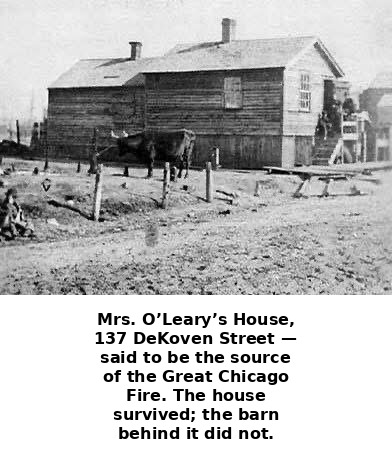
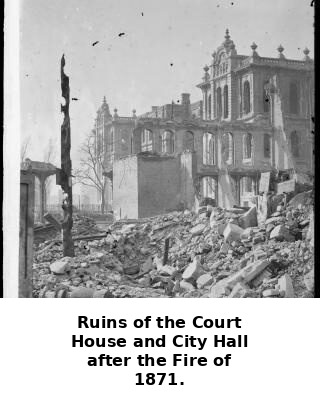
On the night of October 8, 1871, a fire broke out in a small barn behind a cottage on DeKoven Street, on Chicago’s near West Side. Fanned by weeks of drought and a hard wind out of the southwest, it jumped the south branch of the Chicago River within hours, tore through the wooden business district downtown, leapt the main branch of the river a second time, and kept burning north through the wealthy residential blocks along the lakefront until it finally guttered out in the rain early on October 10. By then it had consumed roughly three and a half square miles of the city, destroyed some 17,000 buildings, and killed perhaps 300 people. Many bodies were reduced to ash so no accurate count was ever possible. Drawing on the 1871 city census, contemporary tallies put the number of people rendered homeless at nearly 100,000. This was close to a third of Chicago’s entire population.
The popular legend that Mrs. O’Leary’s cow kicked over a lantern while being milked and started the blaze took hold almost instantly. It has persisted to this day. Writers who investigated the fire in its immediate aftermath were skeptical. Chicago journalists who toured the ruins and interviewed witnesses within days concluded that the fire originated in the O’Leary family’s barn. The specific story of the overturned lantern was, in the words of one contemporary account, already “known to be untrue” even as it spread. Mrs. O’Leary herself always denied it, and a Chicago reporter later admitted to embellishing the tale for a better story.
Theories advanced since then range from neighbors sneaking into the barn to steal milk or gamble, to a stray spark from a nearby chimney, to the more colorful notion of a meteor shower connected to the same night’s other Midwestern fires in Peshtigo, Wisconsin, and across Michigan. No one will ever know for certain how the fire started. What everybody did know was that during an unusually dry summer, for a city built almost entirely of wood, with wooden sidewalks and wood-shingled roofs, a catastrophe was only a spark away.
The “I Will” City Rebuilds
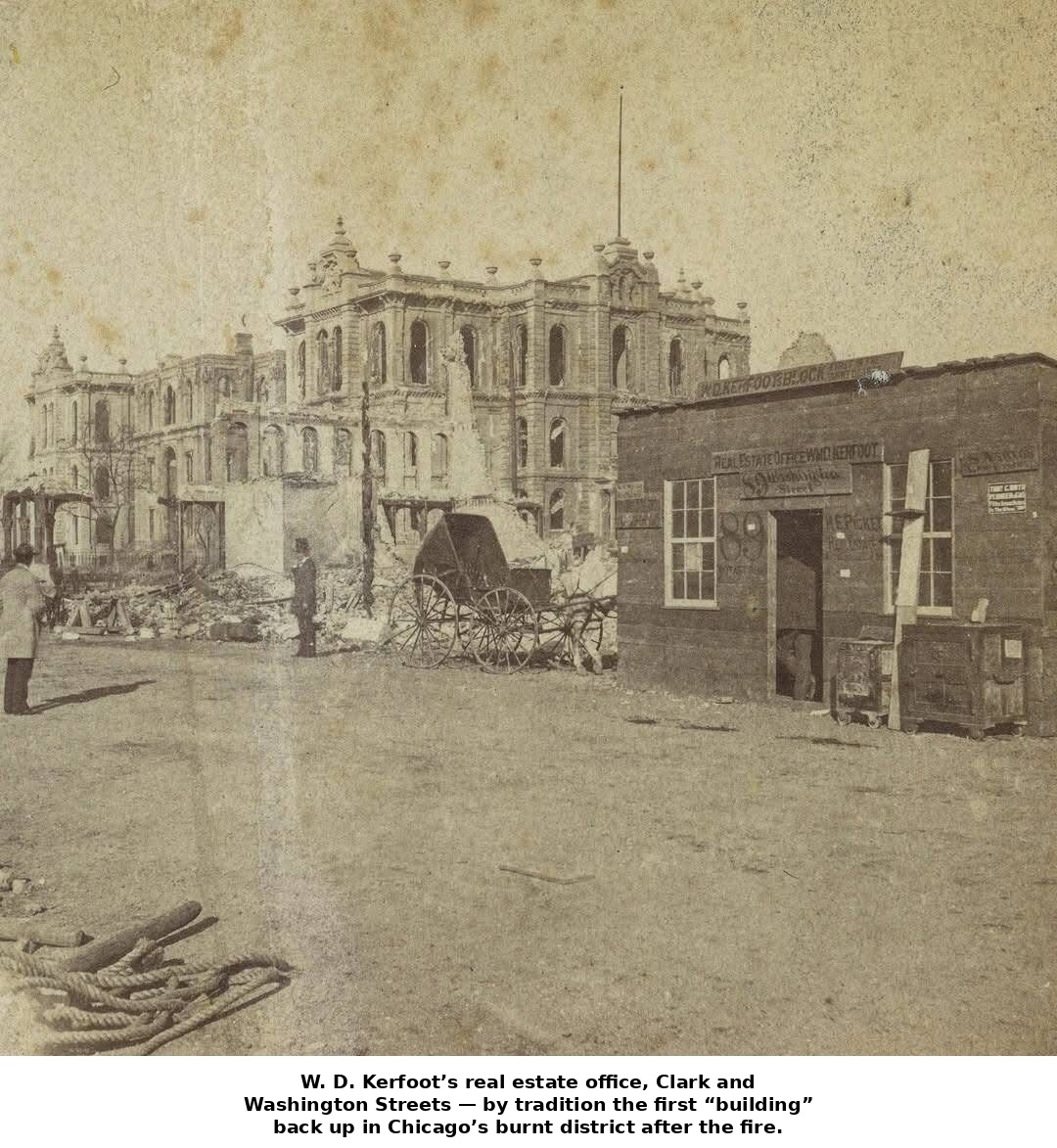
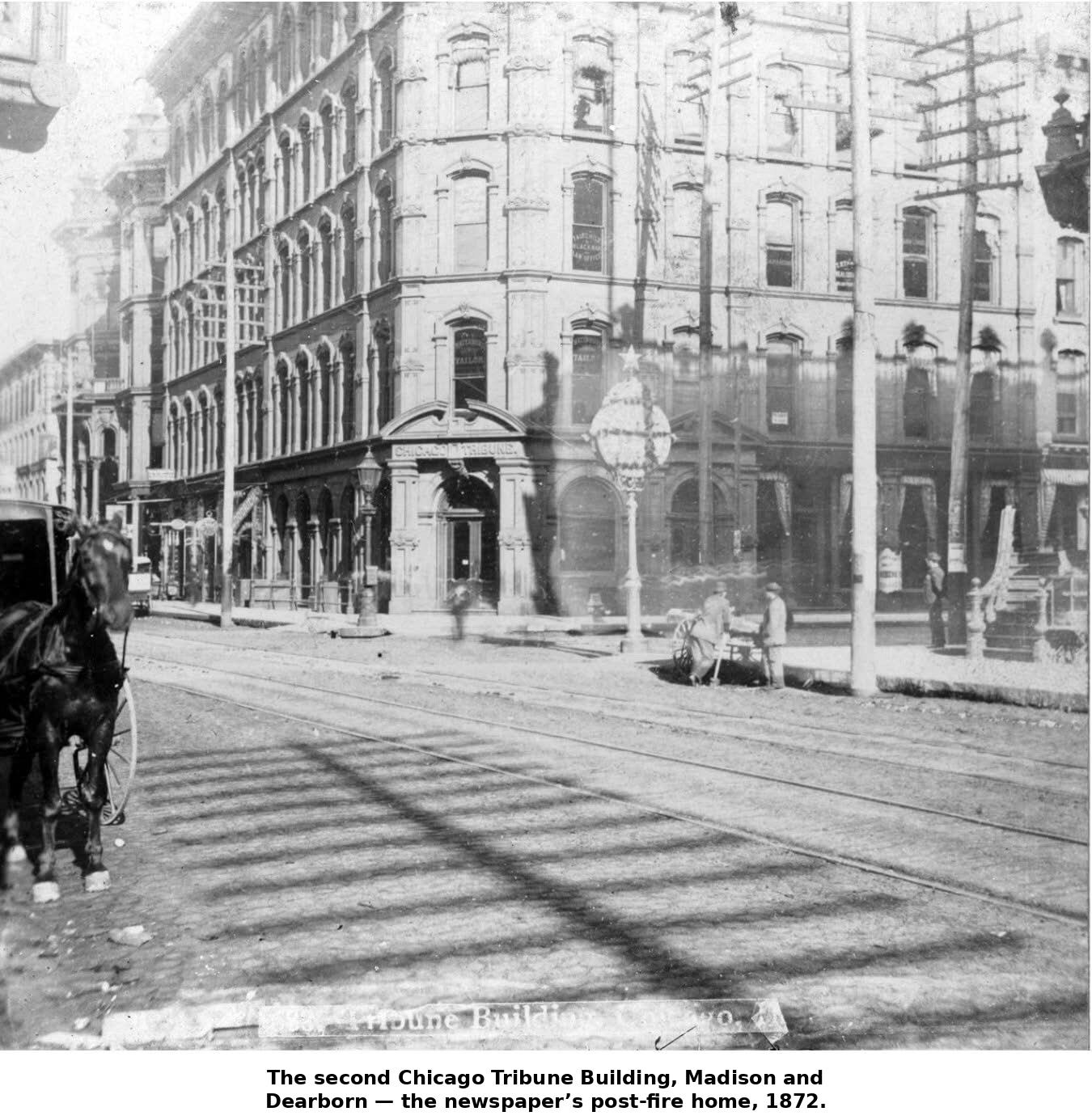
What distinguished Chicago from other cities leveled by disaster was not the fire itself but the astonishing speed of what came after. Within days, temporary shacks and tents covered the burned district. Within weeks, construction crews were clearing rubble and pouring new foundations. Within three years, most of the burned area had been entirely rebuilt, often bigger and sturdier than before. Relief poured in from across the country and around the world. There was grain from Milwaukee, cash from London, and blankets from New York. Chicago’s business class treated the fire less as a tragedy to mourn than a problem to solve. The city adopted a female figure holding a phoenix as an emblem of renewal, and the phrase “I Will” became an unofficial civic motto, capturing a kind of relentless, can-do attitude.
New fire codes required masonry and stone construction downtown in place of wood. This inadvertently accelerated the shift toward the very building methods that would soon make Chicago architecture famous. Population and commerce roared back even faster than the buildings. By the 1880 census, Chicago had more residents than before the fire. By 1890 it had passed the one-million mark, a rate of growth almost without precedent among the world’s cities.
That same rebuilding energy also produced Chicago’s first wave of private clubs, civic institutions that would shape the city’s cultural life for generations. The Chicago Club was founded just before the fire in 1869, and it resumed operations soon after the ash had settled. It became the informal boardroom of the industrialists financing reconstruction. Among them were Marshall Field, Cyrus McCormick, and George Pullman. The Fortnightly of Chicago, founded in 1873 by Kate Newell Doggett, gave the city its first women’s intellectual club, born directly out of the rebuilding fervor. Over the following century, it welcomed speakers from Mark Twain to the Nobel Prize winning “Bard of Bengal,” Rabindranath Tagore. And the Chicago Literary Club, founded in 1874, brought together members to write and read aloud their own essays, a tradition, like the club itself, still unbroken a century and a half later.
Inventing the Skyscraper
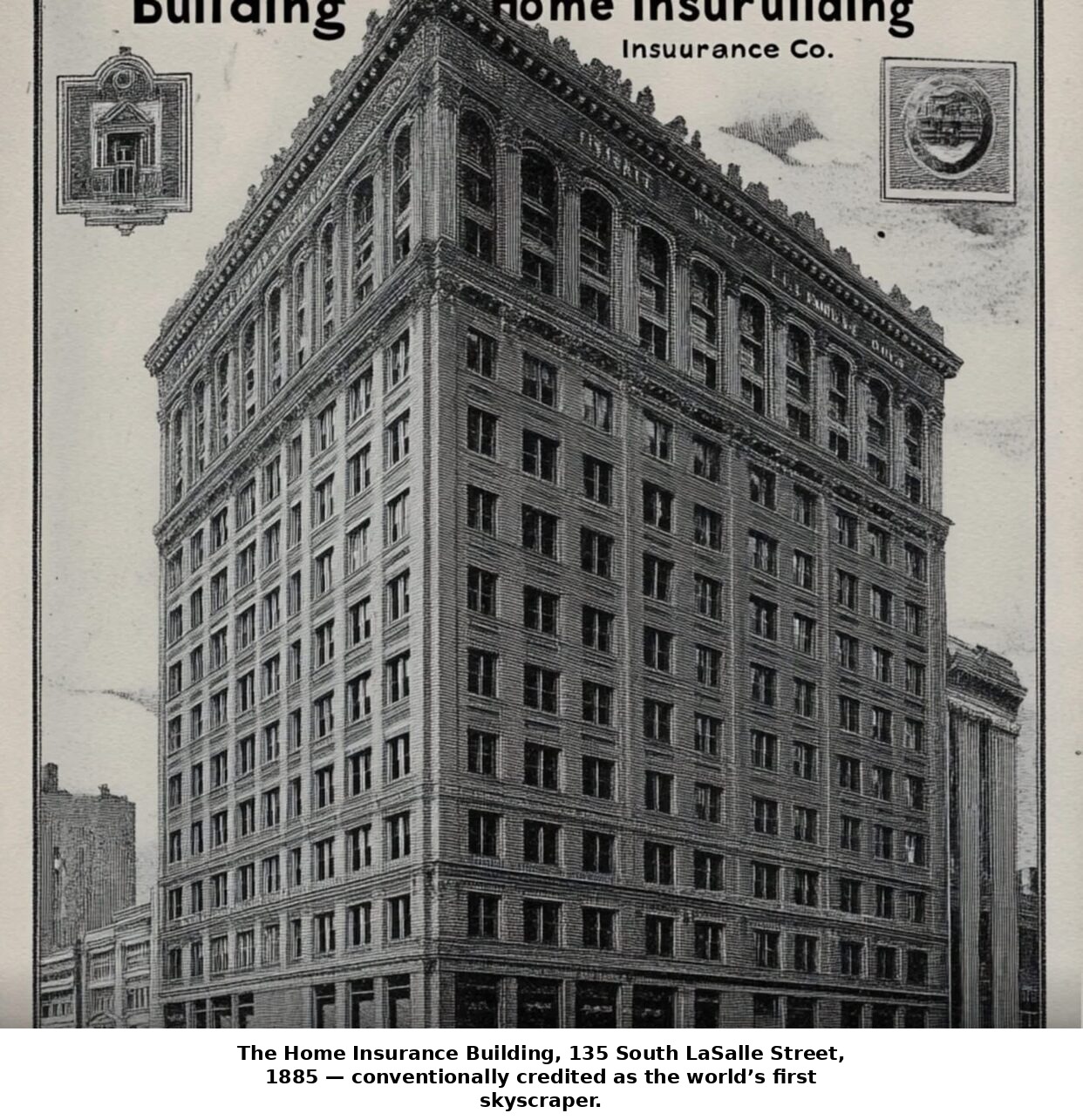
The rebuilding boom, combined with skyrocketing land values in the Loop, created exactly the conditions that would let Chicago architects reinvent the tall building. Real estate in the central business district was too valuable to be used inefficiently, but existing construction methods limited buildings to perhaps ten or twelve stories before the thickness of load-bearing masonry walls at the base became structurally unworkable. The solution arrived in 1884–85 with William Le Baron Jenney’s Home Insurance Building at LaSalle and Adams Streets. Jenney’s building used a full internal skeleton of iron and steel columns and beams to carry the structural load, with the exterior masonry reduced to a non-bearing curtain wall hung on the frame. Standing ten stories (with two more added later), the Home Insurance Building is conventionally credited as the world’s first skyscraper built on true skeletal-frame construction. However, this judgement has always been subject to debate among architectural historians, as other Chicago and New York buildings were experimenting with similar ideas around the same time.
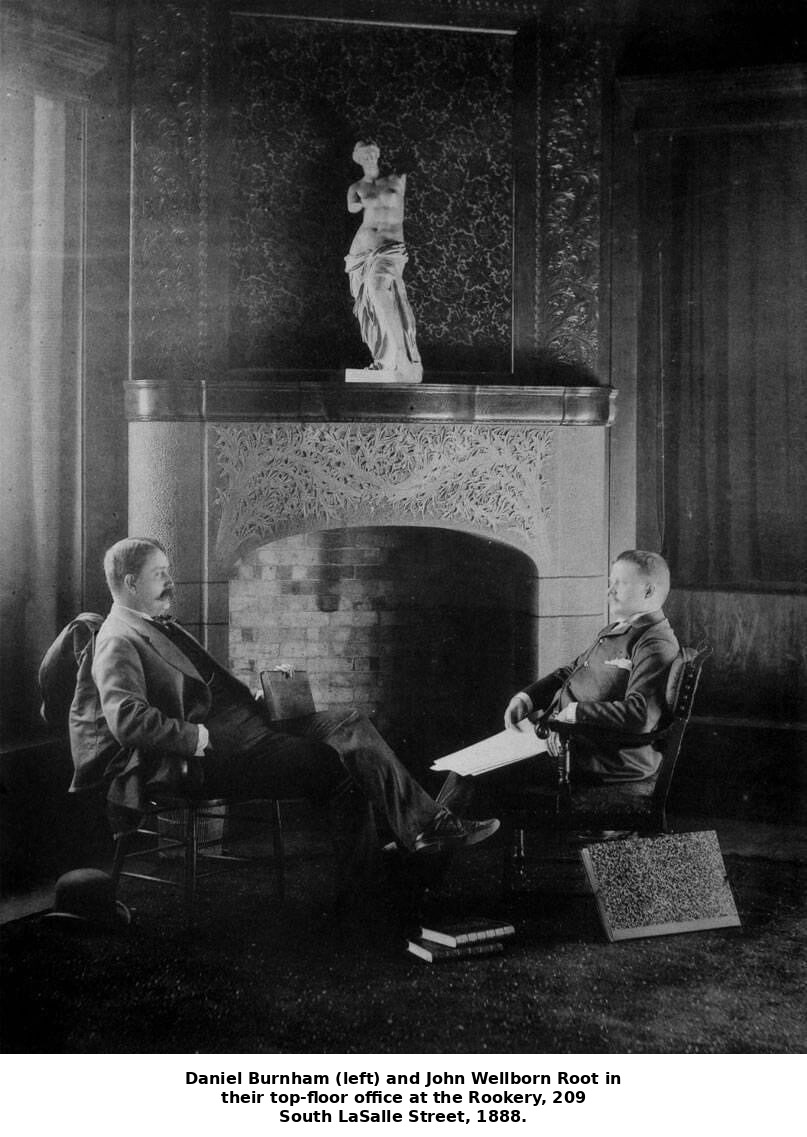
Whatever the precise claim to “first,” Jenney’s innovation opened the floodgates for what became known as the Chicago School of architecture. Louis Sullivan, working first with Dankmar Adler and developing the maxim “form follows function,” designed buildings like the Auditorium Building and the Schiller Building (later known as the Garrick Theater). These were commercial towers that treated the skyscraper as an entirely new architectural problem to be solved. Daniel Burnham and John Wellborn Root, partners whose firm designed the Rookery and the Monadnock Building, pushed load-bearing masonry to its absolute limit even as they experimented with steel framing elsewhere in their portfolio.
Their successor firm of Holabird & Roche contributed a long run of steel-framed commercial blocks, refining the “Chicago window.” Typically a wide central pane flanked by narrower operable sashes, it became a signature of the style. Together these architects and engineers, competing and collaborating in the same few blocks of the Loop through the 1880s and early 1890s, essentially invented the vertical commercial building as the modern world would come to know it. Helping this along was the parallel development of safe elevators and fireproof terra cotta building materials. Their work was a genuinely original American contribution to world architecture born directly out of the fire’s blank slate.
Haymarket and the Labor Question
Nine years before Haymarket, the national railroad strike of July 1877 reached Chicago. Switchmen walked off the job, and crowds of workers and boys shut down rail yards and factories across the city. The worst fighting came at the Halsted Street viaduct near 16th Street, where police, militia and federal troops fired on the crowds. Some thirty people were killed. The “Battle of the Viaduct” left Chicago’s business leaders fearful of labor unrest for a generation.
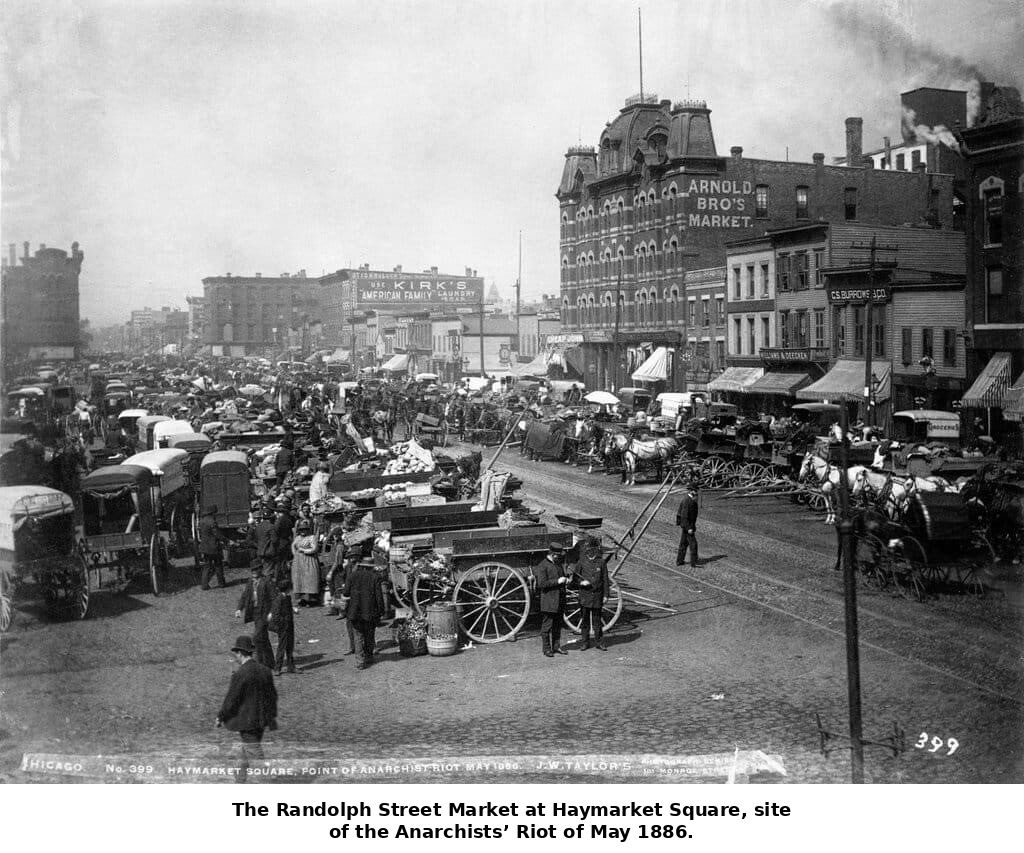
Chicago’s furious industrial growth after the fire also produced furious labor conflict. Nothing crystallized that conflict, or damaged the city’s reputation, more than the Haymarket Affair. On May 4, 1886, a rally was held near Haymarket Square in support of workers striking for an eight-hour day. The gathering was called partly in response to police violence against strikers at the McCormick Reaper Works the day before. As police moved to disperse the crowd toward the end of the rally, an unknown person threw a bomb into the police ranks, killing one officer. The ensuing gunfire, much of it apparently police firing on each other in the chaos and panic, left several more officers and an unknown number of civilians dead. The bomb-thrower was never identified.
In the trial that followed, eight anarchist labor organizers were convicted. Four were hanged, one died by suicide in his cell, and the remaining three were eventually pardoned in 1893 by Governor John Peter Altgeld. Altgeld publicly denounced the original trial as a miscarriage of justice.
Haymarket’s consequences rippled outward for decades. In the short term it triggered a national wave of anti-labor, anti-immigrant, and anti-radical sentiment, associating the eight-hour movement with violence. This set back organized labor’s cause in the public mind for a generation. In the longer term, May Day itself became an international workers’ holiday partly in commemoration of the Haymarket martyrs. The event remains one of the pivotal moments in the history of the American labor movement. For Chicago, the affair cemented an uncomfortable dual reputation the city would carry into the twentieth century. It was a city of audacious commercial and architectural genius that was simultaneously a byword for class violence, corruption, and radical politics.
The Pullman Strike of 1894 made a national figure of Eugene V. Debs, whose American Railway Union refused to handle trains carrying Pullman cars. When federal troops and a court injunction broke the strike, Debs was jailed in nearby Woodstock. He read his way to socialism in his cell and went on to run for president five times, once while in prison.
Among those who lost everything in the 1871 fire was an Irish-born dressmaker named Mary Harris Jones, who had come to Chicago after yellow fever killed her husband and four children in Memphis. Drawn into the labor meetings of the rebuilding city, she became “Mother Jones,” the organizer of miners and mill hands whom a prosecutor would call “the most dangerous woman in America.”
Hog Butcher for the World
Even as architects reimagined the skyline, the city’s underlying economic engine remained resolutely industrial. Nowhere was that more visible than at the Union Stock Yards. It opened on the South Side on Christmas Day, 1865, and expanded enormously through the post-fire decades. It consolidated what had been scattered, competing stockyards into a single vast facility connected to every railroad serving the city. The Union Stock Yards made Chicago the undisputed meatpacking capital of the United States and, for a time, the world.
Firms like Armour, Swift, and Morris pioneered refrigerated rail cars that let Chicago slaughter and dress cattle and hogs locally and ship the meat fresh to eastern markets. This supplanted shipping live animals at far greater expense and loss. The change amounted to a logistical revolution that reorganized the entire American meat economy around Chicago as its hub. The Yards also pioneered a ruthless division of labor along the “disassembly line” that some historians argue anticipated Henry Ford’s automobile assembly line. By the 1890s the stockyards and their surrounding packinghouses employed tens of thousands of workers, most of them recent immigrants, in conditions of danger and squalor that would later draw the attention of reformers and novelists alike.
The scale was staggering. By the century’s end, Chicago’s yards were slaughtering many millions of animals a year, and the smell and smoke of “Packingtown” were, for better or worse, as much a part of Chicago’s international identity as its new skyscrapers.
Carter Harrison, the “Gray Wolves,” and Chicago’s Emerging Machine
The politics of the rebuilt city found their central figure in Carter Harrison Sr., a Kentucky-born Democrat first elected mayor in 1879. He would be reelected four more times over the following fourteen years. Harrison built his coalition by courting Chicago’s immigrant wards directly. He regularly appeared personally at German beer gardens, Irish saloons, and ethnic festivals in a way that polished Yankee reformers of the era rarely bothered to. He engendered a genial, big-tent style of ward politics that would echo through Chicago’s Democratic machine for a century afterward. But the City Council he presided over earned a considerably less flattering reputation. A bloc of aldermen the press nicknamed the “Gray Wolves” made a running business of selling streetcar franchises, utility contracts, and liquor licenses to the highest bidder. This was a form of institutionalized graft contemporaries called “boodle.” It flourished largely because Harrison’s own hands-off style left the Council free to police itself.
No two aldermen embodied the Gray Wolves’ style more vividly than “Bathhouse” John Coughlin and Michael “Hinky Dink” Kenna, the First Ward’s two aldermen. From the early 1890s they ran the lakefront vice district just south of the Loop, the “Levee,” as a semi-official fiefdom of gambling houses, saloons, and brothels. In the process, they were collecting protection payments that helped keep the ward’s vote reliably loyal to the machine on election day. Their annual First Ward Ball, an ostensibly charitable fundraiser that packed the Coliseum with pickpockets, prostitutes, and precinct captains alike, became a byword for the era’s tolerance of vice. For them, it was simply another municipal revenue stream. A 1943 history of their reign, Lords of the Levee: The Story of Bathhouse John and Hinky Dink, remains the standard account of how thoroughly the Levee’s underworld and City Hall’s patronage machine had merged.
Harrison’s own luck ran out in the final days of his fifth term, on October 28, 1893. Just after the World’s Columbian Exposition had closed its gates, a disappointed office-seeker named Patrick Eugene Prendergast shot Harrison dead at his own front door. He was convinced the mayor had promised him a city corporation counsel post. The assassination, coming within days of the fair’s triumphant close, gave 1893 a starkly double character in Chicago’s memory. It was the year of the White City’s gleaming success and also of a mayor’s violent death.
Bubbly Creek and the River’s Reversal
The same stockyards that made Chicago “Hog Butcher for the World” also made its river nearly uninhabitable. Blood, offal, and grease from the packinghouses drained directly into the South Fork of the South Branch. It was a sluggish inlet behind the Yards that decomposing waste kept perpetually gassy and bubbling. Chicagoans nicknamed it “Bubbly Creek,” and the novelist Upton Sinclair would later describe its surface as thick enough to catch fire if a match were tossed onto it.
By the 1880s the main channel fared little better, thick with sewage and industrial runoff from a city whose population had passed a million. Periodic outbreaks of cholera and typhoid swept through neighborhoods that were drawing drinking water from the same lake the river emptied directly into. In 1889 the Illinois legislature created the Sanitary District of Chicago specifically to solve the problem. Its engineers settled on a remarkable engineering fix. Rather than treat the sewage, they would reverse the river’s flow away from Lake Michigan altogether. They would send Chicago’s waste down the Des Plaines and Illinois Rivers toward the Mississippi River instead.
Their solution was construction of the Chicago Sanitary and Ship Canal, a channel roughly twenty-eight miles long. In places, it cut through solid rock. Construction proceeded through the 1890s as one of the largest earth-moving projects then underway anywhere in the world. When the final earthen barrier was dynamited away on January 2, 1900, Lake Michigan’s flow into the Chicago River stopped and then ran backward. This was a permanent hydrological reversal that protected the city’s drinking-water supply, deepened its channels for shipping, and set the template for the locks and controlling works that would manage the river’s altered plumbing through the century to follow.
The White City

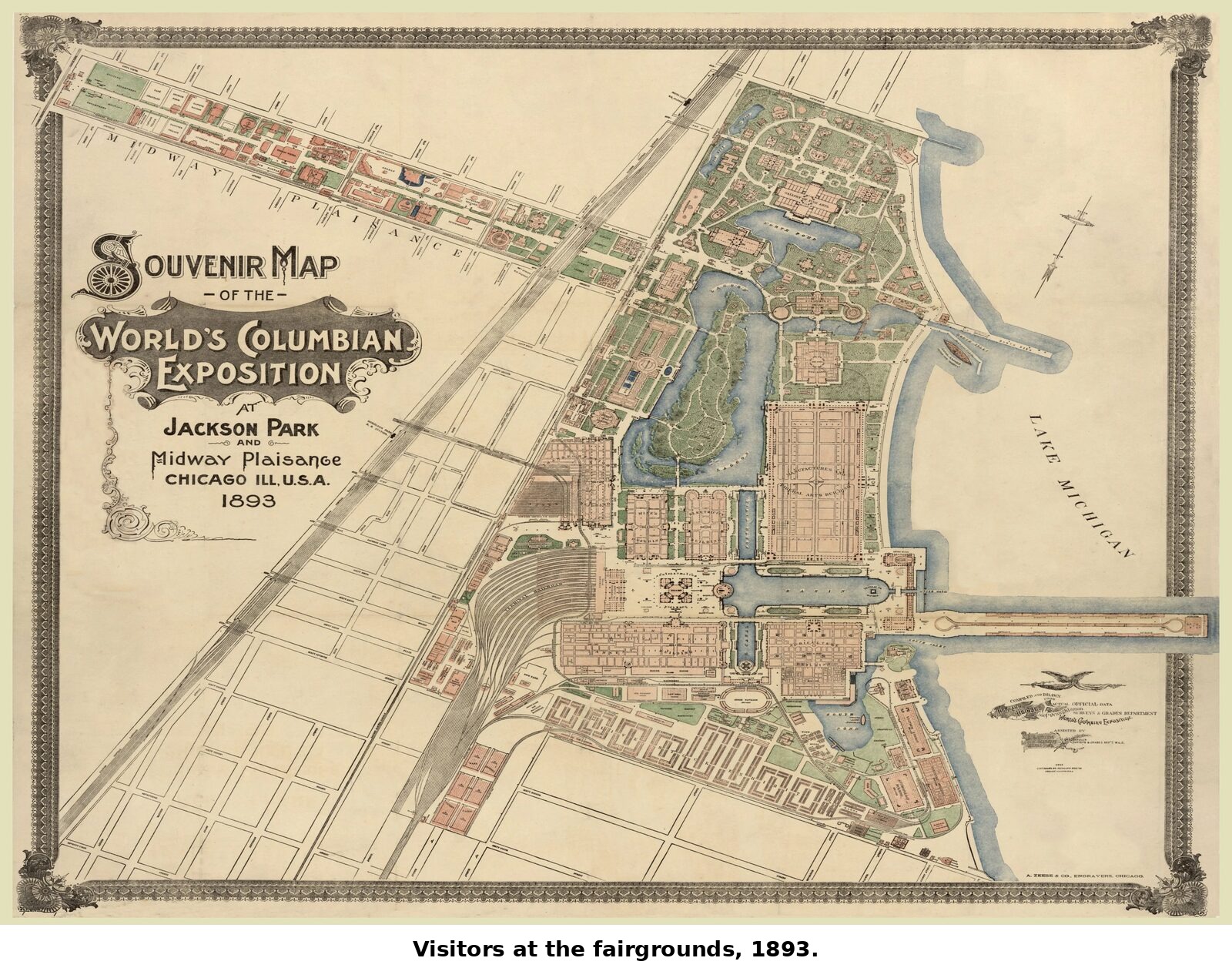
Chicago’s determination to prove itself a first-rank world city culminated in the World’s Columbian Exposition of 1893. It was staged on Jackson Park’s marshy lakefront to mark (a year late) the four-hundredth anniversary of Columbus’s landing in the Americas. Chicago had lobbied hard and beaten out New York, Washington, and St. Louis for the right to host the fair. It was a victory that briefly earned it the nickname “the Windy City” from a New York editor mocking the boastfulness of its civic boosters, though the phrase stuck as an affectionate nickname rather than an insult.
Architect Daniel Burnham was appointed chief of construction and, working with a roster of the nation’s leading architects and with Frederick Law Olmsted, the celebrated designer of New York’s Central Park. Together they laid out an entire monumental city within a city. There was a formal Court of Honor of gleaming white neoclassical palaces arranged around a great basin and canals. These were surrounded by Olmsted’s more informal, naturalistic lagoons and wooded islands. The scale dwarfed anything Americans had seen. The fairgrounds covered some six hundred acres, and the buildings were finished in a temporary white plaster called staff that gave the fair its enduring nickname, “the White City.” Electric lighting illuminated the grounds at a scale that astonished visitors used to gaslight. It uniquely announced the coming electrical age.
More than twenty-seven million visits were recorded over the fair’s six-month run. This was an extraordinary figure given the national population of roughly sixty-five million. The exposition introduced Americans to Cracker Jack, Juicy Fruit gum, the first Ferris Wheel (built specifically to rival the Eiffel Tower as the fair’s signature spectacle). Countless other technological marvels were displayed in the Palace of Fine Arts and the Manufactures Building, then the largest building in the world. The fair’s classical, orderly White City also launched the City Beautiful movement in American urban planning. This directly inspired Burnham’s later Plan of Chicago and comparable planning efforts in cities across the country. Nonetheless, critics like Louis Sullivan later complained that its borrowed European classicism had set back the native, modern architectural language Chicago itself had just invented. For a few months in 1893, the city that a generation earlier had been a smoking ruin stood as the physical proof of American ambition to the entire world.
Rebuilding the Stage: Theater, Opera, and Symphony
The same “I Will” resolve that raised office towers out of the ashes rebuilt Chicago’s stages just as fast. James H. McVicker’s playhouse on Madison Street, the leading home of comedy in the young city since 1857, burned to its foundations along with nearly everything else downtown in October 1871. The architects Wheeler & Thomas rebuilt it within the year, and McVicker’s reopened on August 15, 1872, barely eleven months after the fire. This proved that the city’s cultural life, and not just its commerce, had survived the flames.
Edwin Booth, who had married McVicker’s daughter, performed there regularly, and in January 1881 the theater hosted the American stage debut of the celebrated French actress Sarah Bernhardt in Camille. Adler & Sullivan, not yet the partnership that would define Chicago architecture, remodeled McVicker’s again in 1883. This was a modest preview of the far grander commission the same firm would take on before the decade was out.
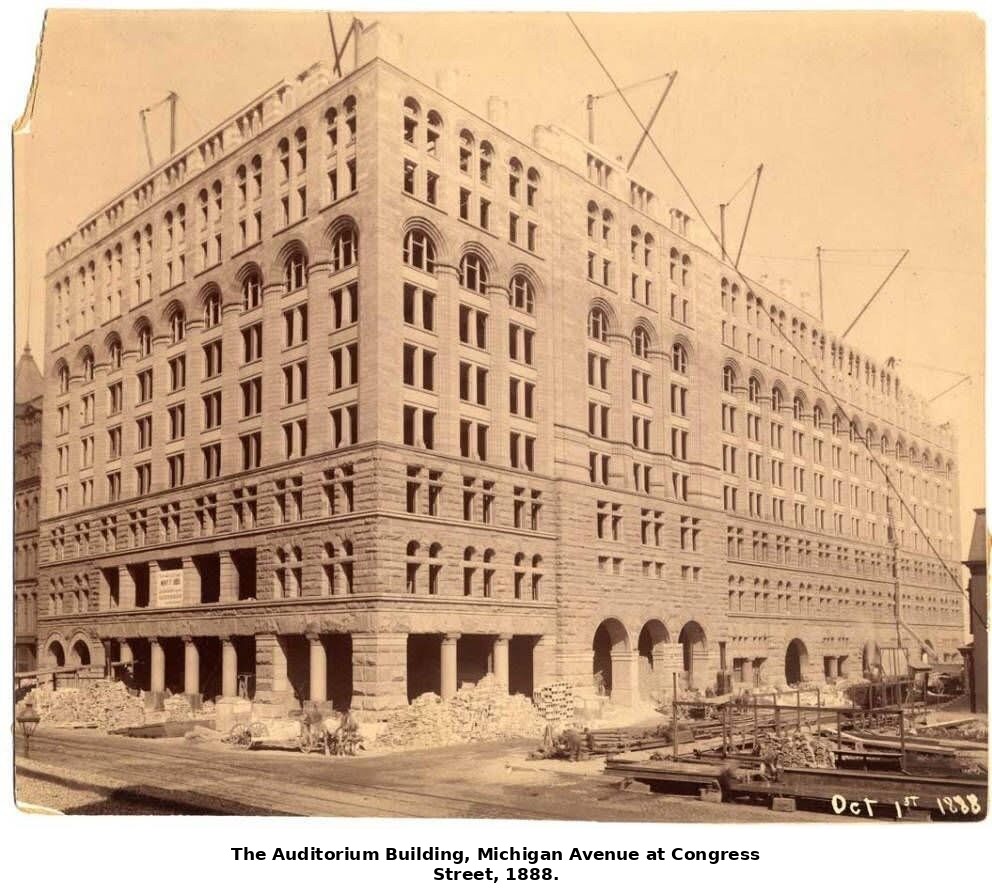
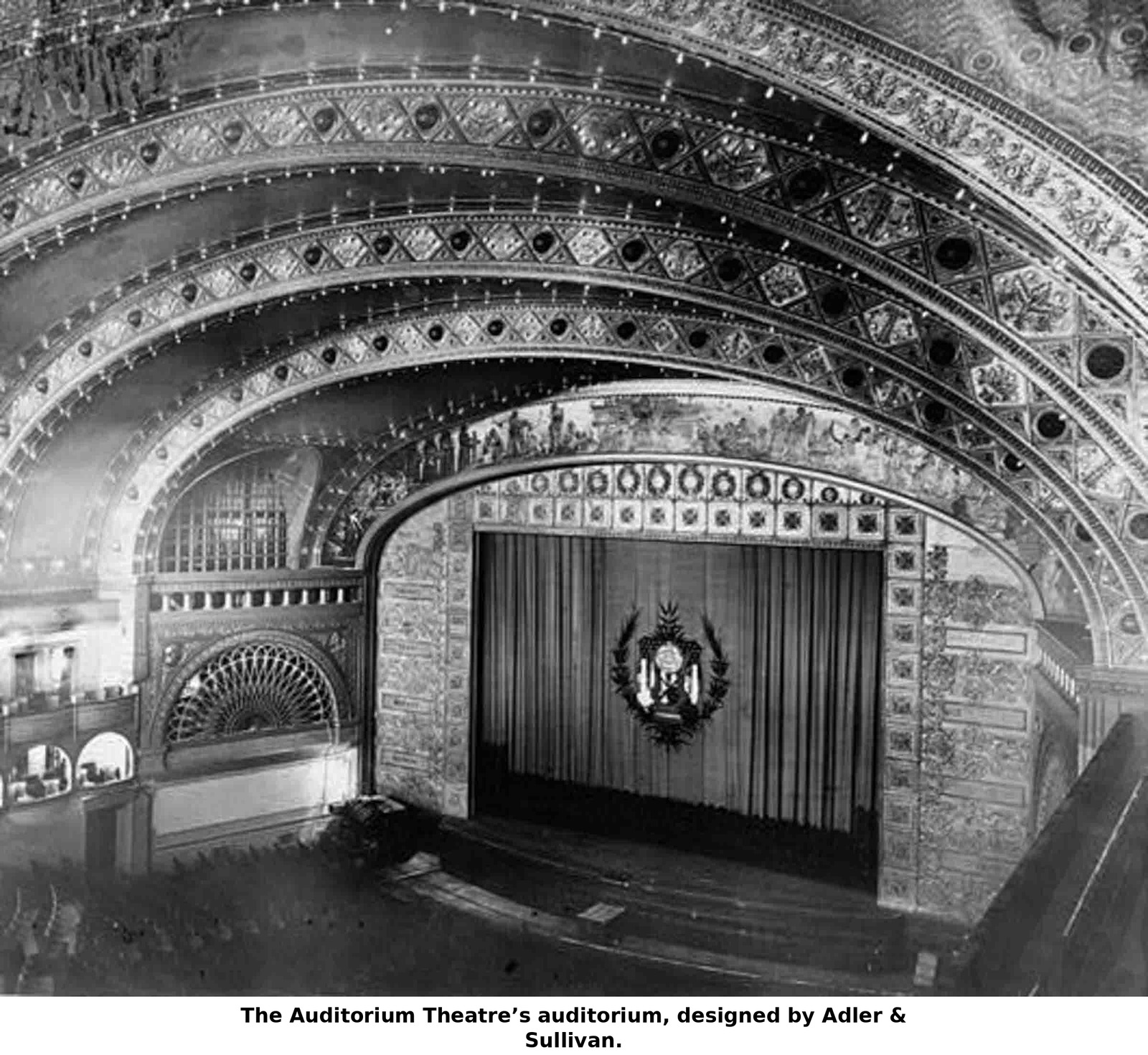
That grander commission was the Auditorium Building, incorporated in December 1886 by the businessman Ferdinand Peck. He had set out to build a theater that could rival New York’s Metropolitan Opera House while remaining, as he put it, open to Chicago’s working people rather than reserved for its elite. Designed by Dankmar Adler and Louis Sullivan, with a young draftsman named Frank Lloyd Wright contributing to the interiors, the building opened on December 9, 1889, dedicated by President Benjamin Harrison in a ceremony where the soprano Adelina Patti sang “Home, Sweet Home.”
Briefly the tallest building in the city and the largest in the country, the Auditorium became the first home of both the Chicago Grand Opera Company and the Chicago Symphony Orchestra, founded in 1891 by the German-American conductor Theodore Thomas. Thomas had come to Chicago after the businessman Charles Norman Fay asked whether he would come there for a permanent orchestra. Thomas reportedly answered that he “would go to hell if they gave me a permanent orchestra.” He led the Orchestra until his death in January 1905, three weeks after conducting the dedication of its new home, Orchestra Hall.
The Art Institute and the Fair’s Midway
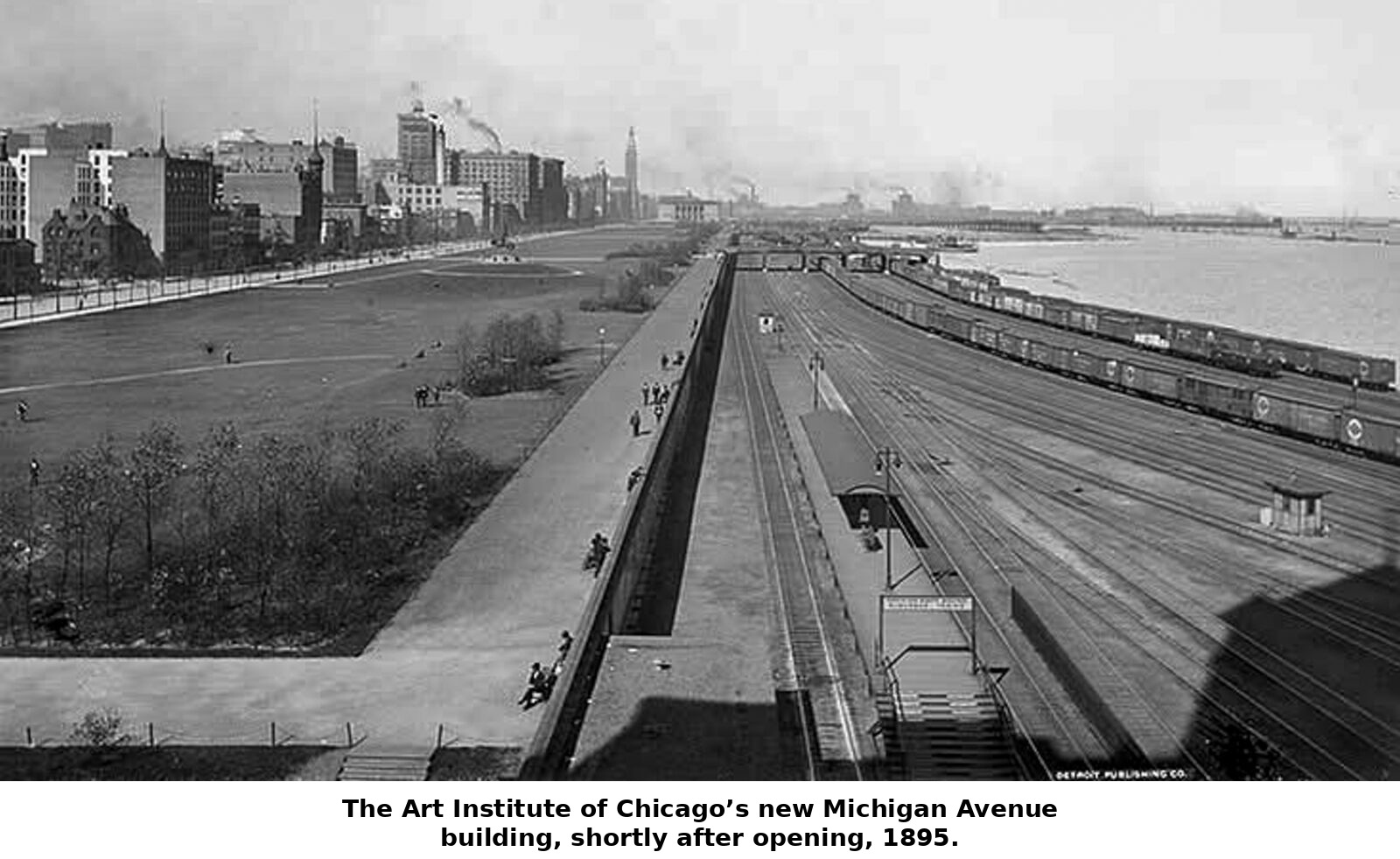
The Chicago Academy of Fine Arts, founded in 1879 as both a museum and a school, renamed itself the Art Institute of Chicago in 1882. It outgrew its quarters almost as fast as it filled them. When the city won the right to host the 1893 World’s Columbian Exposition, the Art Institute’s trustees struck a deal to build a permanent Beaux-Arts building at Michigan Avenue and Adams Street. The building, soon flanked by two bronze lion sculptures at its Michigan Avenue entrance, opened as the Art Institute’s permanent home on December 8, 1893, days after the fair itself closed. This gave Chicago its first serious civic art museum.
One of the era’s private clubs helped underwrite that cultural ambition. The Union League Club, founded in 1879 in the tradition of the wartime Union League of America, built its own collection of American art substantial enough that the Chicago Tribune would later call it “the other art institute in Chicago.”
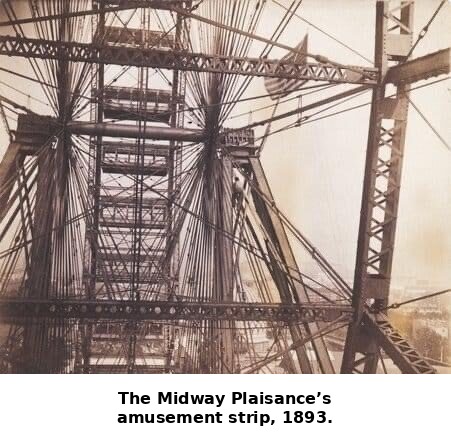
The fair’s own, considerably less high-minded contribution to the city’s cultural life ran along the Midway Plaisance. It was a mile-long strip of amusements that a young promoter named Sol Bloom laid out deliberately apart from the fair’s solemn exhibition halls. The area gave the English language the word “midway” for a carnival’s entertainment strip ever after. Visitors rode George Ferris’s new 264-foot wheel, watched the strongman Eugen Sandow demonstrate his exercise machines, and packed in for the “hootchy-kootchy” dancing of a performer billed as “Little Egypt.” All of this was alongside a row of national villages and sideshows. However, crude by later standards, this taught Chicago and the country that a fair, like a city, could sell spectacle as readily as commerce. This was a lesson the amusement and entertainment industries of the following century would take fully to heart.
From Ashes to Empire
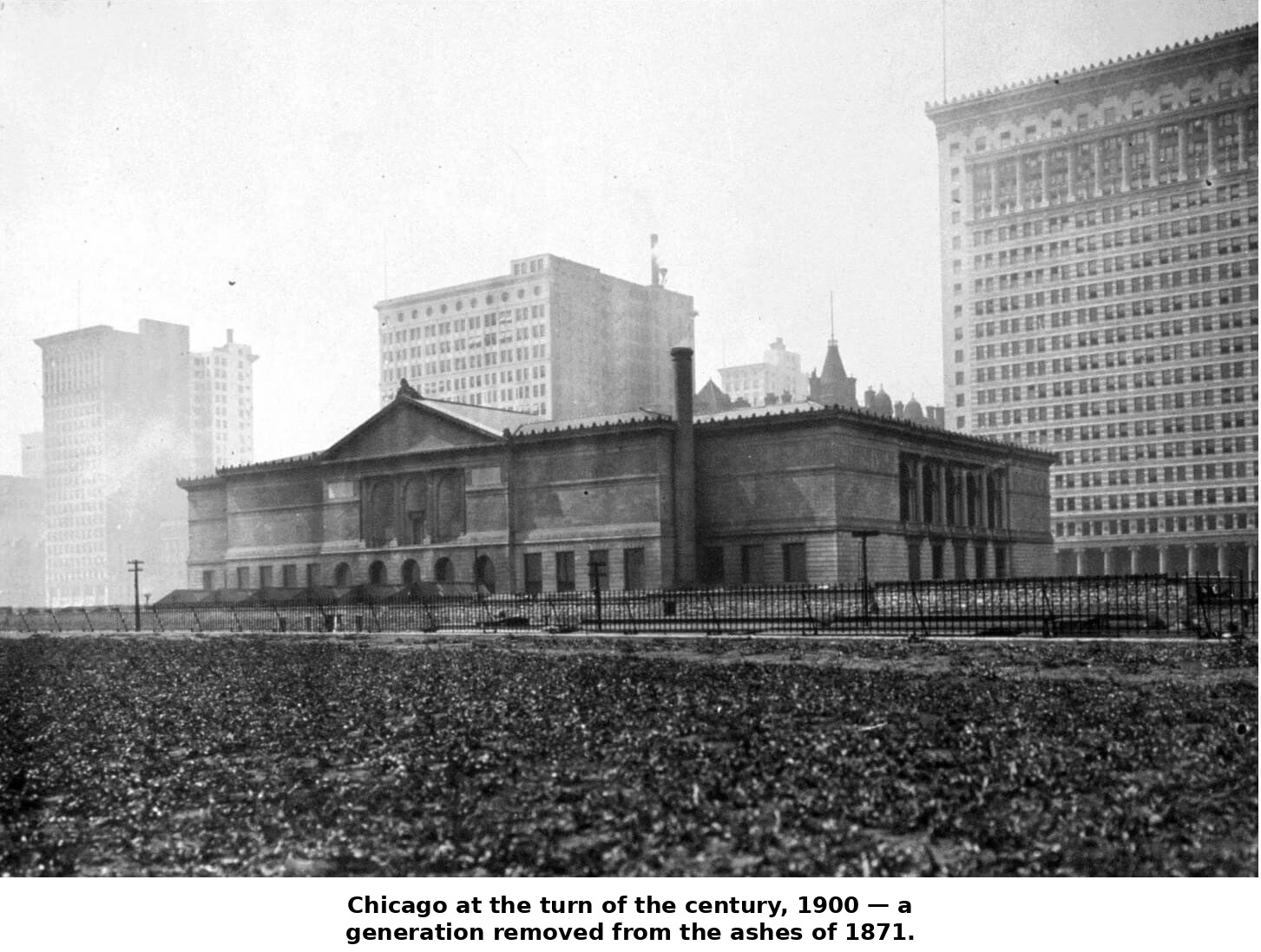
In the Great Fire, Chicago lost its downtown, a third of its population’s homes, and by some measures nearly two hundred million dollars in property in three nights. Yet it emerged within a single generation as the birthplace of the modern commercial skyscraper. It was also the undisputed meatpacking and railroad hub of the continent, and the host of the most spectacular world’s fair the United States had ever staged. The city had done so while absorbing hundreds of thousands of immigrant workers into brutal, dangerous industrial jobs, and while enduring a labor crisis at Haymarket that scarred its reputation even as its architecture and commerce dazzled the world.
In 1891 Dr. Daniel Hale Williams, one of the few Black surgeons in the country, founded Provident Hospital and Training School on the South Side. It was the first hospital in the nation owned by Black Americans and open to patients and nurses of every race. Two years later he repaired the heart lining of a stabbing victim, James Cornish, in one of the first successful operations on the heart.
In miniature, Chicago’s post-fire story is America’s own story in the Gilded Age. It was breathtaking, unsentimental growth built on immigrant labor and industrial ruthlessness, but redeemed in the popular imagination by genuine, world-changing innovation. The “I Will” spirit that rebuilt the Loop in brick and steel was the same restless energy that, twenty-two years after the fire, could raise an entire gleaming White City out of a lakefront swamp. Chicago’s dual identity as both a modern and a fractious American metropolis was set for the century to come.
Sources: James W. Sheahan and George P. Upton, The Great Conflagration: Chicago, Its Past, Present and Future (1871); Elias Colbert and Everett Chamberlin, Chicago and the Great Conflagration (1871); A. T. Andreas, History of Chicago, Vols. 2–3 (1885–1886); general reference sources on the Haymarket Affair, the Union Stock Yards, and the World’s Columbian Exposition of 1893; Libby Hill, The Chicago River: A Natural and Unnatural History (2000); Metropolitan Water Reclamation District of Greater Chicago, A History of Protecting Our Water Environment; Carter H. Harrison, Stormy Years: The Autobiography of Carter H. Harrison (1935); Paul M. Green and Melvin G. Holli, eds., The Mayors: The Chicago Political Tradition; John M. Allswang, A House for All Peoples: Ethnic Politics in Chicago, 1890–1936 (1971); review of Lords of the Levee: The Story of Bathhouse John and Hinky Dink, by Lloyd Wendt and Herman Kogan, Journal of American History 30, no. 1 (1943): 127; Encyclopedia of Chicago, Auditorium Building; Chicago Symphony Orchestra, History of the Chicago Symphony Orchestra; The Art Institute of Chicago, History; Encyclopedia of Chicago, Exhibits on the Midway Plaisance, 1893; McVicker’s Theater, Wikipedia.
Photo Sources: Mrs. O’Leary’s House — Chicago History Museum; Kerfoot’s real estate office — Chicago History Museum / Great Chicago Fire & the Web of Memory; Home Insurance Building, 1885 — Ryerson and Burnham Archives, Art Institute of Chicago; Burnham & Root’s office, the Rookery — Ryerson and Burnham Archives, Art Institute of Chicago; Haymarket Square — Chicago History Museum; World’s Columbian Exposition, Court of Honor — Library of Congress, Prints and Photographs Division; The Auditorium Building — Ryerson and Burnham Archives, Art Institute of Chicago (James W. Taylor albumen prints); The Auditorium Theatre interior — Ryerson and Burnham Archives, Art Institute of Chicago. Internet sources of other photos are not identified.