Chapter 5: Digital Age Chicago, 1951–2000
A City Remade
In 1951, Chicago still looked and felt like the industrial capital it had been for a century. It was a city of stockyards and steel mills, of two-flats and streetcar lines, and its skyline crowded with factory smoke rather than glass towers. By 2000, almost none of that description held true. Over the second half of the twentieth century, Chicago lost more than a million residents from its city limits, watched its manufacturing base collapse, endured some of the most bitter racial conflict in the urban North, and was governed for thirty-five of those fifty years by two men who shared a last name and a talent for concentrating power. This is the story of how Chicago became a modern city — not gently, but through demolition, migration, riot, and reinvention.
On December 1, 1958, fire swept the second floor of Our Lady of the Angels parish school in Humboldt Park. Ninety-two children and three nuns died. The tragedy led to sweeping changes in school fire codes, sprinklers and fire drills in Chicago and across the country.
The Pull of the Suburbs
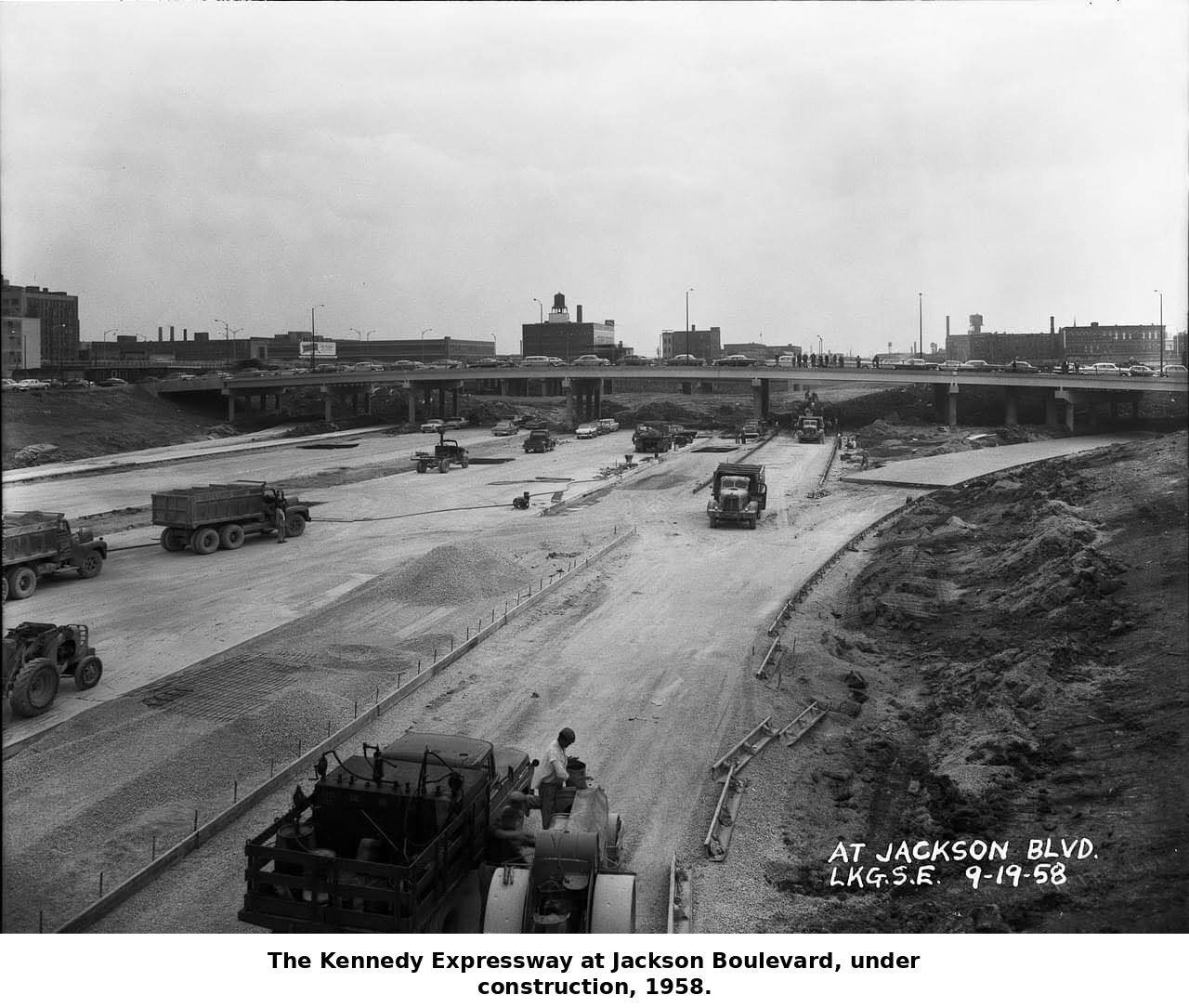
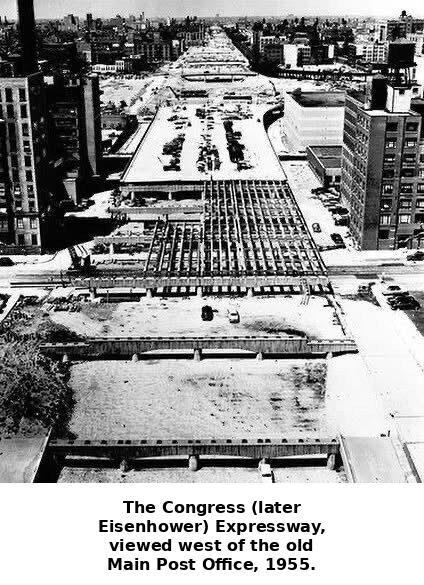
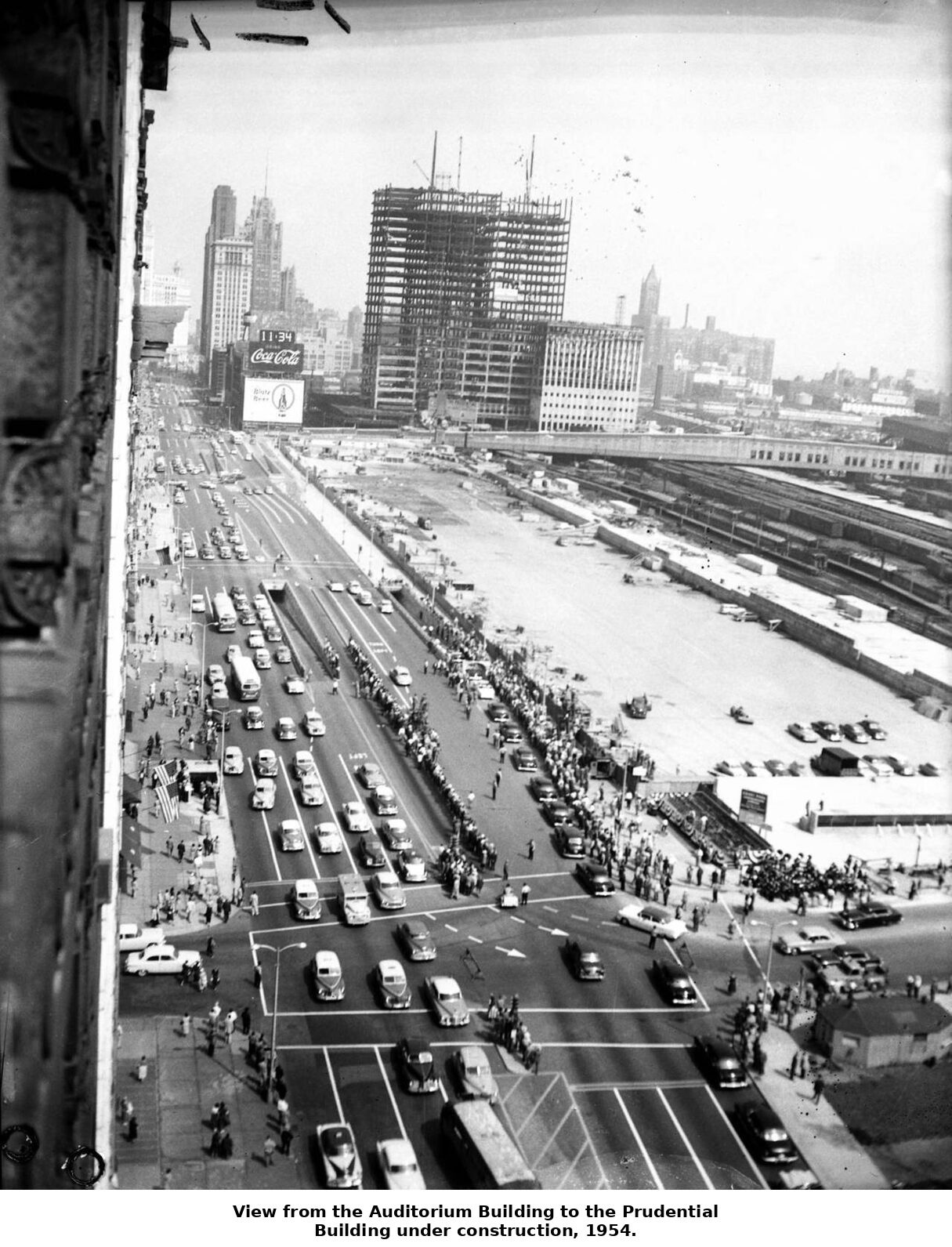
The engine of change was, in part, simple geography. Federal housing policy after World War II, cheap mortgages backed by the Federal Housing Administration and the GI Bill, made single-family homes in the suburbs affordable to millions of returning veterans and their families in a way city apartments were not. The Federal-Aid Highway Act of 1956 then built the physical infrastructure of dispersal, funding expressways like the Eisenhower, the Dan Ryan, and the Kennedy that could move commuters between new suburban subdivisions and downtown jobs in a fraction of the time the old rail and streetcar network required. Cook County’s suburbs, and the collar counties beyond them, absorbed hundreds of thousands of families and, increasingly, the factories and retailers that had once anchored city neighborhoods.
Chicago’s population peaked at 3.6 million in 1950 and began a decline that would not reverse until the 1990s. The people who left were disproportionately white and middle-class; the highways that enabled their departure were often carved directly through Black and immigrant neighborhoods, displacing residents and severing communities that had existed for generations.
Daley and the Machine
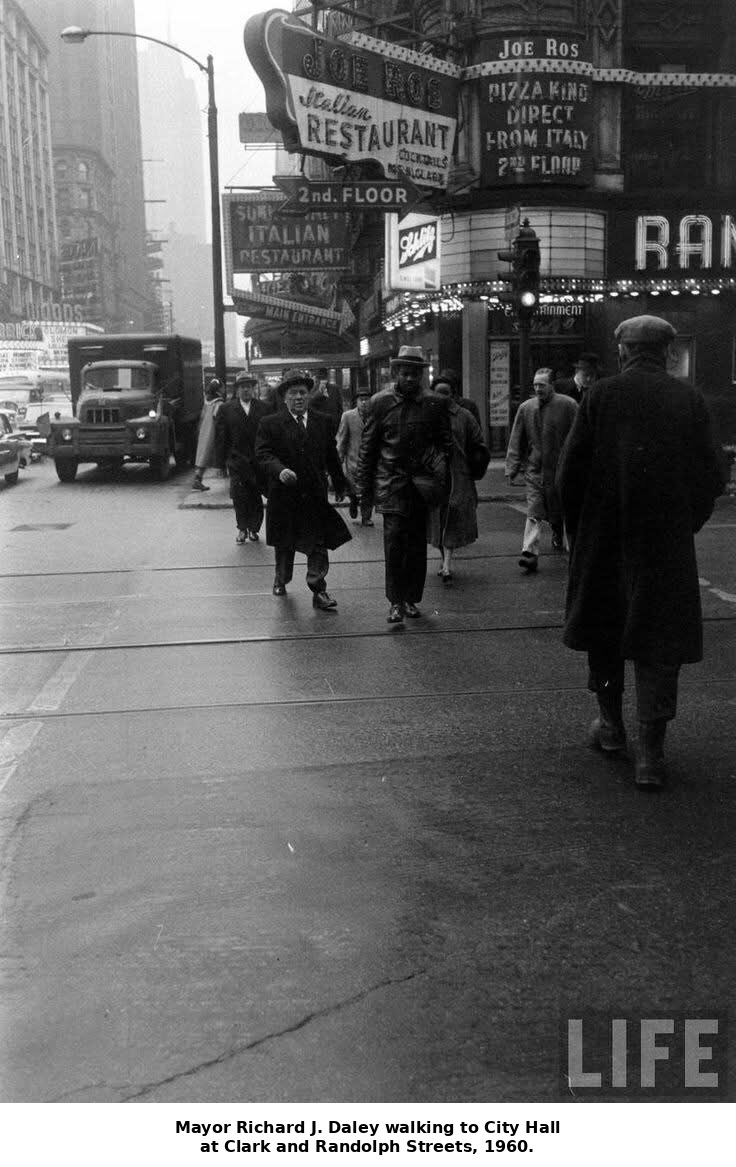
Into this transformed landscape stepped Richard J. Daley, elected mayor in 1955 and reelected five times until his death in office in 1976. Daley was the last great boss of the old-style urban political machine. The Democratic Party organization was built on precinct captains, patronage jobs, and a ward-by-ward turnout operation that could reliably deliver votes on election day. As mayor and, simultaneously, chairman of the Cook County Democratic Central Committee, Daley fused City Hall and party apparatus into a single instrument, controlling appointments, contracts, and zoning decisions with a thoroughness that few American mayors before or since have matched. His power reached beyond Chicago. The Democratic political machine’s ability to produce lopsided Democratic margins in the city made Illinois pivotal in national elections, most famously in the disputed 1960 presidential race between John F. Kennedy and Richard Nixon, where Chicago’s vote count drew lasting accusations of fraud.

Daley’s Chicago was also a city of enormous, visible construction. He backed O’Hare International Airport’s expansion into the world’s busiest airport, built the University of Illinois at Chicago’s Circle campus, and expanded the expressway system inside the city itself. But his signature domestic program was urban renewal, and its most consequential product was public high-rise housing. The Chicago Housing Authority, under pressure from Daley and from aldermen determined to keep public housing out of white wards, concentrated new developments almost entirely within existing Black neighborhoods on the South and West Sides. The results included the Robert Taylor Homes, completed in 1962 as the largest public housing project in the country, and the Cabrini-Green complex on the Near North Side. All expanded through the 1950s and 1960s. Conceived as slum clearance and modern housing, these towers instead concentrated poverty at a scale and density that produced by the 1970s and 1980s some of the most troubled, disinvested communities in urban America, plagued by deferred maintenance, gang activity, and isolation from the city’s economic life.
The Preservation Movement Fights Back
Even as Daley’s bulldozers cleared whole blocks for public housing and expressways, a countervailing movement was taking shape to save what remained of nineteenth-century Chicago. In 1966 the architect Wilbert R. Hasbrouck helped organize the Chicago School of Architecture Foundation specifically to buy and preserve Henry Hobson Richardson’s threatened Glessner House. He served as the young foundation’s president for its first four years and went on to found and edit the Prairie School Review from 1964 to 1981. The magazine was the first scholarly journal devoted to Frank Lloyd Wright and his Prairie School contemporaries. After a career as chief architect for the Illinois Central Railroad, Hasbrouck turned to restoring landmark buildings. These included Wright’s Dana-Thomas House and Louis Sullivan’s Peoples Savings Bank. He also served as president of The Cliff Dwellers arts club as it and other Chicago institutions and businesses opened their doors to women in the 1980s. Hasbrouck’s son Charles similarly served as president of the club and also followed the family’s architectural bent in preservation work before his career with Skidmore, Owings & Merrill took him to work on large-scale projects from Oman to India. He ended his long career at the absolute other end of the preservation spectrum by leading the architect-of-record team behind architect Jeanne Gang’s St. Regis Chicago, the city’s third-tallest tower.
Another father-son pair of preservation architects once serving as president of The Cliff Dwellers is Walker Johnson and his son Ben. The elder Johnson trained at Holabird & Root before co-founding Johnson Lasky Architects in 1992 to carry the rescue-and-restore architectural ethic into the century’s final decade. His architect son, Ben, went from preservation work to help shape the world’s tallest skyscrapers at Chicago’s Adrian Smith + Gordon Gill Architecture. The firm’s designs include what will be the world’s tallest building, the Jeddah Tower in Saudi Arabia.
From saving the old, worth saving, buildings locally, to designing and building the newest and the tallest megatall structures on the planet, Chicago has given birth to unique multi-generational architectural skill sets. These four professionals, and other Chicago architects like them, have helped set both preservation and megatall building and design standards for the world.
The Chicago Seven Take On the Miesians
A parallel rebellion was brewing within the profession itself in this period. In 1976, invited by his friend Stanley Tigerman, the architect Laurence Booth joined Stuart Cohen, Ben Weese, James Ingo Freed, Thomas Beeby, and James L. Nagle in forming the Chicago Seven. The group was a brotherhood of younger architects who chafed against the city’s institutionalized reverence for Ludwig Mies van der Rohe. When the Museum of Contemporary Art mounted a traveling exhibition that told Chicago’s architectural story almost entirely through Mies’s circle, the group staged a pointed counter-show of its own. Through further exhibitions and writings of their own, they argued for a broader, more generous history that made room for underappreciated architectural figures like Daniel Burnham, John Root, and Bruce Goff.
The O’Hare Strip: Annexation’s Last Chapter

Daley’s ambitions for O’Hare exposed a peculiar problem. The airport was then called Orchard Field after the small wartime aircraft plant that had occupied the site. It lay entirely outside Chicago’s city limits, ten miles northwest of the Loop. In 1956, the city annexed a narrow, roughly quarter-mile-wide corridor running out along Foster Avenue and Higgins Road to the airport property. This stitched a slender finger of Chicago territory across unincorporated Cook County so that O’Hare would be inside the city itself and under its taxing and regulatory authority.
The “O’Hare Strip,” as it came to be known, was one of the last significant annexations Chicago would ever complete. It closed out a much longer pattern of territorial growth that had culminated decades earlier in the sweeping 1889 vote that brought the townships of Hyde Park, Lake View, Jefferson, and Lake into the city in a single stroke. This had added some 125 square miles and 225,000 residents and roughly quadrupled Chicago’s area. After the O’Hare Strip, Chicago’s boundaries settled into essentially their present form, and the airport it secured went on through the 1950s and 1960s to become for a time the world’s busiest.
The airport’s growing ambitions found a fittingly bold architectural expression in 1963, when the architect Gertrude Lempp Kerbis, one of the first women to reach the top ranks of Chicago’s modernist design world, completed O’Hare’s circular Rotunda Building. Its 190-foot ceiling was suspended from nearly a mile of heavy bridge cable, and was built to house the jet-age Seven Continents restaurant.
O’Hare’s growth brought the city’s worst disaster of the jet age. On May 25, 1979, American Airlines Flight 191 lost an engine on takeoff and crashed into a field beyond the runway. All 271 people aboard and two on the ground were killed, the deadliest airline accident on U.S. soil.
The Fourth Seacoast That Wasn’t: The St. Lawrence Seaway
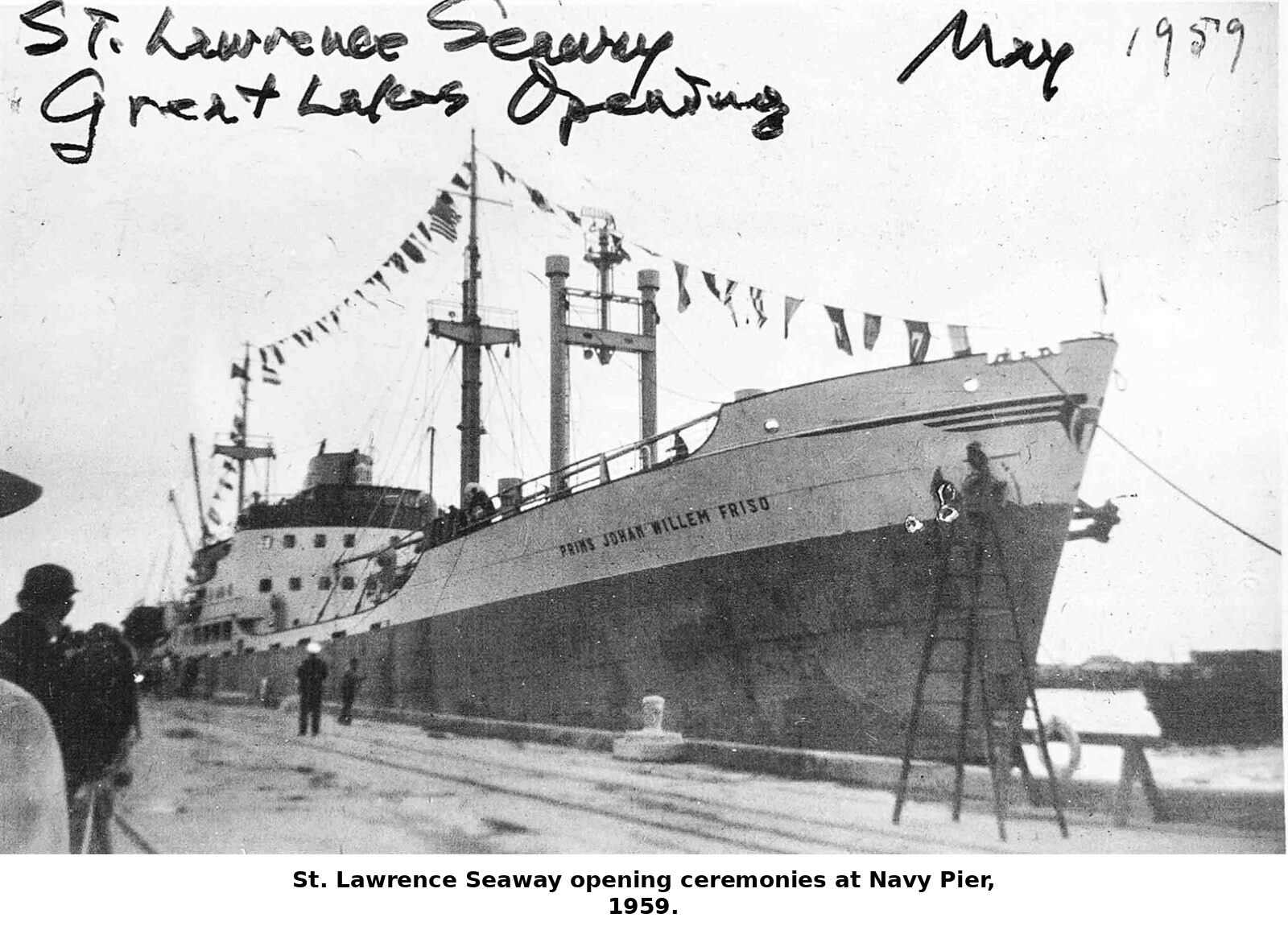
Chicago’s ambitions to become not just an inland rail hub but a true ocean port crested in 1959, when the St. Lawrence Seaway officially opened. Its ceremonial ribbon was cut jointly by Queen Elizabeth II and President Dwight D. Eisenhower. Decades in the planning and built jointly by the United States and Canada, the Seaway paired a chain of new locks and channels along the St. Lawrence River with the existing Welland Canal around Niagara Falls. The result finally gave oceangoing freighters a continuous deep-draft route from the Atlantic Ocean all the way to Lake Michigan.
Boosters in Chicago, Cleveland, Toronto, Detroit, and Milwaukee promoted the project as creating a genuine “fourth seacoast” for the industrial Midwest. The hope was that the project would let landlocked manufacturers and grain shippers load cargo directly for Rotterdam or Liverpool without the added cost and delay of trucks or trains to New York or New Orleans first. Also, newly discovered iron ore deposits in Quebec and Labrador, badly needed by Midwestern steel mills, only sharpened the case for the investment. Chicago built a municipal port facility on the Calumet River specifically to capture this anticipated ocean trade. For a few years in the early 1960s international tonnage through the Great Lakes did climb toward the levels planners had projected.
The boom did not last. The Seaway’s own locks, sized to match the older, smaller Welland Canal rather than the larger Panama Canal, permitted ships no longer than about seven hundred and thirty feet, a limit that seemed generous in 1959 but left the Seaway unable to accommodate the far larger vessels that came to dominate international shipping within a generation. At the same time, the rise of containerized cargo through the 1960s and 1970s rewarded ports that could handle huge specialized container ships and move boxes quickly onto rail and highway networks. This was the model that favored coastal ports like New York and New Orleans over a seasonal, ice-bound inland route that closed for winter each year.
Chicago’s own container terminal at Lake Calumet, opened with high hopes, saw its traffic dwindle as ships too large for the Seaway’s locks simply bypassed the Great Lakes altogether. They unloaded instead at coastal ports for onward shipment by rail. By the 1990s, international cargo moving through the Great Lakes had fallen to a fraction of its early-1970s peak. The Seaway that had promised to make Chicago a world seaport instead stood in retrospect as a costly, underused monument to a shipping economy that had already begun to change by the time construction finished.
Migration, Segregation, and Confrontation
Daley’s Chicago was reshaped as well by the continuation of the Great Migration, the decades-long movement of Black Americans out of the rural South into northern and western cities. Chicago’s Black population, concentrated at mid-century in the South Side’s “Black Belt” and a smaller West Side enclave, grew rapidly through the 1950s and 1960s as new arrivals sought factory jobs and an escape from Jim Crow. But the same forces that built the machine also built and enforced segregation: restrictive real estate practices, banks’ refusal to lend in Black neighborhoods (a practice later named redlining), and, at times, violent resistance from white residents when Black families tried to move into previously all-white blocks. Housing segregation in Chicago became so entrenched and so thoroughly engineered through public policy that historians would later describe the city as having built a “second ghetto,” one created not simply by private prejudice but by the deliberate decisions of housing authorities, banks, and elected officials.
These conditions drew the civil rights movement north. In 1966, Martin Luther King Jr. moved into a West Side apartment and, alongside local organizers, launched the Chicago Freedom Movement. The group demanded open housing and an end to slum conditions. Marches into white neighborhoods such as Marquette Park were met with mobs throwing rocks and bottles. King himself was struck by a rock during one march. He later remarked that he had never seen such hatred, even in the Deep South. The campaign produced a negotiated agreement on fair housing that summer, though its practical effects were limited. It left King and his allies with a sober understanding of how deeply segregation was embedded in Northern cities.
Two years later, the assassination of King in April 1968 set off days of arson and unrest on Chicago’s West Side, leaving several people dead, and blocks of Madison Street and other commercial corridors burned out. This was a scar on West Side neighborhoods that persisted for decades afterward. Daley’s public order to police to “shoot to kill” arsonists during the unrest became one of the most controversial statements of his mayoralty.
1968: The Whole World Watching
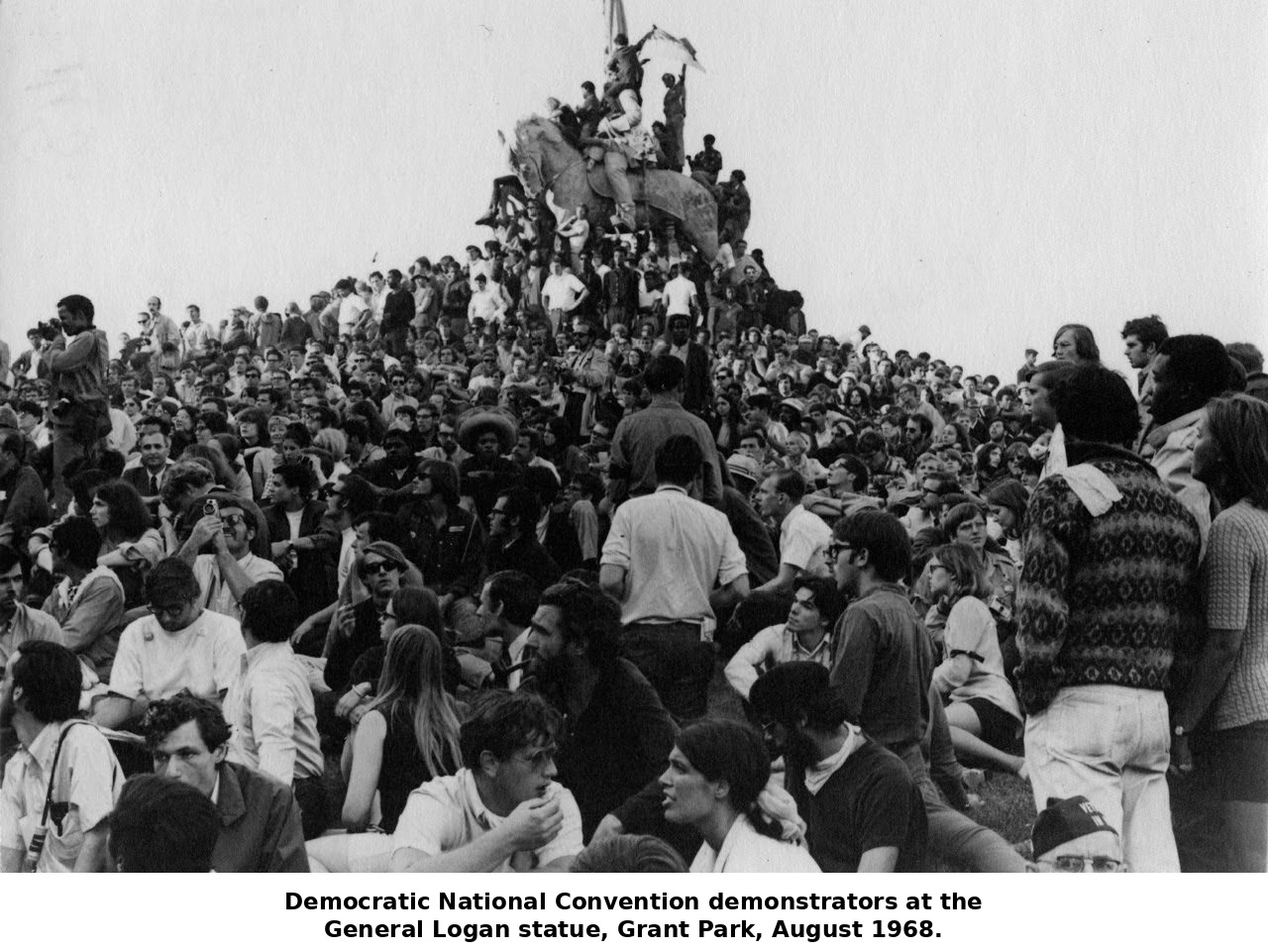

Chicago’s reputation for civic turbulence crested later that same year, when the city hosted the Democratic National Convention in August 1968. The nation was already reeling from King’s assassination in April and Robert F. Kennedy’s in June, and the convention itself was consumed by the party’s split over the Vietnam War. Thousands of antiwar protesters, Yippies, and student activists gathered in Grant Park and around the Conrad Hilton hotel. Over several nights that August, in full view of television cameras, Chicago police clashed violently with demonstrators, tear-gassing and beating protesters, bystanders, and journalists alike. A subsequent federal commission would later label the events a “police riot.” The images broadcast worldwide, with chanting crowds, riot police wielding batons, a haze of tear gas along Michigan Avenue, cemented an image of Chicago as a city of both raw political power and unresolved violence. This was an image the Daley administration spent years trying to counter.
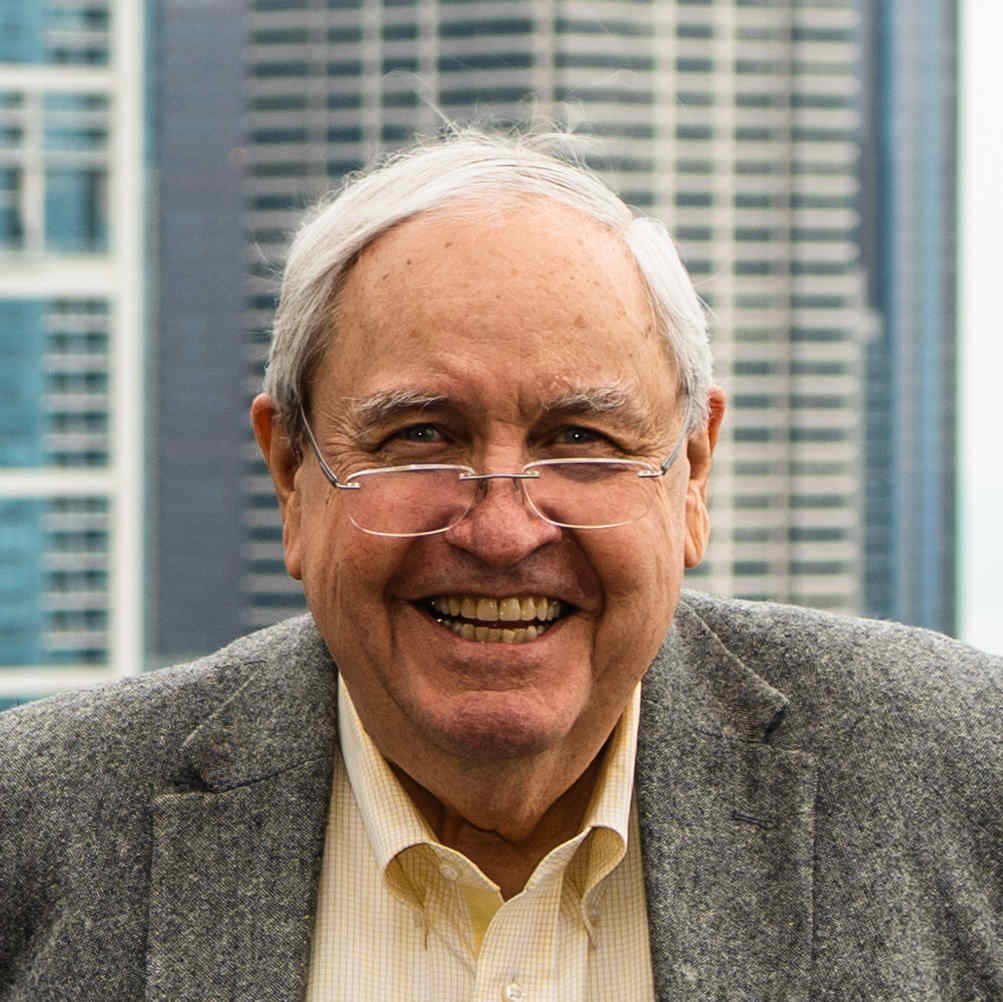
The convention’s violence carried a personal dimension for at least one figure who would later chronicle it. Both William J. Bowe and Bernardine Dohrn were 1967 graduates of the University of Chicago Law School. Dohrn had by the summer of 1968 risen to Interorganizational Secretary of Students for a Democratic Society (SDS), whose activists helped drive the antiwar mobilization that converged on Chicago that August for the Democratic Convention. Within a year Dohrn would lead SDS’s “action faction” into founding the Weather Underground, a group Encyclopædia Britannica describes as having “sought to advance communism through violent revolution” and having called on America’s youth to “bring about [the government’s] downfall.”
Bowe’s chapter in his memoir Riots & Rockets, “Bernardine Dohrn, The SDS Revolutionaries Then and Now,” traces her path from being a first-year student who “stood out with both her miniskirts and her politics” to the 1970 fugitive from justice named to the FBI’s Ten Most Wanted list. Bowe found himself tracking her radicalization in real time in the 1960s as an Army counterintelligence agent at the Pentagon assigned to assess the likelihood of domestic unrest serious enough to require federal troop deployments.
A year after the convention, before dawn on December 4, 1969, Chicago police working for State’s Attorney Edward Hanrahan raided a West Side apartment and killed Illinois Black Panther Party leader Fred Hampton. Evidence soon showed nearly all the shots came from police. The case became a lasting symbol of the era’s policing, and the city and county later paid a settlement to the survivors.
The Factories Close
Even as these political dramas played out, a quieter but equally transformative process was underway in Chicago’s economy. The manufacturing base that had built the city, steel mills along the Calumet River, meatpacking (the Union Stock Yards finally closed in 1971), garment and metalworking shops, rail-car and machinery plants, all began a steep decline through the 1970s and into the 1980s. National deindustrialization, driven by foreign competition, automation, and the relocation of factories to the Sun Belt and overseas, hit Chicago’s South Side and Southeast Side especially hard.
The closure of the massive Wisconsin Steel plant in 1980 and the contraction of U.S. Steel’s South Works through the 1980s eliminated tens of thousands of union jobs that had sustained entire neighborhoods for generations. The economic fallout deepened poverty and population loss on the South and Southeast Sides in particular. This compounded the effects of segregation and disinvestment that had already concentrated hardship in Black neighborhoods. By the early 1980s, Chicago’s unemployment and fiscal problems were severe enough that the city’s long-term survival as a major economic center was an open and anxious question.
In the fall of 1982, seven people in and around Chicago died after taking Extra-Strength Tylenol capsules laced with cyanide. The killer was never caught. Johnson & Johnson pulled every bottle from store shelves nationwide, and the case led to the tamper-evident packaging now found on nearly every medicine.
Harold Washington’s Breakthrough
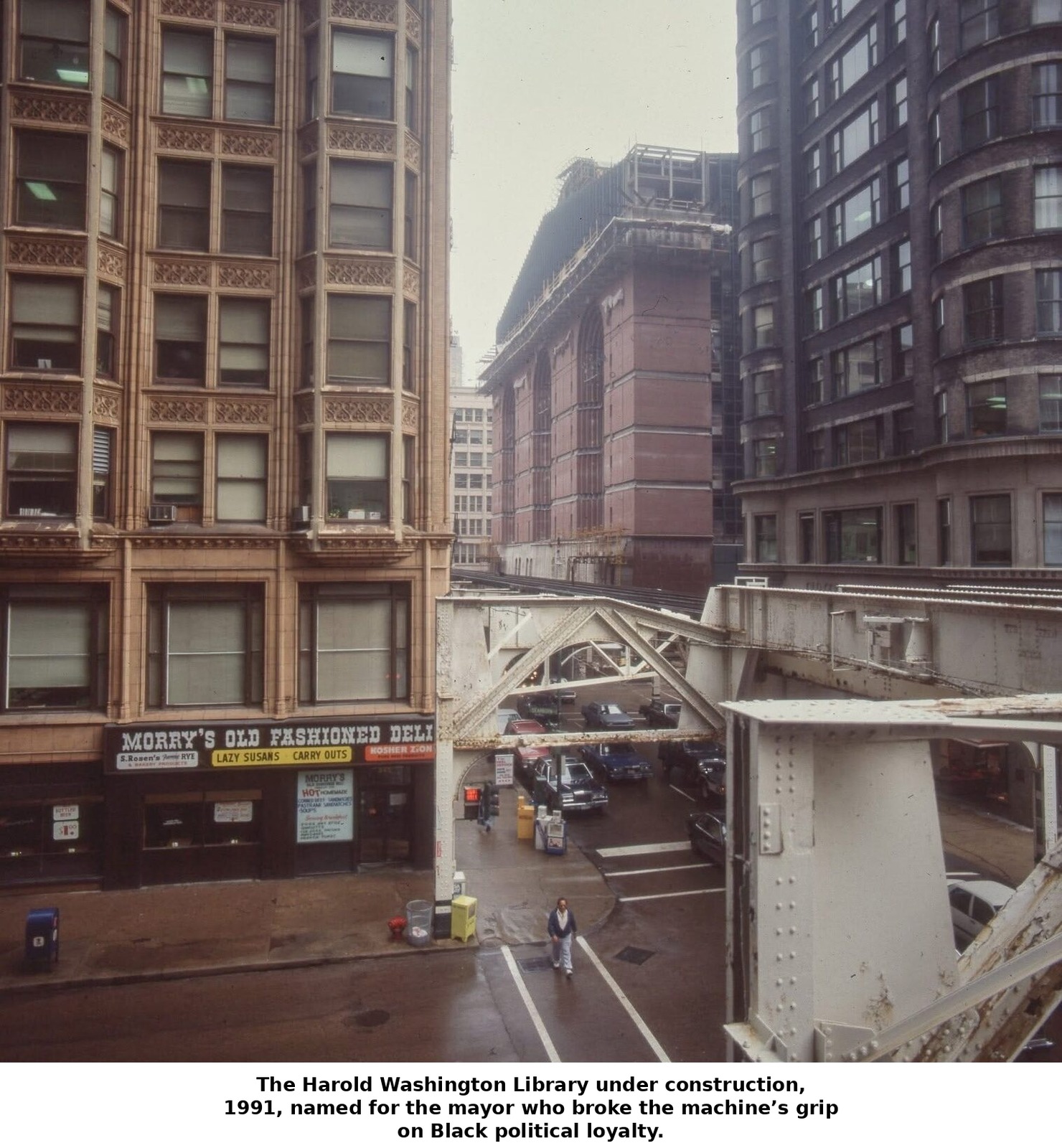
It was against this backdrop of economic distress and racial grievance that Chicago elected its first Black mayor. Richard J. Daley had died in office in 1976, and a rapid succession of mayors followed, including Jane Byrne, the city’s first female mayor elected in 1979. In 1983, Congressman Harold Washington won a hard-fought three-way Democratic primary against Byrne and Richard M. Daley, the late mayor’s son, riding an unprecedented mobilization of Black voters along with support from Latino and liberal white constituencies. His general election victory that April made him Chicago’s first Black mayor and a landmark figure in American urban politics.
Washington’s first term was consumed by what became known as the “Council Wars.” A bloc of white aldermen loyal to the old machine blocked much of his agenda in the City Council. Only after a 1986 special election shifted the balance did Washington gain working control of the council. He was reelected in 1987, but died of a heart attack that November, less than a year into his second term. This cut short a mayoralty that had nonetheless permanently broken the machine’s grip on Black political loyalty and opened city government to a wider circle of Chicagoans.
Patronage, the Shakman Decrees, and the Council Wars
The machine Richard J. Daley inherited from the Kelly-Nash organization ran on a single currency, patronage jobs. Tens of thousands of such jobs across city and county government were awarded and withdrawn by precinct captains in direct proportion to how reliably a block of voters turned out on election day. That system faced its first serious legal challenge in 1969, when an independent political candidate named Michael Shakman sued to stop it, arguing that conditioning public jobs on political loyalty violated the constitutional rights of both employees and the candidates they were never free to support.
The resulting consent decrees, first entered in 1972 and steadily expanded over the following decades, gradually outlawed politically motivated hiring, firing, and promotion across most city and county positions. This was a slow-moving legal siege that took direct aim at the mechanism Daley’s machine depended on most. Full compliance remained an open struggle for years after the relevant court decisions.
The machine’s weakened but still formidable resistance to change showed itself most vividly after Harold Washington’s 1983 election. That’s when a bloc of twenty-nine white aldermen led by Edward Vrdolyak and Edward Burke, quickly nicknamed the “Vrdolyak 29,” used their council majority to block Washington’s committee appointments, budgets, and legislative agenda almost item by item. It plunged City Hall into the prolonged legislative stalemate the press dubbed the Council Wars. The deadlock finally broke only after a federal court, ruling that the city’s ward map had been racially gerrymandered, ordered a 1986 special election in seven wards. The results flipped the council’s balance and gave Washington, for the first time, a working majority to govern with.
Richard M. Daley and a Post-Industrial City
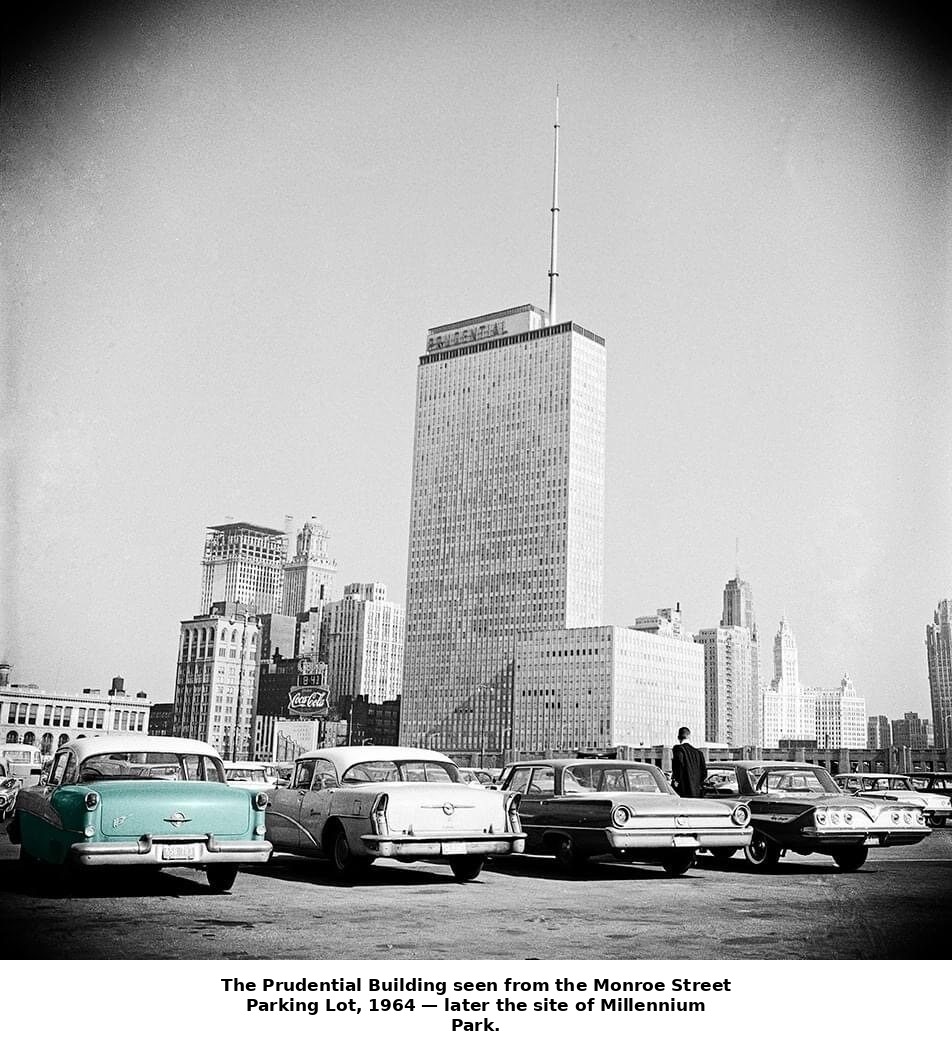
After a brief interim mayoralty by Eugene Sawyer, Richard M. Daley won election in 1989. This began a twenty-two-year tenure that would remake Chicago’s economy and physical form once more. Where his father had governed an industrial city and built public housing towers, the younger Daley presided over their eventual demolition. He launched the Chicago Housing Authority’s “Plan for Transformation” in the early 2000s that tore down Cabrini-Green and the Robert Taylor Homes. Through the 1990s, his administration pursued redevelopment of the Loop and Near North Side, promoted downtown residential conversion, courted corporate headquarters and financial firms, and invested heavily in tourism, culture, and public amenities. This was a strategy that accelerated the city’s shift from a manufacturing economy to one centered on finance, services, and hospitality.
On April 13, 1992, river water began pouring into the forgotten freight tunnels beneath the Loop through a breach near the Kinzie Street bridge, where new pilings had been driven. Basements flooded, the power was cut, and downtown was evacuated for days. It took weeks to pump the tunnels dry, and the losses ran to nearly $2 billion.
In mid-July 1995, temperatures above 100 degrees and stifling humidity settled over the city for days. More than 700 people died, most of them elderly, poor and living alone. The disaster exposed how isolated many Chicagoans had become and led the city to open cooling centers and check on vulnerable residents in every heat emergency since.
Neighborhoods near downtown that had been disinvested for decades, including parts of the Near North and West Loop, saw substantial private investment and gentrification. This occurred even as many South and West Side communities continued to struggle with the legacies of deindustrialization and segregated public housing. By 2000, Chicago’s economy and skyline bore little resemblance to the industrial city of 1951. The transformation set the stage for the redevelopment projects, including Millennium Park and the 2016 Olympic bid, that would define the city’s next chapter.
The Blues Goes Electric, and House Music Is Born
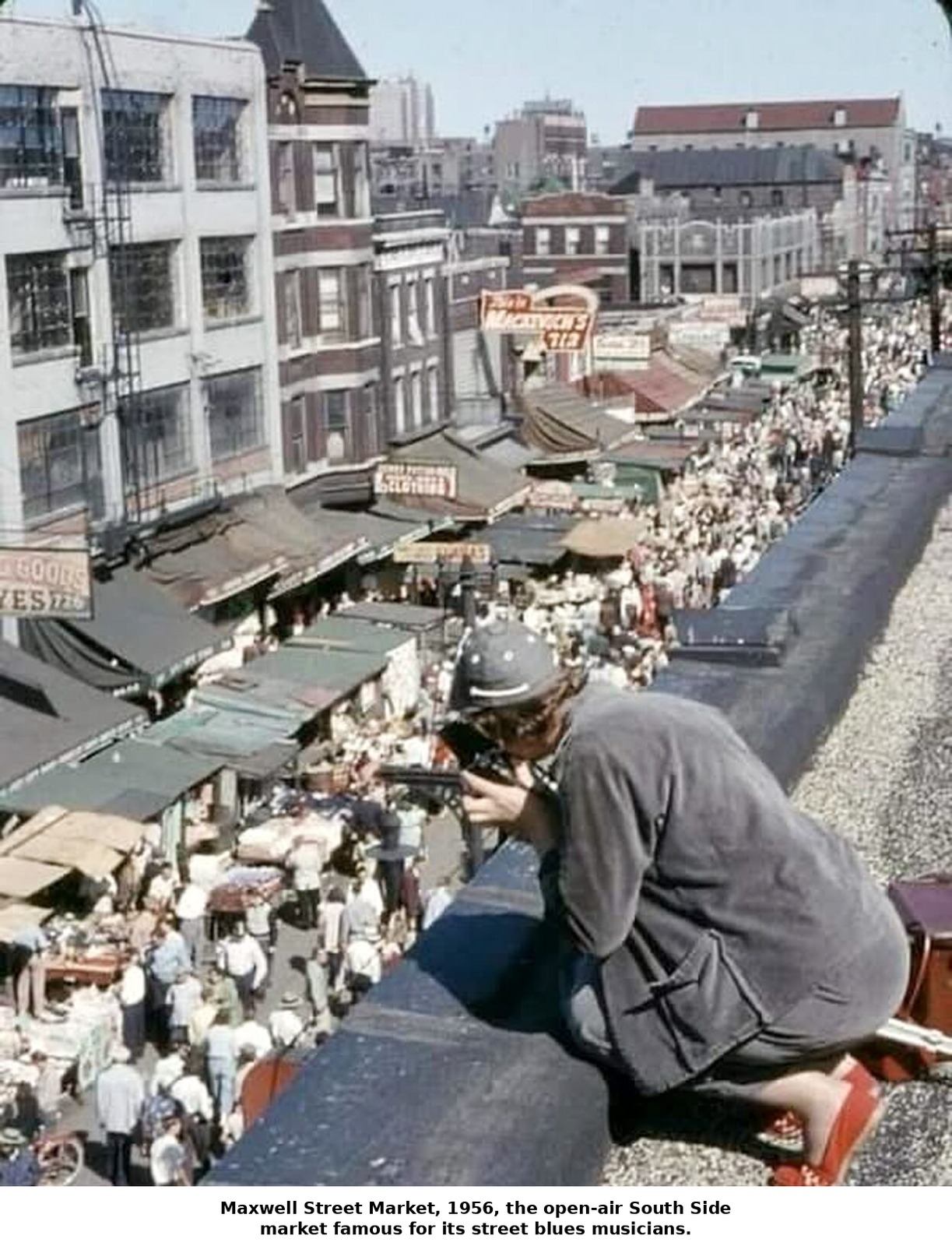
Chicago gave the twentieth century two entire genres of music, fifty years apart. Both were born in unglamorous rooms on the South and West Sides. McKinley Morganfield, known to the world as Muddy Waters, arrived from the Mississippi Delta in 1943 hoping to work as a full-time musician. He found that an acoustic guitar simply couldn’t be heard over a noisy Chicago club. “When I went into the clubs, the first thing I wanted was an amplifier. Couldn’t nobody hear you with an acoustic.” His 1948 single “I Can’t Be Satisfied,” cut for the newly formed Aristocrat label, sold out its first pressing in a single day. This gave the label’s founders, the Polish-immigrant brothers Leonard and Phil Chess, the sound that would define Chess Records after they renamed it in 1950.
Chess became the workshop where Delta blues turned electric and urban, recording Muddy Waters, Howlin’ Wolf, Little Walter, Willie Dixon, Sonny Boy Williamson, Etta James, and Chuck Berry. Its records crossed the Atlantic to reshape British rock. The Rolling Stones took their name from a Muddy Waters single, and both they and Fleetwood Mac counted themselves direct disciples after a galvanizing 1958 Muddy Waters tour of England.
On July 12, 1979, radio host Steve Dahl blew up a crate of disco records on the field at Comiskey Park between games of a White Sox doubleheader. Thousands of fans stormed the field, and the Sox had to forfeit the second game. Disco was declared dead, but in South Side and West Loop clubs like the Warehouse, DJs such as Frankie Knuckles were already turning it into house music.
Three decades later, a different Chicago dance floor produced a second genre from scratch. The Warehouse, a members-only West Loop club that opened in 1977, hired the DJ Frankie Knuckles as its musical director. Through the early 1980s, Knuckles built sets that spliced disco records with European electronic music and a harder, more mechanical beat, played for a crowd rooted in the city’s Black and gay club culture. Regulars started asking record shops for the kind of music they’d heard “at the Warehouse.” By the mid-1980s, Chicago DJs and bedroom producers were pressing their own “House” records and shipping them worldwide. The building itself was designated a Chicago Landmark in 2023, and the city renamed its block Frankie Knuckles Way in his honor.
Second City, Steppenwolf, and a New Chicago Stage
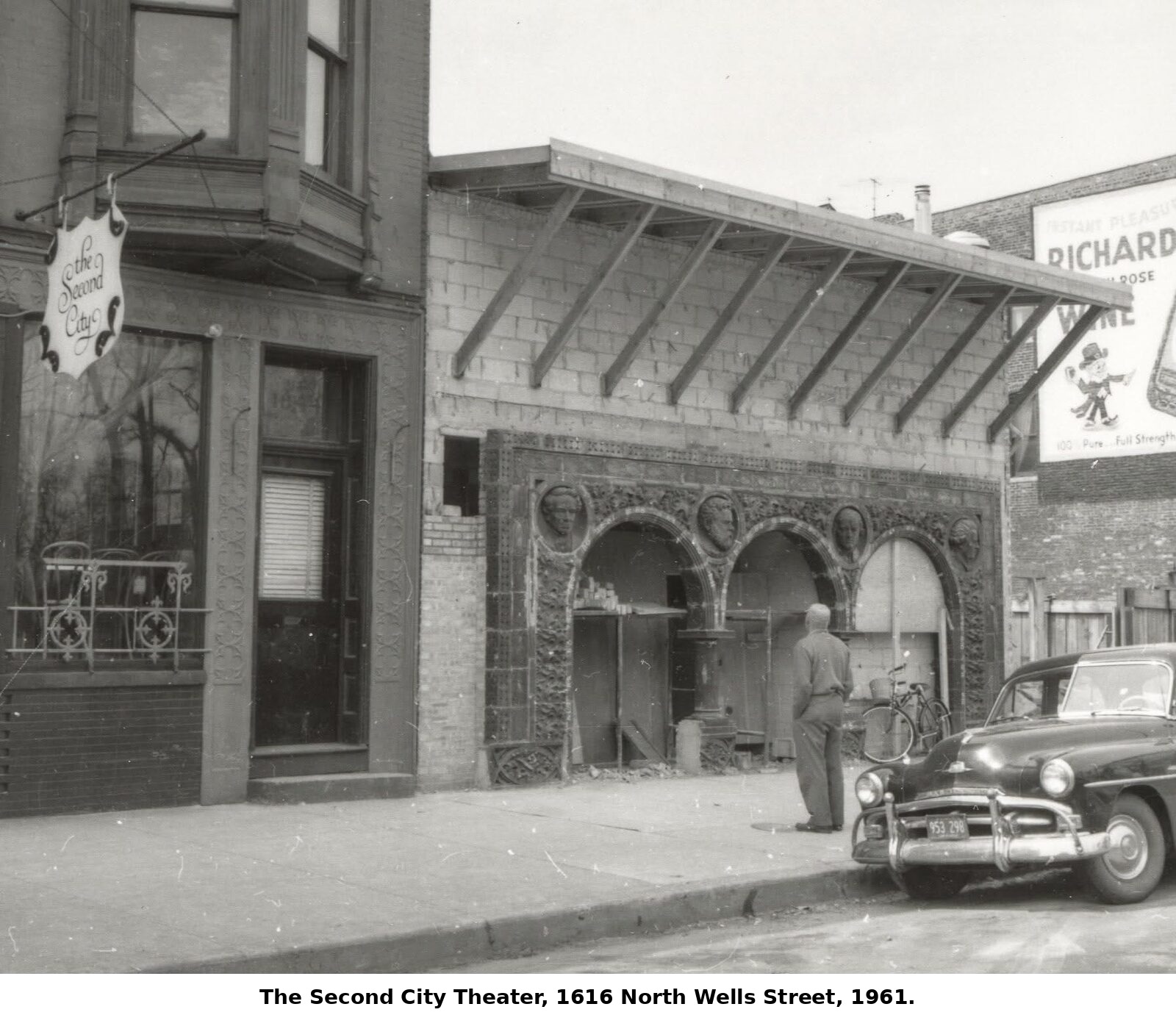
Chicago also reinvented American comedy and, separately, American acting in these decades. The Second City opened its doors at 1842 North Wells Street on December 16, 1959. It was founded by Paul Sills, Bernard Sahlins, and Howard Alk and grew out of the University of Chicago’s earlier Compass Players group. It built on the improvisational “theater games” developed by Sills’s mother, Viola Spolin. Its satirical revues were aimed squarely at the conformity of the era and quickly became a launching pad rather than a destination. Alumni over the following decades included Alan Alda, Joan Rivers, John Belushi, Bill Murray, Dan Aykroyd, Chris Farley, Mike Myers, Tina Fey, Stephen Colbert, and Amy Poehler. They formed an unbroken line running from a Chicago storefront stage to Saturday Night Live and well beyond it.
Fifteen years later, three young actors named Terry Kinney, Jeff Perry, and Gary Sinise staged their first production in a suburban Highland Park church basement in 1974. They named their new company Steppenwolf after the Hermann Hesse novel one of them happened to be reading. Steppenwolf’s raw, ensemble-driven realism came to include John Malkovich and Laurie Metcalf. The company built a national reputation from the ground up. By 1991, the company had moved into its own purpose-built home on North Halsted Street, and was sending a string of its productions on to Broadway along the way.
Bellow, Terkel, and Chicago’s Postwar Voice
Chicago’s novelists and journalists found an equally distinctive postwar voice. Saul Bellow, who had arrived from Montreal as a child, opened his 1953 breakthrough novel The Adventures of Augie March with the declaration “I am an American, Chicago born,” and went on to win the Nobel Prize in Literature in 1976. Studs Terkel spent decades coaxing ordinary Chicagoans to tell their own stories, first on his long-running WFMT radio program and then in oral histories like Division Street: America (1967), and The Good War (1985), which won the Pulitzer Prize.
Roger Ebert, who joined the Chicago Sun-Times as film critic in 1967, became in 1975 the first film critic ever awarded the Pulitzer Prize. His televised sparring with the Chicago Tribune’s Gene Siskel made “two thumbs up” a household phrase. A younger generation carried the tradition forward. Practicing attorney Scott Turow turned his own Harvard Law School diary into the bestseller One L (1977) before reinventing the legal thriller with Presumed Innocent (1987), while Stuart Dybek’s story collections captured the working-class alleys of Pilsen and Little Village and, in 2007, earned him a MacArthur Fellowship.
The Hairy Who and the Uptown Poetry Slam
Chicago’s visual artists and poets built their own scenes just as deliberately outside New York’s shadow. In 1966, six recent graduates of the School of the Art Institute, Jim Falconer, Art Green, Gladys Nilsson, Jim Nutt, Suellen Rocca, and Karl Wirsum, began exhibiting together at the Hyde Park Art Center under the name Hairy Who. They were showing loud, cartoonish, deliberately un-cool paintings drawn from sources as varied as Surrealism, mail-order catalogues, and medical illustrations. The group disbanded after three years, but it touched off a broader, decade-long wave of exhibitions, Nonplussed Some, False Image, and others, that critics later grouped together as the Chicago Imagists, a body of work as strange and specific to the city as the blues or the skyscraper.
Chicago’s literary scene found an equally scrappy, equally lasting home when the poet Marc Smith started a Monday-night open mic at the Get Me High Lounge in Bucktown in 1984. On July 25, 1986, he hosted what he called a poetry “slam,” reading aloud judged, competitively, by audience members pulled at random. The show moved to the Green Mill, the old Uptown jazz lounge on North Broadway, where the Uptown Poetry Slam ran every Sunday night and became the acknowledged birthplace of slam poetry as a national and international art form.
A Half-Century of Reinvention
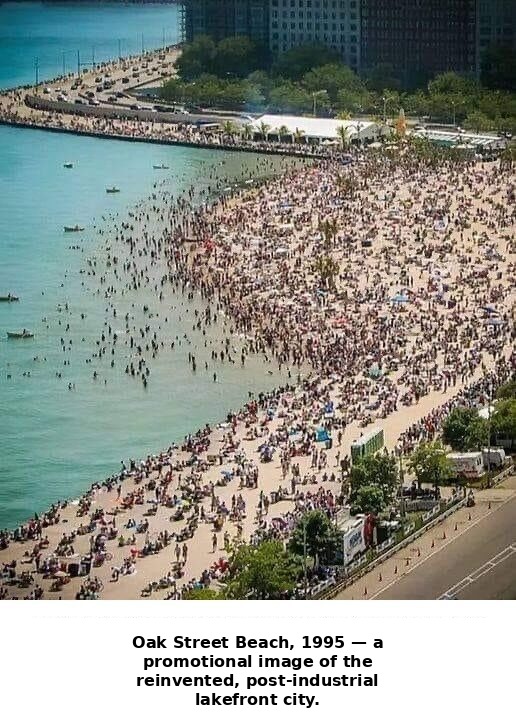
By the year 2000, Chicago had survived the loss of its old industrial identity and the trauma of its racial and political conflicts to emerge, however unevenly, as a global city. It was prosperous and had rebuilt its downtown, but it was still grappling on the South and West Sides with choices its leaders had made along the way. Going from an industrial powerhouse organized around a disciplined political machine, factories, and rail yards into a post-industrial center defined by finance, tourism, and service was not a smooth transition.
It was driven by highways that hollowed out neighborhoods even as they built suburbs, by a mayor whose iron control of city government also produced the housing towers that concentrated a generation of poverty, by a civil rights movement that exposed how thoroughly segregation had been built into Northern urban life, and by the shock of deindustrialization that emptied out the manufacturing jobs that had sustained the city’s working class. It was also a half-century of hard-won political change, culminating in Harold Washington’s election, and of eventual civic reinvention under Richard M. Daley, as Chicago repositioned itself for a service and information economy.
Further reading: Mike Royko, Boss: Richard J. Daley of Chicago (1971); Adam Cohen and Elizabeth Taylor, American Pharaoh: Mayor Richard J. Daley — His Battle for Chicago and the Nation (2000); Arnold R. Hirsch, Making the Second Ghetto: Race and Housing in Chicago, 1940–1960 (1983); Isabel Wilkerson, The Warmth of Other Suns: The Epic Story of America’s Great Migration (2010); Gary Rivlin, Fire on the Prairie: Chicago’s Harold Washington and the Politics of Race (1992); William J. Bowe, Chapter 3, Riots & Rockets (2024); William J. Bowe, Bernardine Dohrn and John Ashcroft Look Back (2022); Ann Durkin Keating, Chicago Neighborhoods and Suburbs: A Historical Guide (2008); Chicago Department of Aviation, O’Hare History; Paul Kleppner, Chicago Divided: The Making of a Black Mayor (1985); Paul M. Green and Melvin G. Holli, eds., The Mayors: The Chicago Political Tradition; History.com, St. Lawrence Seaway Officially Opened; Encyclopaedia Britannica, St. Lawrence Seaway; Congressional Research Service, Shipping on the Great Lakes and St. Lawrence Seaway: An Update; Illinois Rock & Roll Museum, Chess Records; NPR, From the Warehouse to the World: Chicago and the Birth of House Music (2023); The Second City, Alumni & Comedy History; Steppenwolf Theatre Company, History & Founders; Art Institute of Chicago, Hairy Who? 1966–1969; Poetry Foundation, Marc Kelly Smith.
Photo Sources: Cabrini-Green high-rises, 1958 — Getty Images archival photograph (March 24, 1958); 1968 Democratic National Convention demonstrators, Grant Park — Chicago History Museum (photograph by Peter Bullock, ICHi-050772); Anti-war protesters at the Logan statue, 1968 — Photo by Lawrence Okrent, CD; Harold Washington Library under construction — Chicago Public Library Archives (Peter Fish Studios construction photographs, 1988–1991). Photographer Mildred Mead photographing the Maxwell Street Market — Mildred Mead Photographic Collection, University of Chicago Library. Internet sources of other photos are not identified.