
Chapter Seven: Bowe Family History and Personalities
Chapter Seven of “Gus and Julia Bowe, Remembered”
As told by William J. Bowe, drawn from his January 29, 2021 interview with his cousin Tony Bowe.
Table of Contents
Bowe Family History & Personalities
Ellen Canavan Bowe at Lyon & Healy
Ellen Bowe & Education: Gus Reads Ibsen & Dickens
Hart’s Memoirs: Gus, Bill, Ellen & John Canavan
Julia & Mary Bowe & Their Formidable Mother-in-Law Ellen Bowe
Relations Among the Siblings: Gus, Bill & Anna
Gus & Julia & the Kids: Home Alone? or Dumped with Bill & Mary
Summary
This chapter traces the Bowe family back to its Irish immigrant roots with Moses Bowe and Honora Hurley, through John Joseph Bowe and Ellen Canavan Bowe, the formidable matriarch who raised Gus and Bill after their father’s early death and insisted on their education. It also covers the brothers’ short-lived Mission Art Company, family recollections from cousin James Austin Hart, and Julia’s own account of marrying into the family in 1926.
The Narrative
Bowe Family History & Personalities
We know less about the Bowes than about Gus and Bill’s mother’s family, the Canavans. This mostly had to do with the Canavans being more prolific than their father John Bowe’s family. What we do know about the Bowes comes largely from two books: Julia’s, The Generations and her memoir Julia and Gus, and my mother’s book of family trees and stories, The Families.
Moses Bowe & Honora Hurley
Moses Bowe & Honora Hurley
Gus and my father’s grandfather, Moses Bowe, was born in Ireland and orphaned at eleven. An uncle in America sent for him, and he came over young, ran away from that uncle before long, and worked as a laborer helping dig the Erie Canal. Later, he worked for the Illinois Central Railway, which reached Kankakee in 1853. He settled in nearby Monee, Illinois, and married Honora Hurley, who ran a boarding house there for railway workers. Not long after they married, Honora’s brother Patrick, a recent immigrant, was drafted and killed at the Battle of Chattanooga during the Civil War. The government bounty that followed his death let Moses and Honora buy a farm near Peotone, Illinois where their children grew up. Moses and Honora’s son, my grandfather John Joseph Bowe, had two brothers, Philip and Michael, and a sister, Agnes, who married John T. Rice. I never knew anything more about these Bowe ancestors.
John Bowe & Ellen Canavan
John Bowe & Ellen Canavan
The real turn in the Bowe family’s fortunes came when John Joseph Bowe married Ellen Frances Canavan, daughter of Anthony and Ann Hughes Canavan. Ellen had grown up not far from John Bowe’s home in Sumner Township, Kankakee County. Bowe first worked as a telegraph operator for the St. Paul Railroad, and the job took the newlyweds out to Salt Lake City after they married. John Bowe had promised Ellen that if she ever got too homesick, they’d move back east. Eventually they did, settling at 1239 North Ashland as their children began arriving. Around the turn of the century, John Joseph Bowe developed tuberculosis, and later ulcers, which killed him in 1910. I still have some of the correspondence between him and my father from that period. It is written in a formality that sounds very foreign to modern ears.
Ellen Canavan Bowe at Lyon & Healy
Ellen Canavan Bowe at Lyon & Healy
Ellen Canavan Bowe was a real pistol. She was called “Lib” by the family, and was a real go-getter with an entrepreneurial drive she clearly passed on to her sons. Beyond simply keeping food on the table, her most important contribution was insisting her children get an exceptional education. The importance of education was certainly front of mind for both Gus and Bill as they raised their own children later. Their sister Anna, after her own schooling, worked as the Bowe & Bowe receptionist. Even before her husband John Bowe died, Ellen was selling insurance for New York Life. After 1910, it became the family’s only income. She would take my young father out with her in the evenings on her sales calls to Irish families in the neighborhood. He’d stand by silently as his mother, a widow with children of her own at home, made her case for the value of life insurance. The sales pitch more or less spoke for itself. My mother recorded another story that captures Ellen’s same spirit. Ellen, standing outside a music store on South Wabash, likely the Lyon and Healy store, struck up a conversation with a stranger who was looking at a piano in the window. She convinced him she could get him a better price than he’d get on his own. She went in, negotiated a good price, and took a cut of the savings for her trouble. That instinct, of not waiting to be told what to do, but figuring things out and going, was a trait that ran straight through from her to Gus and my father.
Ellen Bowe, with John Casey & Ray & Raymond Walters
Ellen Bowe & Education: Gus Reads Ibsen & Dickens
Ellen Bowe & Education: Gus Reads Ibsen & Dickens
That same drive certainly shaped their education. Gus later described taking seven years of Greek at St. Ignatius, six of Latin, some modern history, and a little scholastic philosophy. In winter, walking the long way from Fulton Street down to Roosevelt Road and Blue Island, they’d stop at a library along the route to warm up. Warming up in a library in those days meant reading, which is how Gus could say later that he’d read all of Ibsen by the time he was twelve, and later worked his way through the whole of Dickens as an adult, a shelf’s worth, all of it.
Jim Hart’s Memoirs: Gus, Bill, Ellen & John Canavan
Hart’s Memoirs: Gus, Bill, Ellen & John Canavan
Ellen’s forceful personality wasn’t to everyone’s taste. A cousin, James Austin Hart, wrote in his own memoirs about visiting the Bowes in Chicago on a hot summer day, hoping for a swim at Oak Street Beach. He was told by Ellen, “We don’t swim in Lake Michigan. You can swim tonight at the pool in Palos Park.” He found himself driven out to the family’s summer cottage for a dip in an overcrowded public pool, a considerable letdown. Hart got along fine with the rest of the family, though, and recorded the stories Gus and my father told him about their uncle John Canavan, Hart’s own grandfather. John Canavan would bring cattle to the stockyards at dawn, sell his lot, and then walk down to meet his nephews at their law office at 127 North Dearborn Street. He took evident pleasure in telling the young lawyers they had a rather poor work ethic compared to a farmer’s morning. Hart also wrote something kinder, about my own father: “Bill Bowe was one of the nicest, kindest, most personable men I’ve ever known.” That personality is very likely why he was such a good rainmaker for the firm.
The Mission Art Company
The Mission Art Company
There’s a family story of luminous crucifixes tied to that same building on North Dearborn where the Bowe & Bowe law firm had their offices. Sometime around 1912 to 1916, before they were practicing law, Gus and my father started a side business called the Mission Art Company. It sold religious goods, portraits of Jesus and of the Sacred Heart, but their real best-seller was a luminous crucifix, infused with a phosphorescent wax that made the figure of Christ glow in the evening. It sold well to the Irish immigrant families of the neighborhood, until they tried to expand into a market in Mexico and the entire shipment melted in transit. That was the end of that particular venture, but it always struck me as a good window into how hungry and entrepreneurial they were, a trait straight from their mother, and a family that badly needed whatever help necessity could offer.
Julia & Mary Bowe & Their Formidable Mother-in-Law Ellen Bowe
Julia & Mary Bowe & Their Formidable Mother-in-Law Ellen Bowe
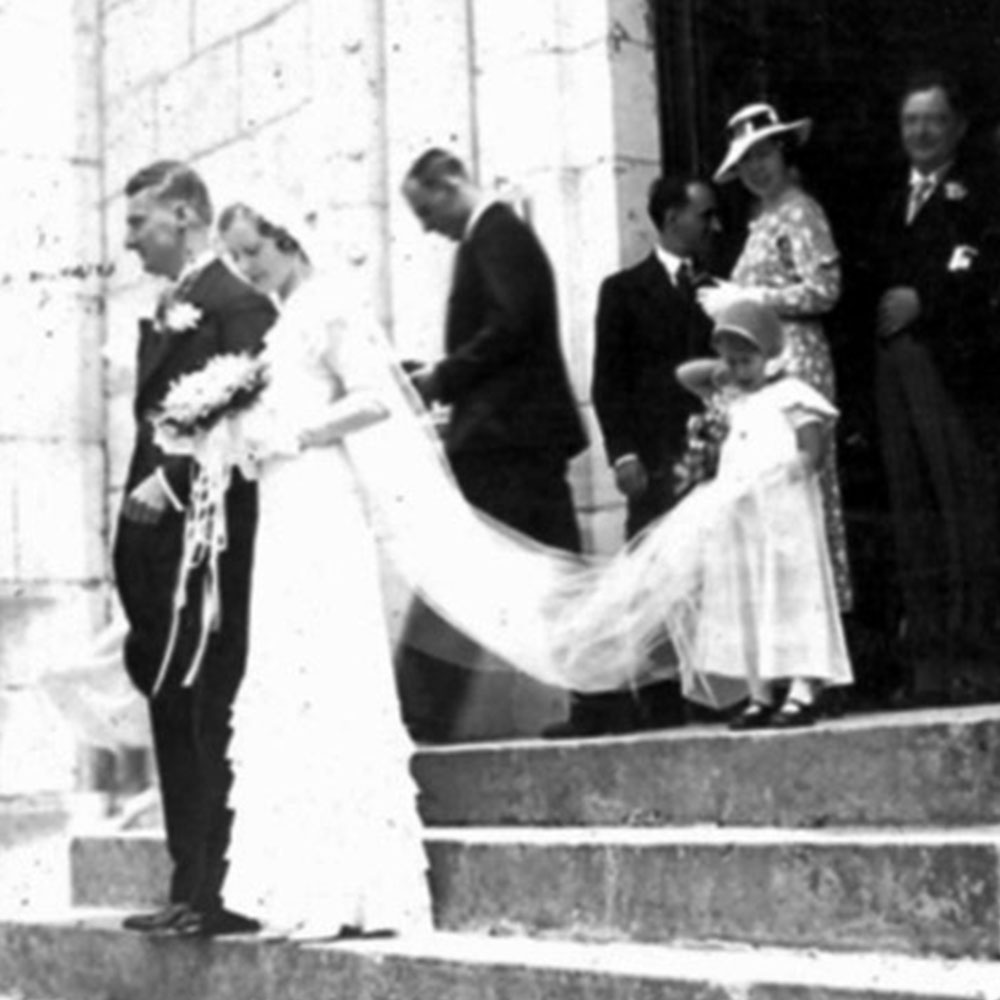
Neither Julia nor my mother ever said an unkind word to me about their mother-in-law, but reading between the lines, it was clear Ellen was queen of the roost. She would always get her way with her sons over the wishes of the two perfectly nice, well-educated young women who had married into the family. From Ellen’s point of view, however nice they were, neither had actually raised Gus and my father out of poverty and turned them into successes. That had been Ellen’s doing, and she expected some return on it. I wrote about this once in the preface to Julia’s memoir, Julia and Gus, where Julia recounted that the only word of caution she ever heard before marrying Gus came from her own father. Her father told her he’d been patient with all of his wife Mabel’s relatives, but that marrying into the Bowes would take every bit of patience she had where Mabel’s sister Ellen Canavan Bowe was concerned. Mr. Lecour doubted the wisdom of it, but said he’d back her if she went in with her eyes open. In Julia’s own words, she and Gus married in Chicago in 1926 and moved into 4D, on the fourth floor, with Ellen and my father on five above them. “It was a crazy idea,” she said later, “but I was young and naive.”
Julia & Mary Bowe: Over the Years
Relations Among the Siblings: Gus, Bill & Anna
Relations Among the Siblings: Gus, Bill & Anna
My father and Gus stayed close as brothers throughout, bound together by the family business in a way that was common enough then, even if it’s harder to imagine now. Their sister Anna, who worked as the firm’s receptionist for a period, was very much part of that dynamic. My mother used to say that if you told Anna it was a beautiful, sunny day, she’d allow it was true, but that it could always be raining tomorrow. I never knew her well, nor her husband Raymond Joseph Walters. I knew their son, Raymond Bowe Walters, much better. He was a very nice fellow, though a good deal older than me.
Gus & Julia & the Kids: Home Alone? or Dumped with Bill & Mary
Gus & Julia & the Kids: Home Alone? or Dumped with Bill & Mary
As for Gus and Julia as parents, I’m not really a good witness. Both of their children were grown and out of the house by the time I came of age. My cousin John graduated high school in 1946, when I was four, so I never watched that parenting happen directly. I only heard secondhand from my mother about what John or Julie Anne were up to. What I can say is that my mother and Julia remained close friends for the rest of my mother’s life, and even ended up living together again. They were roommates once more when Julia moved into what had been my own childhood apartment at 1120 in the late 1960s. Both were born in 1901, Julia in Kankakee and my mother in Baltimore, and both were classmates and roommates at Trinity College, class of 1923. Julia had introduced my father to my mother during those years. And, after they were both widowed within a month and a half of each other, both were sensible about their finances. Julia sold 4D and moved into 4B with her old roommate. Class of ’23, together again.
The Family Struggles
← Previous: Chapter Six · All eight chapters and the video record · Next: Chapter Eight →