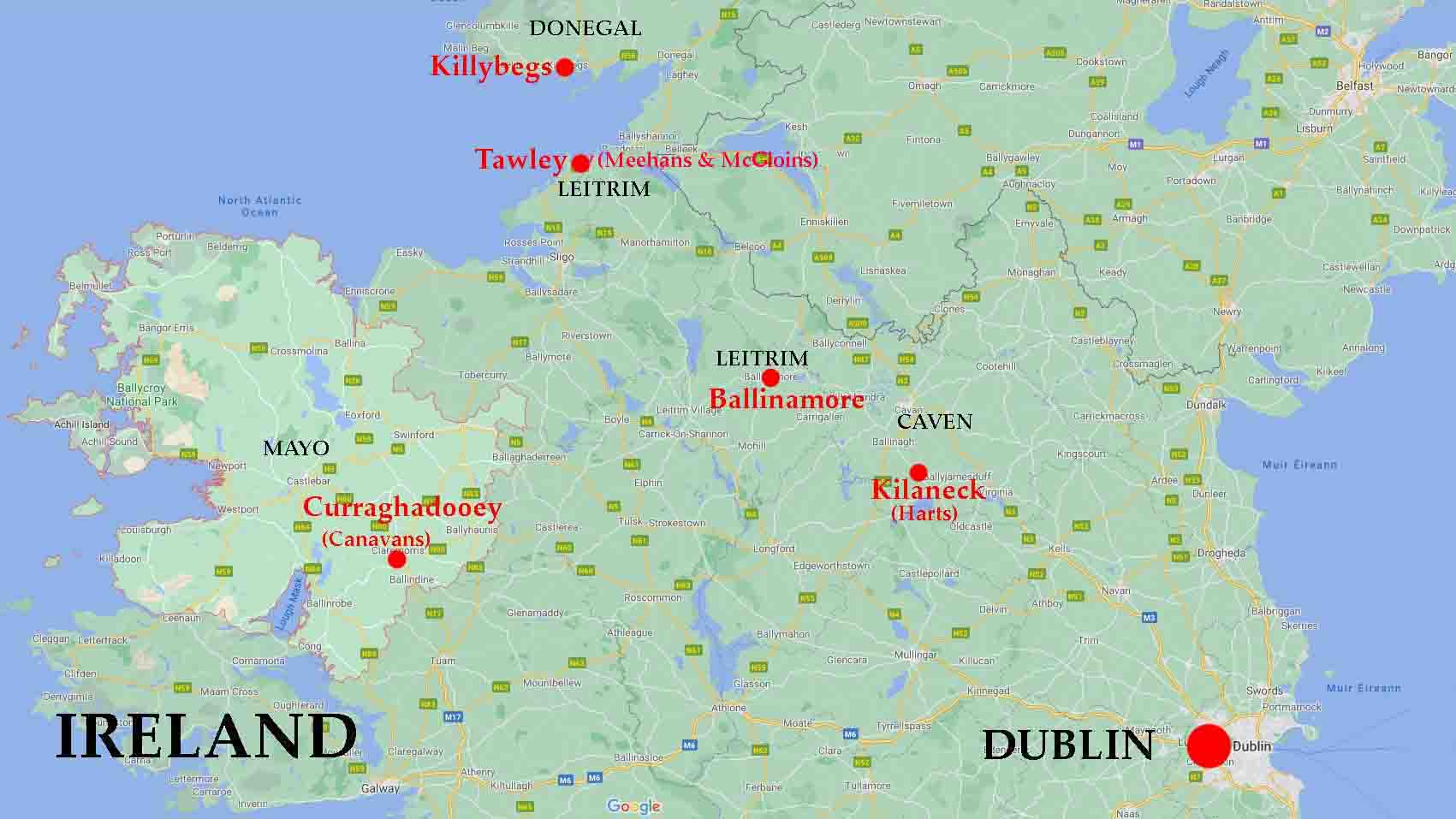
Joe Hart’s Meticulous Research Notes and Jim Hart and Mary Bowe’s More Narrative Forms of Family History
Editor’s Note: I invited Joe to add anything else about his process, and he offers advice for beginners: check whether a family member has already done the work, and decide what a finished result would look like — a long line of names, or a narrative like my mother’s The Families and his Uncle Jim Hart’s memoirs. Joe describes his own work as academic note-taking with careful source citations rather than literary. I point out that those years of notes now feed the 500-to-600-page digital books on the Canavan descendants, with photographs and hyperlinks, and suggest that extracting bite-sized pieces of that mass of facts is the easiest path to a narrative form.
Transcript
Speakers: WJB — William J. Bowe; JH — Joseph Hart. Transcribed from the recording; punctuation added and obvious mis-hearings corrected.
WJB: So maybe — we’ve been going on for a while. Would you like to enlighten me on something else in this area, either your own family history or the processes that you think would be interesting?
JH: Yeah. Let me just add a couple of things about the process. One is, somebody who has an interest in tracing ancestors, how do they get started? One is, check with family members and see if somebody has already done all the work for you. The other thing is, even if somebody else has done some genealogy for your family, and you look at it, does that satisfy your curiosity, or do you see some way that you would like to try and advance the research that’s been done by another family member? And what is it that you’re interested in doing if you want to do some research or advance some research? What is it going to look like when you feel like you’ve accomplished something? Is it going to be just adding to a line of ancestors, just adding a lot of names? Is it going to turn out to be something like your mother did and my Uncle Jim did, where they take — and admittedly, they were taking oral history and turning that into a narrative. That’s quite interesting to read. Most of my research up to this point has just been adding names and taking notes, making citations for sources and that kind of thing, turning it into more of an academic thing than a literary thing.
WJB: If I might pause for a moment on your note-taking, if I may. One of the things that — when you shared that portion of your tree with me, and I plugged it into the tree and the software that I had plugged in at an earlier time all of my mother’s research, when I took hers from the analog world to the digital world. One of the things that happened when I imported it into the current software that I use for that is there was a new tool — and you can see the result, I’m sure you’ve looked at it on the website — that lets you print out, create a PDF file, a digital file that can be printed out in book form if you’re so inclined. And there are two works that were created that are fundamentally regurgitations of your careful research and note-taking. One is The Descendants of Anthony Canavan and Catherine Kirby, and the other is the history of his son, The Family Tree of Anthony Canavan and Ann Hughes — our Sr., if you will, of the two. And those notes now can be integrated and are integrated in these digital books. They’re, I think, 500 to 600 pages long, and after the family trees, into which there are integrated photographs so that it helps to bring these names alive — you see what somebody looked like in many, many cases. But these notes that now are able to be easily seen and accessed through the hyperlinks that let you move around easily through a mass of data, all thanks to the modern era. My point here is that all of those years of the careful note-taking that you did now just have put a feast of family data of the most particular informative detail out there for those that are curious about that stuff.
JH: Right. And I need to keep that in mind, that those notes are contributing a lot of information that provides some insight into what was going on with our ancestors over time. I guess what I’ve always thought as well is that I was comparing some of my work to your mother’s work and to Uncle Jim’s work, which was a narrative. And of course, they were taking an oral history from their sources, their grandparents or whatever, and writing it down. So it naturally flowed into a narrative form for them. And the work that I was doing more naturally flowed into a note-taking format. And I don’t feel like I’ve got the literary talent that your mother or Uncle Jim had. And I’m so still devoted to the research that I think if I wanted to do something like take a portion of it, maybe — I couldn’t do it all, but take a portion and turn it into a narrative form — that I would need to take some time away from research to do that.
WJB: Yes.
JH: And I don’t know that I’m ready to do that at this point yet, but I appreciate what you’re saying, because in those reports that you can format, you can format a descendant report, or you can turn it around and do something similar that is more of a pedigree where you’re going up the —
WJB: Right.
JH: — up the family line rather than coming down. But either one of those create a report that will take the notes and plug the notes into where they need to go in the different generations, in the different family lines, and that’s amazing to me sometimes, and it’s a little intimidating at times that if I want to print something like that or format something like that to send to a new cousin that I’ve found or something — how do I send them this file with 500 pages? I mean, my God. That’s an awful lot of information.
WJB: What I’ve found is, one thing that helps, if you have it in the digital form in a typical PDF file in that transferable format, if you can move it over through a format change into a more text-oriented product, a Word product of some sort, you can grab part of it. And it’s only when you grab part of it, a little part of a sprawling family tree —
JH: Yeah.
WJB: — or a little bit of narrative or factual information in a sea of facts. If you can extract it, then you’ve gotten more to the narrative form, and it’s no longer an oral history anymore. Let’s say it’s able to be translated into a narrative a lot easier if it’s in bite-sized chunks rather than trying to eat the cake in one bite.
JH: Right. And so —