3. Tony Bowe on Adlai Stevenson, Retirement, Wall Street, Consulting, Nancy, and the Kids
Tony Bowe on Adlai Stevenson, Retirement, Wall Street, Consulting, Nancy, and the Kids
Transcript of February 17, 2026 Interview of Anthony C. Bowe (TNB) by William J. Bowe (WJB)
Table of Contents
The Stevenson Family Connection (00:00)
Adlai Stevenson and the Reverend Peale (01:22)
Tony’s Retirement from Wall Street (03:15)
Why Wall Street Is a Young Person’s Business (05:24)
Post-Retirement Consulting and Advisory Work (08:21)
Nancy’s Career (13:29)
First Chicago Leadership Succession (14:53)
Family and Children (16:50)
Moving to New York: Manhattan and Then Brooklyn Heights (17:34)
Brooklyn Heights Real Estate: 148 and 290 Hicks Street (18:51)
The Children’s Education: Packer Collegiate and Poly Prep (22:10)
Buck Hill Falls and the Pocono Mountains (24:55)
Closing (29:13)
Summary
This interview continues the ongoing conversation between Bill Bowe (WJB) and his cousin Tony Bowe (TNB). The session opens with a family anecdote connecting the Bowe family to Adlai Stevenson III (son of the two-time Democratic presidential candidate Adlai Stevenson II), whose children were roughly Tony’s age and who babysat Tony and his brother Sandy one evening at the Stevenson farm in Libertyville, Illinois. WJB then shares a well-known story about Adlai Stevenson II’s wit: when asked by a reporter what he made of the Reverend Norman Vincent Peale’s opposition to a Catholic president, Stevenson replied without hesitation, “I find St. Paul appealing and the Reverend Peale appalling.”
Tony then describes his retirement in January 2014 at age 57 after working continuously from July 1979, never taking more than a two-week vacation and attending business school at night. He explains the culture of major investment banks as a young person’s world—intensely competitive and demanding—and notes that firms have a structural incentive to turn over their senior ranks to make room for the next generation of hungry younger professionals, comparing it to professional sports.
Rather than retiring cold, Tony transitioned through a series of advisory and board positions: serving on the advisory board of a Swiss asset management company seeking to expand its U.S. institutional business; advising a startup private equity firm based in Toronto, helping it identify U.S. investors and launch successfully; and serving on the board of a publicly registered 40 Act mutual fund specializing in private equity. Together these commitments occupied roughly two days a week—enough to keep him engaged without the full-time grind he had left behind.
The conversation turns to Nancy Bowe’s career. She began at Arthur Andersen as a CPA, where in her late twenties she managed the audit of the First National Bank of Chicago. She then joined First Chicago as head of investor relations—a challenging role during the turbulent period when Continental Illinois Bank’s troubles cast a shadow over the entire banking sector. Tony and WJB briefly discuss the succession struggle at First Chicago following the long tenure of Gaylord Freeman, in which three candidates competed and the two who lost departed with their teams. Nancy later moved to Lehman Brothers in an investment banking capacity, remaining there until shortly after their daughter Kate was born in 1989.
Tony outlines his family life: three children—Kate (1989), Gus (1991, named for grandfather Augustine), and Nick (1995)—all of whom grew up in Brooklyn and remain in New York today. He describes the family’s move to New York in 1985, their initial apartment near Lincoln Center at 45 West 60th Street, and their decision to settle in Brooklyn Heights, which offered a neighborhood feel closer to Lincoln Park Chicago. He recounts the purchase of a duplex at 148 Hicks Street for $380,000 in 1987, its sale at an $80,000 loss in 1995 (a casualty of the 1987 stock market crash, the 1989 market downturn, and early-1990s interest-rate spikes), and the simultaneous renovation of a dilapidated brownstone at 290 Hicks Street that became the family home for nearly three decades. Tony and Nancy recently sold that brownstone and moved to a new high-rise apartment nearby, from which he can see two of his children’s apartment buildings.
The three children attended Packer Collegiate in Brooklyn Heights—33 tuition-years in total—leading Tony to serve on its board of trustees and later as board chair. Kate transferred to Poly Prep for high school. All three went on to good colleges and all live in or near Brooklyn today. The interview closes with a discussion of the family’s house at Buck Hill Falls in the Pocono Mountains, purchased in 1991 and still enjoyed today. Tony served stints as a board member and eventually as chairman and CEO of the Buck Hill Falls Company, the public entity that manages the community’s 5,000 acres of forest, 27-hole golf course, tennis courts, and ice-skating rink. He played a role in the decision to demolish the community’s derelict 400-room inn, which had burdened real estate values, and counts Buck Hill Falls among the enduring pleasures of his retirement years.
Interview Transcript
The Stevenson Family Connection (00:00)
WJB: Tony, did your parents ever have any relationships—as I have said, both active politically—with the politicians of the day?
TNB: Well, one anecdote that I will tell you is that my parents became friendly with Adlai and Nancy Stevenson. Adlai was the son of the presidential candidate, and he ultimately was, I think, governor of Illinois, and I think he was a senator as well.
WJB: Yes.
TNB: They were roughly the same age as my parents, and Adlai and Nancy had children who were roughly my age. At some point, my parents were going out to dinner with Adlai and Nancy, and they agreed to meet in Libertyville at the Stevenson farm. My parents left me there with the seniors—with Adlai and Nancy—and I ended up being babysat that night by Adlai Stevenson, the presidential candidate in the 1950s.
I guess it must have been myself and my brother Sandy. And then there was Adlai the Fourth, who was I think a year ahead of me and went to Latin. He was also there, and our babysitter was none other than Adlai Stevenson Junior, I suppose.
Adlai Stevenson and the Reverend Peale (01:22)
WJB: Well, that brings to mind a story that has just always stuck with me about Adlai Stevenson and his presidential runs. Of course, he ran in 1952 and 1956, and lost both times to Eisenhower. But he was still being discussed as a candidate when Kennedy was winning the primaries, and when Kennedy won the nomination, Stevenson campaigned for him. Stevenson was at a campaign event in St. Paul, Minneapolis, when a big controversy erupted because a Chicago preacher—the Reverend Norman Vincent Peale, a very prominent theologian with a large popular following—raised the question of whether the country would really be well served if a Catholic were elected president. So Stevenson was asked by a reporter what he made of Reverend Peale’s remark about Catholics not being right for the presidency. And Stevenson said right off the cuff: ‘I find St. Paul appealing and the Reverend Peale appalling.’
TNB: Clever fellow, wouldn’t you say?
WJB: Yes, that is not bad.
Tony’s Retirement from Wall Street (03:15)
TNB: I guess, just to finish up on the whole career topic—I retired at a relatively young age from full-time work. I retired in, I guess it was 2014, at the age of 57.
WJB: So that is early. Tell me something about your thought process. How long had you been thinking about that seriously, and what was going on?
TNB: Well, the fact is that I graduated from college and, as I described in our earlier conversation, I got a job in July of 1979, shortly after graduating, at Walter Heller and Company. And I worked nonstop from July of 1979 until January of 2014. I never took more than a two-week vacation. I went to business school at night. And candidly, I was rather tired at that point.
The nature of my work was such that the travel was so intense and the clients were demanding, tough, sharp people. The work environment in these large securities firms is very competitive and behavior is generally pretty aggressive.
I think I thrived in that environment. But that said, there is a limit to how long you want to do it and how long you will stay good at it. It got to the point where, at the age of 56 or 57, I was getting in the elevator in the morning surrounded by people who were 10, 20, 30, and even 40 years younger than I am. Well, perhaps not 40—but in any event, just about the oldest person in the building other than myself was the fellow who looked after the elevators. So it is a young person’s business.
Why Wall Street Is a Young Person’s Business (05:24)
WJB: Why do you think that is?
TNB: For just the reasons I mentioned. People ultimately find it too demanding in terms of the consumption of time and energy and the like. That is certainly part of it. In addition to that, it is actually in the interest of these firms to turn people over. You want a group of really hungry people in their thirties trying hard to move the ball ahead and generate profits for the firm. They have to be able to see that they are going to get to the next level up reasonably quickly, or they will scatter and do something else—go to another firm or perhaps a different corner of finance altogether. And so these big investment banks really operate in a way where, once you get to be in your mid-fifties, you are pretty much done. Candidly, it is a little bit like professional sports in that regard. You are not going to play football for the Bears in your fifties. And in the same way, you are probably not going to be working at Credit Suisse or any other large investment bank at that age either.
WJB: So what is the mechanism, besides compensation declining as an indicator that your time might be up? What keeps things going as you advance?
TNB: In most cases, at some point or another, people get fired—which did not happen in my case, perhaps because I more or less chose to exit at the point at which that might have happened. My suspicion is that had I said, ‘No, I am not going anywhere; I am going to stick it out for another few years,’ I eventually would have been shown the door. I could very easily have gone and obtained another job—particularly with a large asset management firm or one of the big private equity platforms—and I had several conversations with people about doing exactly that.
But the fact is that I simply did not want to jump back in with both feet and start working like mad again. It has to be all in, because if you are not fully committed, someone else will be. It is a little bit like these big law firms here in New York City, and I am sure in Chicago as well. The fact of the matter is that they are pushing people out the door in most cases by the time they are 65, and in many cases younger, for exactly that reason: they need to make room for the next generation to move up.
Post-Retirement Consulting and Advisory Work (08:21)
TNB: So in my case, I did retire. And I immediately had the opportunity to take on a number of board, consulting, or advisory positions.
WJB: I was just wondering about that, because it is not uncommon—after an energetic career, retirement arrives suddenly, with no tapering off. You are simply not going into the office the way you did for all those decades. That is somewhat jarring. It is a big change for a lot of people. Some struggle more than others. But it sounds as though you had something in mind.
TNB: Candidly, it was jarring. I finished up on the thirty-first of December of whatever year it was—I guess 2013 or 2014. We happened to be skiing as a family out West, and I got back towards the end of the first week of January. That was really the first time I had had a moment to stop, or any reason to sit down in the living room and read the newspaper. It was about nine-thirty in the morning and I was thinking, ‘What is this all about?’
Fortunately, I ended up with an advisory assignment for a Swiss asset management company that had a specialty in areas I was particularly familiar with. I became an advisory board member to them, which involved going to Switzerland a couple of times a year and helping them with their U.S. business in particular.
WJB: Give me another level of detail as to what kind of consulting work that was. What were they struggling with, and what exactly were you doing?
TNB: They were a Swiss asset management company with some active business among U.S. institutions—managing money for U.S. institutional investors—but their American operation had not achieved the scale they had hoped for. I was brought in. So it was a marketing problem.
WJB: It was a marketing problem.
TNB: Yes, although what I was not willing to do—and what they really did not ask me to do—was actually sell for them. I was advising them and their sales, marketing, and management people about how to penetrate the U.S. market, which was something I knew a fair amount about.
I also took on an advisory role with a private equity firm based in Toronto—a startup operation headed by a fellow with whom I had done a great deal of work during my time at DLJ and Credit Suisse. I helped them identify investors in the United States and get their business off the ground, which proved to be a lot of fun. It was a great and very successful enterprise. They did a really good job investing money and it grew very quickly. I worked with them for seven or eight years in an advisory capacity.
WJB: And how much time would that take? Give me a sense.
TNB: All told, when I had all of these things going at once, it was probably a couple of days a week, which was perfect. Had I had none of that, I probably would not have been able to stand it and would have gone back to work full time. But being able to do it two days a week satisfied my curiosity and kept me current with what was going on in the industry—while also reminding me that I really did not want to work full time again, which, absent those commitments, I might have ended up doing.
And then finally, I was on the board of—and still am on the board of—a publicly registered mutual fund that specializes in private equity. It is a 40 Act fund, which is really a regulatory phenomenon, but it focuses on an area in which I have some expertise, and I work with people I came to know and enjoy spending time with back when I was at DLJ and Credit Suisse. All of those things have been great, interesting, and somewhat remunerative. That really was the glide path that made it possible for me to begin retirement.
WJB: Well, that is a very graceful tapering off—also something I was unaware of. That was a good phrase you used: a glide path. For a lot of people, you are right, it is very jarring. If it just ends all of a sudden, they find their personal identity tied up in their work and they do not really know how to spend their time doing anything other than working.
TNB: That has never really been my problem. I have been reasonably curious, and fortunately physically fit, so I can do whatever I want athletically or in terms of adventures. Honestly, it has worked out incredibly well.
Nancy’s Career (13:29)
TNB: And I do not know if we touched on this, but my wife Nancy also had a reasonably full career. She was originally at Arthur Andersen as a CPA, but she ended up at the First National Bank of Chicago, which is where I met her. When she left Arthur Andersen to go to First Chicago, she had actually been the manager of the audit of the First National Bank of Chicago for Arthur Andersen. She ran that audit and then became the head of investor relations for First Chicago.
Actually, during that same period when we were discussing Continental Bank, looking after stockholders—but also people who had invested in debt securities or deposits, with the real risk of the bank unraveling—it was a genuinely challenging role. She was in her late twenties at the time.
WJB: That sounds like a very responsible position at a young age.
TNB: Yes, she was. She was probably in her late twenties, early thirties at that point. And she ran that audit and then became head of investor relations for First Chicago.
WJB: Were you there when Abood was the president?
First Chicago Leadership Succession (14:53)
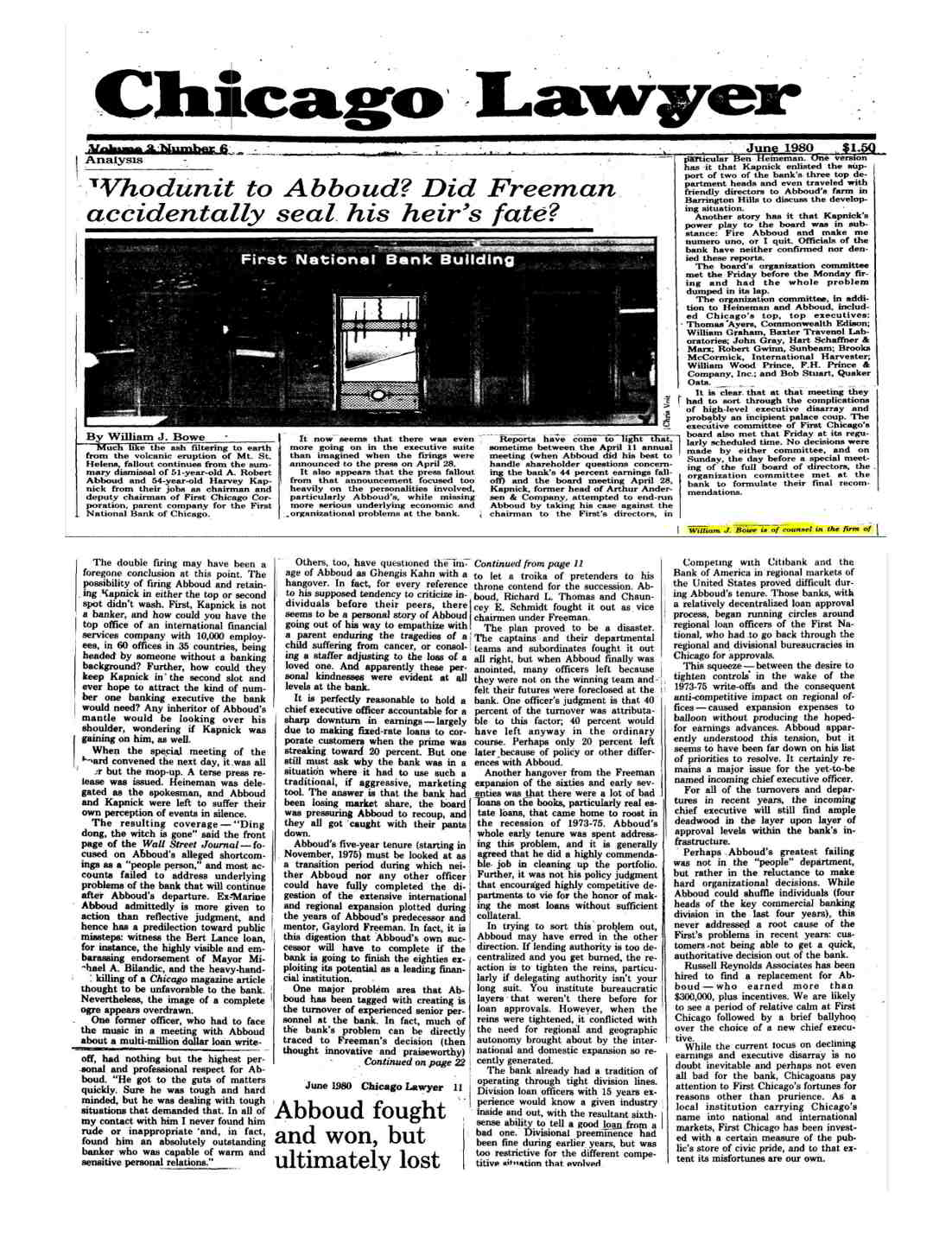
TNB: No. Nancy would have worked on the First Chicago audit when Abood was president. But by the time I got there, a fellow named Barry Sullivan, who had been a senior executive at Chase Manhattan Bank, was CEO. In that period, I happened to write a lengthy article for Chicago Lawyer about the succession of Abood and the competition among the three people who were candidates to succeed him. They were succeeding Gaylord Freeman.
WJB: Yes. It was Gaylord Freeman who had had such a long tenure there. And he apparently—as I recall—had set up, not perhaps all that unusually, a competitive situation among three potential successors when he retired. When one person, Abood, won, all of the other two left. And with them, they took people who had been lining up behind them as subordinates, thinking there was a good chance they would move up when their chief became the head of the bank.
TNB: I would have to look up my article. I will send it to you.
WJB: Please do. I think you had sent it before, actually, but I would like to refresh my memory on it.
TNB: Anyway, Nancy ended up working for Lehman Brothers in an investment banking capacity, and she worked there until shortly after our daughter Kate was born in 1989.
William J. Bowe Chicago Lawyer Article
Family and Children (16:50)
TNB: I have three children. Kate was born in 1989. Gus, who was named after my grandfather Augustine, was born in 1991. And Nick was born in 1995. Nancy and I moved to Brooklyn not too long after we moved to New York, so that was 1987. New York was a little overwhelming, and I had always loved living in downtown Chicago. We wanted to find a place in New York City that was as close as possible to living in Lincoln Park.
WJB: And where did you first land in New York?
Moving to New York: Manhattan & Then Brooklyn Heights (17:34)
TNB: We lived at 45 West 60th Street, which is basically across the street from Lincoln Center. That was great. It was nice to live in Manhattan for a couple of years, and particularly so close to Lincoln Center, where there is an incredible amount going on all the time. But this was in 1985, and New York was still recovering from its fiscal crisis. The subway cars were all graffitied, and it was a fundamentally less safe place than it is today. But it was fun to be here and fun to be a newly married couple in New York. In our search for a place that felt a little more like Chicago, we ended up in Brooklyn Heights.
Brooklyn Heights is a neighborhood directly on the Brooklyn side of the Brooklyn Bridge, so it is easily accessible to lower Manhattan, where both Nancy and I worked. I could commute from my front door in Brooklyn Heights to my seat on the trading floor at Bankers Trust Company in 14 minutes.
WJB: Wow.
TNB: And Nancy’s commute was only slightly longer than that. So Brooklyn Heights has proved to be for us just an absolutely wonderful place to live.
Brooklyn Heights Real Estate: 148 and 290 Hicks Street (18:51)
TNB: We always were at the same spot on Hicks Street. Well, when we first moved, we bought a condominium on Hicks Street. In 1987—I will tell you more than you probably want to know—we paid $380,000 for a three-bedroom duplex apartment in a brownstone built in 1854. The address was 148 Hicks Street. We lived there and had our first couple of children there. And then when Nancy was expecting Nick, we needed more space. We had, a couple of years previously, bought a dilapidated brownstone at 290 Hicks Street, about three blocks south of where we were living. Nancy oversaw a complete gut renovation of that beautiful brownstone. When we moved in in 1995 into the renovated brownstone, we sold the duplex. We sold it for $300,000, which was an $80,000 loss over a seven-year period in New York real estate.
WJB: Tell me a little bit about what was going on in New York during that period to produce that kind of result in what is today, of course, a highly sought-after desirable neighborhood.
TNB: My suspicion is that if you look around the country at exactly that time frame—from 1987 until 1995—you had the 1987 stock market crash, which took place not too long after we bought the place. Then there was a subsequent market crash in 1989, and then in the early 1990s there was a spike in interest rates that completely decimated commercial and residential real estate markets around the country. It was a combination of all those things that resulted in the depreciation of our co-op apartment. But we bought the townhouse at the same time, and of course it turned out to be a fantastic investment. We sold it just a year and a half ago to move into this apartment, which is a newly constructed high-rise.
WJB: And how far are you from the old house?
TNB: I can see it. As the crow flies, it is probably 200 yards from here. In any event, we raised our kids in that house and it was perfect. We had three bedrooms on the top floor for the children. It was not spacious, but it was certainly comfortable.
The Children’s Education: Packer Collegiate and Poly Prep (22:10)
TNB: The kids went to school at a place called Packer Collegiate in Brooklyn Heights. I often joked that I had two children who spent 12 years there each, and my daughter Kate spent nine years there—a total of 33 tuition-years. Somewhere around the twentieth tuition year, they asked me whether I would serve on the board of trustees of the school, and when I got to about the twenty-fifth or twenty-eighth year, they asked if I would like to be chair of the board. I agreed to do that. It was actually a school very much like Francis Parker, where I had gone to grammar school. I very much enjoyed my time on the board there and worked very closely with the head of school; my biggest functions were raising money and looking after the head of school—because somebody had to do that, and that was the board chair’s responsibility. Being involved in an educational institution like that gives you an appreciation for the very many constituencies that exist in those institutions. You have faculty, students, other staff, parents, and then the surrounding community. It is a more complex environment than many.
TNB: It is highly political.
WJB: Yes, in other lines of work it is very obvious who you are looking after. For me, for instance, I have my clients and basically management of the firm and perhaps my colleagues. If you are running a school, you have to look after the faculty, the students, the other staff, the parents, and then the broader world. So it is a more complex environment.
TNB: My daughter actually transferred when she was in high school to a school in Brooklyn called Poly Prep, which is another independent school that was a little more athletically oriented. She had had nine years at Packer, and that was enough. She had a good four years at Poly. And they all went on to good colleges, and they all live here in New York City. I can actually see two of their apartment buildings from this apartment. My son Gus lives in Queens nearby but is in the process of purchasing an apartment here in Brooklyn as well. I think the fact is that young people like to be in New York City, and for perhaps obvious reasons, my kids have been here their whole lives, and other than going away for college, have been here for the duration.
Buck Hill Falls and the Pocono Mountains (24:55)
TNB: I guess one other thing I would mention is that somewhere around 1991, we purchased a house in the Pocono Mountains—at Buck Hill Falls, actually not too far from where your mother went to camp, if I am not mistaken.
WJB: Yes. Do you remember the town? I was trying to think of it. I think her camp might have been in Mount Pocono. Is that right?
TNB: Yes, I think that is right. I have many stories about camp Takawitha and my mother serving as a counselor there to the young girls, including, famously, rubbing shoulders with the children of celebrities. One of the baseball managers—Connie Mack’s daughter was there, if I recall correctly. Connie Mack was from Philadelphia, I believe, though I cannot quite remember. But in any event, that was quite an adventure in the Poconos for my mother. The fact of the matter is that the Poconos went through many changes. It became a destination for honeymoon resorts for a long time, and it suffered—as did many of these resort communities along the eastern seaboard—when people started being able to board airplanes and fly to perhaps more desirable places.
We ended up buying a house in a community called Buck Hill Falls, which had a huge inn on the property—a 400-room old-world establishment with very rich recreational resources. Nancy and I had actually stayed there in 1989. It went bankrupt at the end of the 1990 season. We spent a weekend there and ended up, in 1991, buying a house in the community. We have had a house there ever since. My kids grew up going there, and we had a group of friends who also raised their families there. My kids still come up. I was up there last weekend.
WJB: And how long a drive is it for you?
TNB: It is a two-hour drive from Brooklyn on a good day—it can sometimes be worse, and occasionally slightly less, but not by much. But we have a 27-hole golf course, all set within 5,000 acres of unimproved forest land, a dozen tennis courts, an ice-skating rink. It is a spectacular place from a recreational standpoint. I learned really how to play all of those things. I believe you and I used to play tennis together up there in the early 1980s. I still play a good deal of racquet sports, and that has been a great part of our adult lives.
I also ended up—oddly enough—serving on the board of the Buck Hill Falls Company, which is a publicly organized entity that owns all the recreational resources and manages the community, essentially performing the same function as a homeowners association, except it was organized as a public company dating back to when it owned and operated the inn.
I did a couple of stints as a board member and ended up as chairman and CEO. The community collectively—and I played some role in it—took down that 400-room inn, which was a huge undertaking. They literally wrecked the whole thing and carted it away, which was an important step for the community, because having an empty 400-room hotel sitting in the middle of a resort community is not a very desirable thing, and it was making it difficult to sell real estate there. It is a great place, and we spend a lot of time there.
Closing (29:13)
WJB: Well, that is a good account. I think we have done a good exchange here, and I have learned a lot that I did not know before. I appreciate your taking the time to do this.