
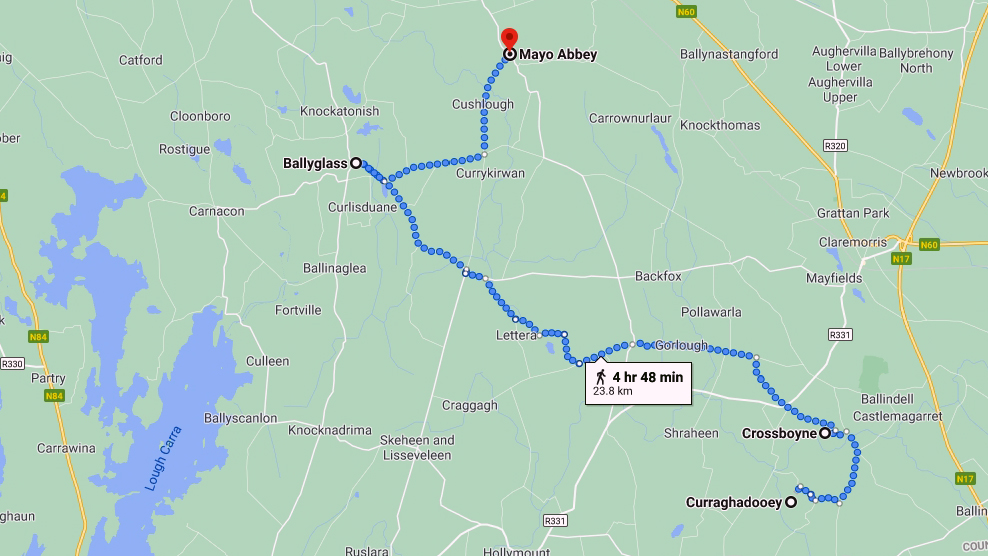
Ballyglass Townland In County Mayo: Another Early Canavan Home?
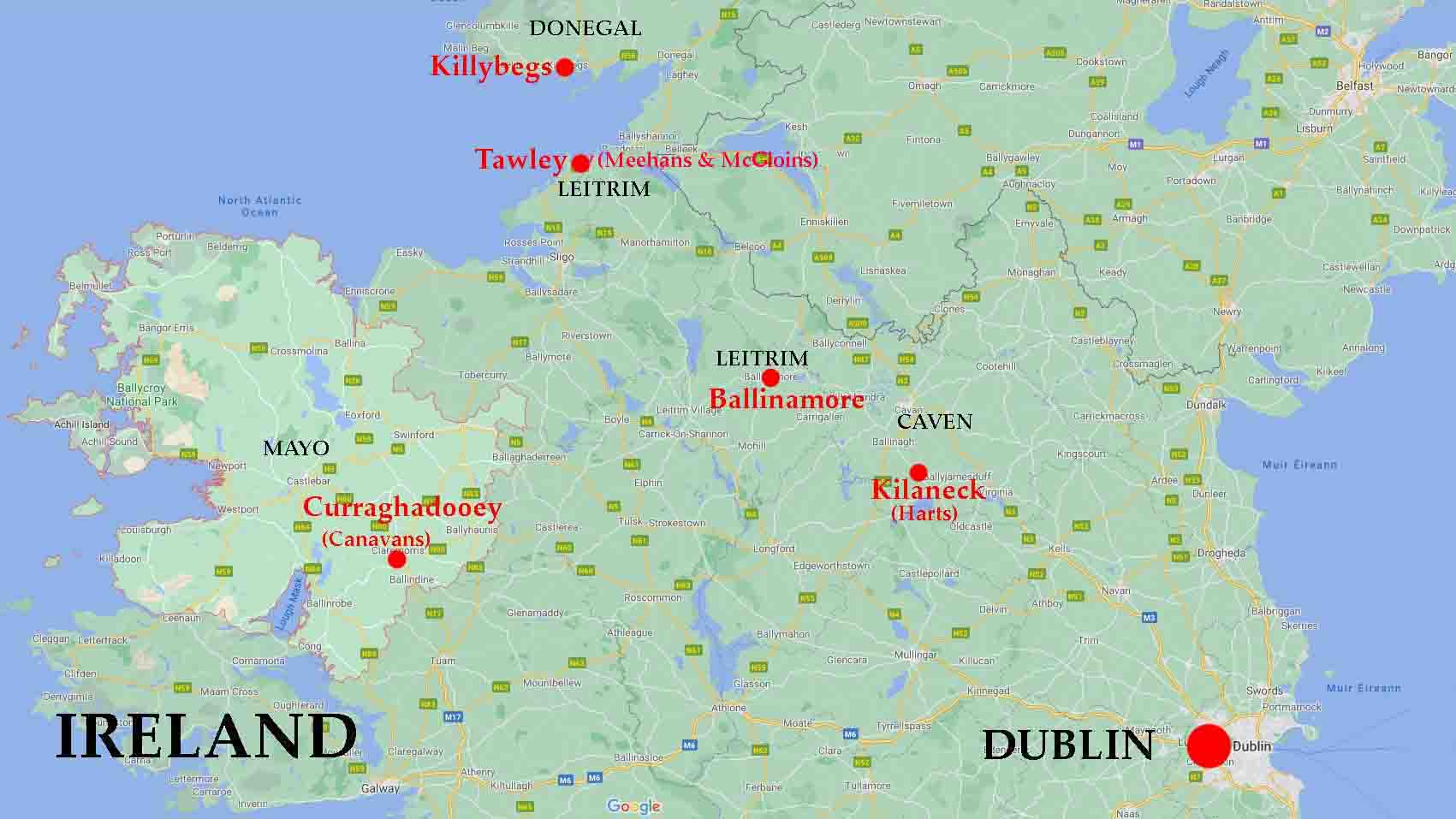
Editor’s Note: I asked Joe about the timing of Anthony Canavan Sr. and Ann Hughes’s emigration with four of their thirteen children, wondering whether the potato famine was the prime motivating factor. Joe recalls it as about 1849 or 1850, after the famine. He adds that while no Canavans remain in Curraghadooey today, there are lots of Hugheses, and he hopes to bring DNA kits on a return visit. A staff member named Delaney at the South Mayo genealogy center suggested the Canavans were not farmers but more mobile people, and one of their places was Ballyglass townland, near the Galway border — one of eight Ballyglasses in Mayo, and a name that also appears in the account of Joe’s Uncle John’s 1966 visit.
Transcript
Speakers: WJB — William J. Bowe; JH — Joseph Hart. Transcribed from the recording; punctuation added and obvious mis-hearings corrected.
WJB: —a little bit to understand the timing of the emigration from Ireland to the US. I had thought that it was for Anthony Canavan Sr. and Ann Hughes, and four of their 13 children. I had thought earlier that it was right after the potato famine of 1846, along in there, but I guess it was earlier. Do you have that timing in mind at all?
JH: I want to say that your first guess is right, that it’s probably 1849, 1850.
WJB: So after the famine.
JH: Yes. And I can look in my records and—
WJB: Yeah, but that’s close enough.
JH: That question pops up in my own mind once in a while. But that’s my recollection, is that it was after the potato famine.
WJB: So what that further suggests to me is that they had been living through that famine period, which must have, of course, been a terrible period. But maybe it was largely over, or maybe the crops were permanently damaged, so that they left after. They certainly didn’t get out of there ahead of time, it seems. So I’m just trying to focus in on whether the potato famine and that rot was the prime motivating factor. The timing sounds about right that it was.
JH: It’s hard to say. The most interesting, curious information that I’ve gotten about… Well, let me back up and start from the fact that there aren’t any Canavans in Curraghadooey townland today, but there are lots of Hughes still there. So I think if I ever get back to Curraghadooey to do some more poking around, I’m going to take a number of DNA kits with me and see if I can recruit some Hughes to take a DNA test, and see if I end up as a DNA match with them. So—
WJB: Well, maybe that’s a good place, too, to talk about the DNA, as that has entered the mainstream of family trees. You didn’t start out with that there. I certainly remember, as you do, when DNA was a very suspect technology. It was rejected by the O.J. Simpson jury as not sufficiently scientific back in that ’90s moment. So when did you notice it and begin to see that that was a useful tool in what you were interested in?
JH: Well, let me just add one bit of information about the Canavans, because when I start talking about DNA, I’m going to go back to County Cavan. So when I was on one of my trips down to Mayo, I stopped in at the genealogy center for South Mayo. I made several visits there. I ended up making a contact with one of the staff members. His name was Delaney. And when I talked to him about the Canavans, his impression was that the Canavans were not farmers, so that they were more mobile. There definitely were Canavans in Curraghadooey at one time, but the Canavans seem to come from a couple of different places. And one of them was a townland called Ballyglass, which was near Curraghadooey, but closer to the Galway border. And so that’s been quite interesting to me and makes it a little bit more difficult to pin down the Canavans in County Mayo, because I don’t know what they did for an occupation. Anthony Canavan Sr.’s father may have been a shopkeeper or a tradesman of some kind, but Anthony Canavan Sr.’s father is so far back, maybe born 1790, maybe a little bit earlier, that there really aren’t any records to find to identify him, to confirm what he might have done as an occupation or where he might have lived at one time. Okay. So that’s a really good question that deserves some research. So I haven’t been down to Mayo since I was able to pinpoint where this Ballyglass townland was, because in County Mayo, there are eight Ballyglass townlands. But the one that I’ve most recently pinpointed as my point of interest is the one where they undoubtedly lived for a time, and maybe it was the time before they emigrated. That seems that Ballyglass pops up in another document that has been a more recent source of information, which was the account of my Uncle John’s visit to Ireland in 1966—