Canavan Origins Found: Curraghadooey Townlands, Crossboyne Parish, County Mayo
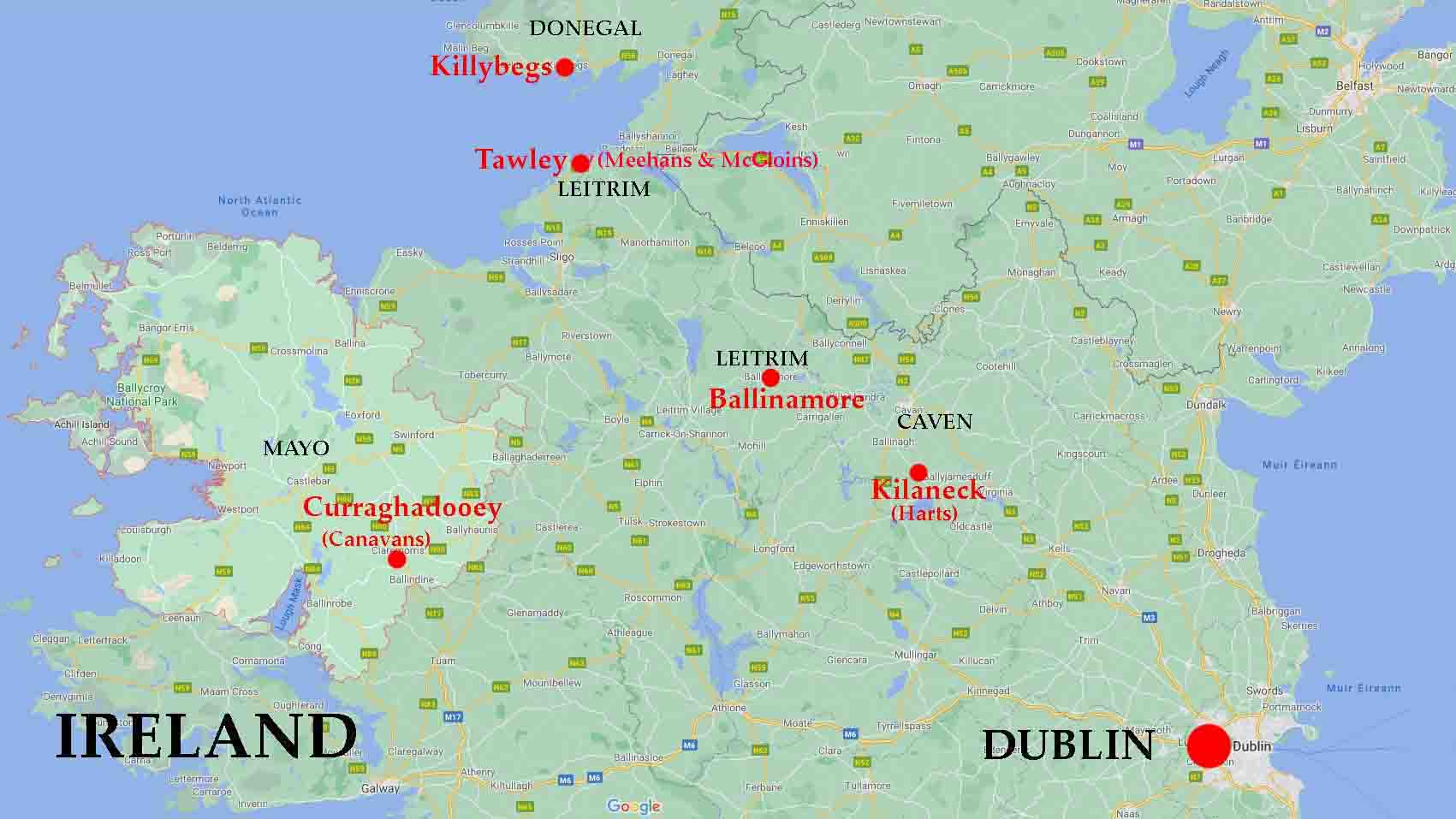
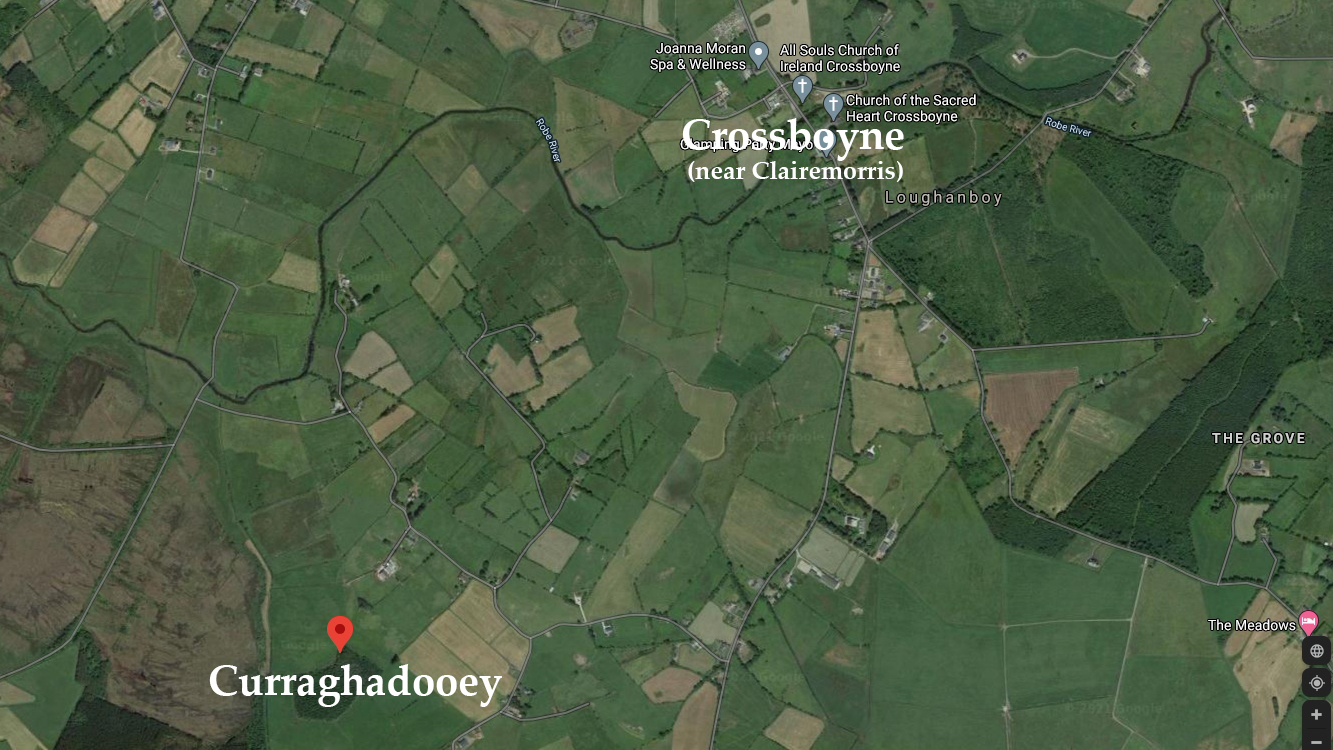
Editor’s Note: Once he had a car, Joe got down to County Mayo, where both my mother’s and Uncle Jim’s notes placed the Canavans in a townland called Curraghadooey. Joe explains how the Hart brothers’ pronunciation, “Kirkadewy,” puzzled the local post office until they realized what he meant. I asked what the “town” was like, and Joe explains that townlands are subdivisions of parishes, and civil parishes are distinct from church parishes. Curraghadooey lies in the very rural parish of Crossboyne, whose church, built before Anthony Canavan Sr. married Ann Hughes, is undoubtedly where they wed. Knowing the townland, Joe says, is the big clue to finding Irish cousins.
Transcript
Speakers: WJB — William J. Bowe; JH — Joseph Hart. Transcribed from the recording; punctuation added and obvious mis-hearings corrected.
JH: Eventually, I ended up, probably after I purchased a car and was able to travel a little bit broader, I eventually got down to Mayo. And in Mayo there are two genealogy centers. One is North Mayo and the other one is South Mayo. And the information that I had from the notes, both your mother’s and Uncle Jim’s, was that the Canavans came from a townland called Curraghadooey. And of course the—
WJB: Can you pronounce that one again for me?
JH: Curraghadooey. It would be looking at the name and pronouncing it.
WJB: Okay.
JH: It’s more corrupted than that. And so if you went to Ireland and were looking for this spot, you’d say, “I’m looking for Curraghadooey.”
WJB: Curraghadooey.
JH: Yeah. And the Harts, the brothers, would’ve called it Kirkadewy, which might be another corruption that they heard from somebody. But the locals in that area would say it’s Curraghadooey. So anyway, it was a little bit difficult to find, probably because I was pronouncing it Kirkadewy to begin with. And I went to a post office and asked if they knew where the townland of Kirkadewy was, and they looked kind of puzzled for a minute, and they said, “You got to be talking about Curraghadooey.” So eventually I found the townland.
WJB: And what is the town like in this era?
JH: Well, it’s not a town. Townlands are subdivisions of parishes. So you have the counties, parishes are subdivisions of the county, and the townlands are the subdivisions of the parishes. So—
WJB: So the parishes in this context, while they may have originally had a religious connotation, I take it they’re more of a governmental, or in addition they have a governmental function. Is that right today?
JH: It’s a governmental subdivision. And that can get kind of confusing, having a church parish. They’re closely related to a civil parish using the same name, but maybe a slightly different spelling. Instead of an E, they use an A.
WJB: All right. So they don’t overlap, in other words, exactly, in all cases.
JH: Well, they can pretty close, but not necessarily.
WJB: All right.
JH: So sometimes that’s kind of confusing. So when you’re looking at records—
WJB: Right. So you were getting close to some answers in what sounds like rural farmland.
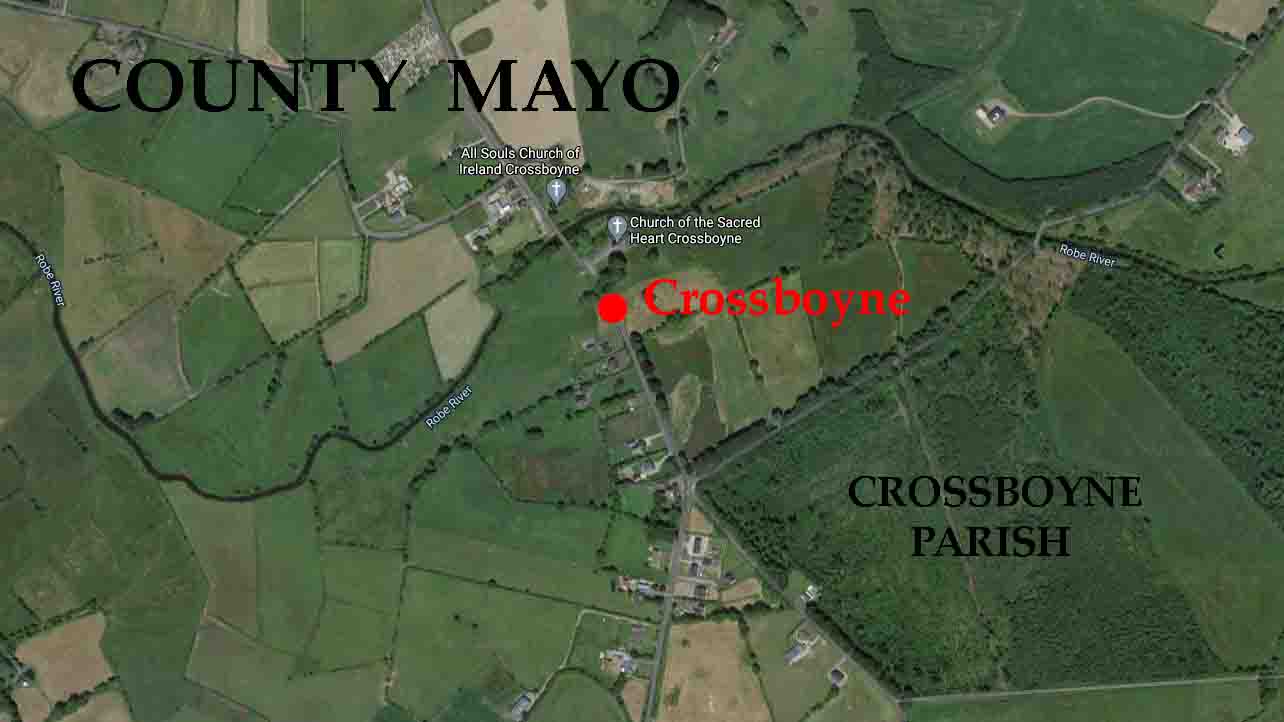
JH: Very. Very rural. It’s in a parish called Crossboyne. In the townland, there is a town, kind of a crossroads with a pub and a church, called Crossboyne, and that’s undoubtedly where Anthony Canavan Senior and Ann Hughes got married, was in the church that’s there in the town. It was built before the time that they were married, and so that’s—
WJB: So is it still there? I seem to recall one of the earlier folks that was looking into that thought that a church had burned down and records had been lost in a fire, that kind of thing.
JH: Well, there’s always that possibility, but the church that’s there now was built before the time that they were married. So—
WJB: Oh, wow. Yes.
JH: I’m guessing that, yes, certainly that church could’ve burned down. Well, I’ll get around to talking about Mayo Abbey in a second. But the family history would say that Anthony Canavan Senior was born in Curraghadooey townland. Today, there aren’t any Canavans in Curraghadooey townland. And the big clue to tracing your Irish roots is to know the townland that they came from, because if you go back there today and you find somebody with the surname that you’re interested in, and if that’s one of your ancestral surnames, then people in that townland today with that surname are going to be your cousins. Because almost everybody was a farmer, and they didn’t move much. The farm was inherited by the oldest son, and the others probably stayed pretty close. So that’s a big thing to look for when you’re tracing your Irish roots, is to know—