
Subchapters
- A Milestone in Evolution of the Human/Machine Interface
- The Proper Study of Mankind
- The Encyclopædia Britannica First Edition
- The Encyclopedist’s Art
- William Benton, EB Owner and Publisher
- Robert Hutchins, University of Chicago President
- Mortimer Adler, Philosopher
- Charles Van Doren, EB Editorial Vice President
- Reinventing the Encyclopedia in Electronic Form
- Solving the PC Data Storage Problem
- Patricia Wier, EB, Marvin Minsky, MIT, and Alan Kay
- Peter Norton Takes Britannica into the Software Business
- Harold Kester, SmarTrieve, and Compton’s Encyclopedia
- Dr. Stanley Frank, Vice President, Development
- Compton’s Patent R.I.P.—An Afterthought
- A Look Back from Encyclopaedia Britannica
Reinventing the Encyclopedia in Electronic Form
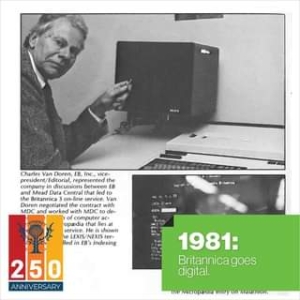
1981 Charles Van Doren with the Britannica on the Lexis-Nexis Terminal

Warren E. Preece, Encyclopaedia Britannica Editor
As one of the architects of the 15th Edition, Preece was intimately familiar with the dense tapestry of cross references that connected related pieces of information spread throughout the Micropaedia, Macropaedia, and Propaedia, the three parts of the encyclopedia. He, more than most, was in a position to ponder the way in which the electronic publishing future might affect a corpus of this nature, and he explored the contours of these possibilities in his article.
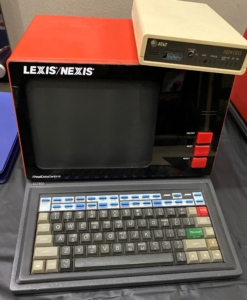
1981 Lexis Nexis Terminal
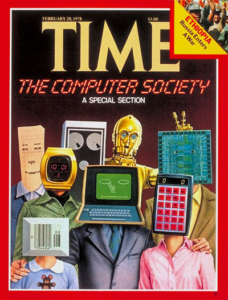
1978 Time Magazine – The Computer Society
Not only did Preece write that his newly envisaged encyclopedia would have an electronic version, but he also saw what Vannevar Bush had not been in a position to see: optical laser-disc technology could be the likely storage medium for encyclopedic data.
Preece also noted that with over 300,000 home computers then in private use in the U.S., online query privileges for up-to-date encyclopedic information was another possible direction for the encyclopedia of the future to take. He also was attuned to the competitive advantages an electronic encyclopedia would have over the book: it could hold more, be searched faster, and be updated more easily.
At Britannica at this time, Van Doren was already leading the charge into Preece’s Brave New World. In May 1980, he had circulated to his colleagues a new agreement between Britannica and Mead Data Central. The four-year agreement called for the full text of the Encyclopædia Britannica to be put online as part of the Lexis-Nexis service.
Mead was to pay Britannica up to 25 percent of Mead’s revenues from encyclopedia subscriptions. While being careful to discourage copyright infringement by not permitting subscribers to print articles from the encyclopedia, Britannica had now committed itself to an electronic future in more than a symbolic way.