
Subchapters
- A Milestone in Evolution of the Human/Machine Interface
- The Proper Study of Mankind
- The Encyclopædia Britannica First Edition
- The Encyclopedist’s Art
- William Benton, EB Owner and Publisher
- Robert Hutchins, University of Chicago President
- Mortimer Adler, Philosopher
- Charles Van Doren, EB Editorial Vice President
- Reinventing the Encyclopedia in Electronic Form
- Solving the PC Data Storage Problem
- Patricia Wier, EB, Marvin Minsky, MIT, and Alan Kay
- Peter Norton Takes Britannica into the Software Business
- Harold Kester, SmarTrieve, and Compton’s Encyclopedia
- Dr. Stanley Frank, Vice President, Development
- Compton’s Patent R.I.P.—An Afterthought
- A Look Back from Encyclopaedia Britannica
William Benton, EB Owner and Publisher

President John F. Kennedy with William Benton
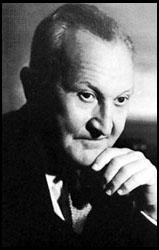
William Benton, Publisher of Encyclopaedia Britannica
The 14th Edition of the Encyclopædia Britannica had been published in 1929, when the company was owned by Sears, Roebuck. That same year, William Benton founded the Benton and Bowles advertising agency in New York City.
The agency prospered with the growth of network radio and its own innovations in the development of national advertising. Among other things, Benton & Bowles is credited with inventing the radio soap opera, which it used as a vehicle to sell its clients’ products.
Benton, later a vice president at the University of Chicago, used the proceeds from his sale of Benton & Bowles to acquire Britannica in 1943, after Sears failed at gifting the company to the University.