

Subchapters
- Riots & Rockets Army Days Map (1968-1971)
- Family in the Military
- The Vietnam War Heats Up
- The Decision to Enlist
- Fort Holabird and Intelligence Training
- CIAD in the CD of OACSI at DA in DC
- The Vance Report
- Directorate of Civil Disturbance Planning and Operations
- Bernardine Dohrn-The SDS Revolutionaries Then and Now
- The Army Operations Center (AOC)
- The Blue U and CIA Training
- The Safeguard Anti-Ballistic Missile System
- Huntsville, Alabama, and the Army Missile Command
- NORAD and Cheyenne Mountain
- Johnston Atoll and the Origins of Space Warfare
- Kwajalein Atoll—The Ronald Reagan Missile Test Site
- Kent State University and the Aftermath
- Yale, The Black Panthers, and the Army
- The Secretary of the Army’s Special Task Force
- Getting Short—The 1971 Stop the Government Protests
- 1974 Congressional Hearings on Military Surveillance
- Lunch with Gen. William Westmoreland
1974 Congressional Hearings on Military Surveillance
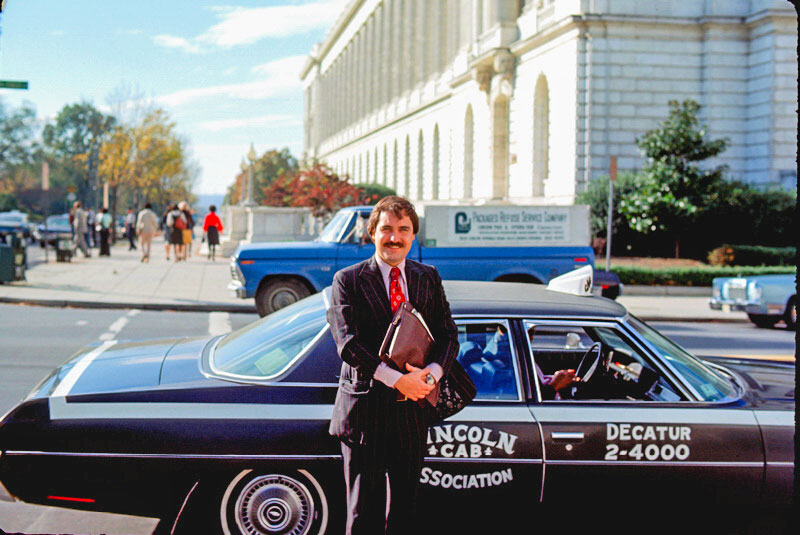
Testimony of William J. Bowe before U.S. Sen. Sam Ervin (D-NC), Chairman, Senate Judiciary Committee
U.S. Senator Sam Ervin (D-NC)
Christopher Pyle, the author of the Washington Monthly articles, was working as a consultant for Ervin’s Committee. Having earlier met me, he contacted me to see what I thought about Col. Downie testifying.
Downie had spent his entire professional career in counterintelligence, and I knew he and I saw eye to eye on its proper role in regard to its rare civil disturbance mission. As it happened, he was interested in sharing his perspective, so I drove from Chicago to his home in Pennsylvania, picked him up, and then drove down with him to Washington for the hearings.
We both had our say on Ervin’s proposed legislation, with Col. Downie bringing to bear his wealth of practical experience. I had more lawyerly suggestions for amending Ervin’s bill to try to correct some problems I foresaw if it became law. Sen. Ervin was having none of my advice on how to rewrite his bill and made sure that he created a record in the hearings that dealt with my points in the event a court ever had to interpret the statute. During the course of Sen. Ervin’s work on the military surveillance hearings, I had the chance to privately chat informally with him in his Senate office.
At the time, I don’t think I’d ever been so struck by a person. I came away feeling I had not only met a friendly, serious, and fair-minded man of purpose, but one with an outsized intellect and an even greater quotient of common sense.
Later in 1974, the Senate Watergate hearings Ervin had chaired the year before finally bore fruit. While Sen. Ervin’s proposed bill regulating surveillance by the military never became law, his adroit conduct of the Watergate hearings ultimately gave him and the country a great victory. Fatally damaged by facts revealed in the Watergate hearings, and facing imminent impeachment and conviction by the Congress, Richard Nixon resigned as President on August 9, 1974.
Also in 1974, Lawrence Baskir, who served as Chief Counsel and Staff Director for the Senate Judiciary Committee’s Subcommittee on Constitutional Rights, published an article in the Indiana Law Journal detailing the way in which the Senate hearings on military surveillance had unfolded. (Baskir, Lawrence M. (1974) “Reflections on the Senate Investigation of Army Surveillance,” Indiana Law Journal: Vol. 49 : Iss. 4 , Article 3)
This comprehensive account of the hearings provides a sophisticated look at the work in the Senate. It also provides another reason beyond his performance in the Watergate affair to admire the decency, legislative skills, and political acumen of Sen. Sam Ervin.