

Subchapters
- A Milestone in Evolution of the Human/Machine Interface
- The Proper Study of Mankind
- The Encyclopædia Britannica First Edition
- The Encyclopedist’s Art
- William Benton, EB Owner and Publisher
- Robert Hutchins, University of Chicago President
- Mortimer Adler, Philosopher
- Charles Van Doren, EB Editorial Vice President
- Reinventing the Encyclopedia in Electronic Form
- Solving the PC Data Storage Problem
- Patricia Wier, EB, Marvin Minsky, MIT, and Alan Kay
- Peter Norton Takes Britannica into the Software Business
- Harold Kester, SmarTrieve, and Compton’s Encyclopedia
- Dr. Stanley Frank, Vice President, Development
- Compton’s Patent R.I.P.—An Afterthought
- A Look Back from Encyclopaedia Britannica
Peter Norton Takes Britannica into the Software Business
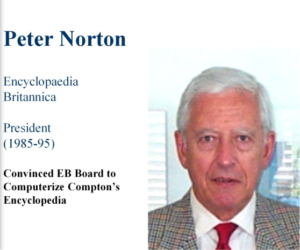
Peter Norton, EB President
Although not willing to follow Wier’s advice in 1983, Britannica’s board of directors did believe the company needed to get closer to the emerging personal computer market. That year, Encyclopaedia Britannica Educational Corporation, which I later served as president, published a dozen floppy disk educational titles that it had acquired for the Apple II platform. Soon Britannica decided to directly acquire its own software development capability. In 1985, it purchased Design Wear, EduWear, and Blue Chip, three small San Francisco-based software publishers also selling 5¼ inch floppy magnetic disk products.
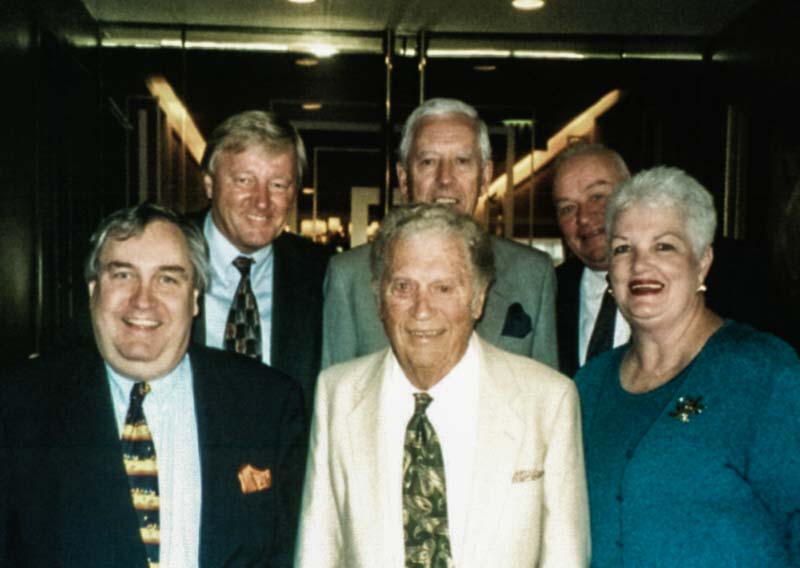
2000 Bill Bowe, EVP & Gen. Counsel, Karl Steinberg, VP HR, Robert Gwinn, Chairman, Peter Norton, President, EB, Patricia Wier, President, EB USA
With the introduction that year of the CD-ROM format, Britannica also began to think about how it might exploit this new medium. The question was not a simple one. The Encyclopædia Britannica itself was thought to be too massive to be put on a CD-ROM, even with minimal indexing and a text-only format.
Also, the entire business model of the company was still built on selling its flagship, multi-volume print work at a purchase price of $1,200 and up, depending on the binding. The direct selling sales culture that prevailed at Britannica was no more receptive to the idea of an inexpensive, electronic alternative to the print set than it had been when Patricia Wier first made her recommendation.
In 1987, Britannica’s management, led by former Englishman, now American citizen, Peter Norton, hit on a solution.
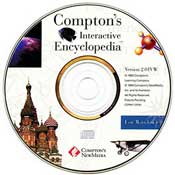
This time the plan was not seen as a threat to the sales force, and it was endorsed by the board of directors. Instead of putting the Encyclopædia Britannica on a CD-ROM, Britannica would become a leader in the newly developing software publishing industry by building a multi-media CD-ROM version of its student-oriented Compton’s Encyclopedia. At the time, the Compton’s print set was given away free as a premium to purchasers of the more expensive Encyclopædia Britannica print set.
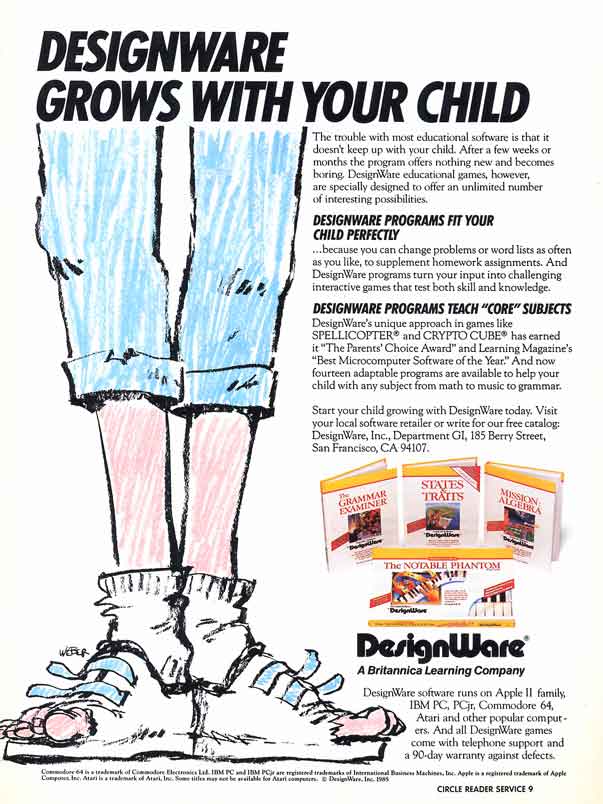
1986 EB DesignWare Ad
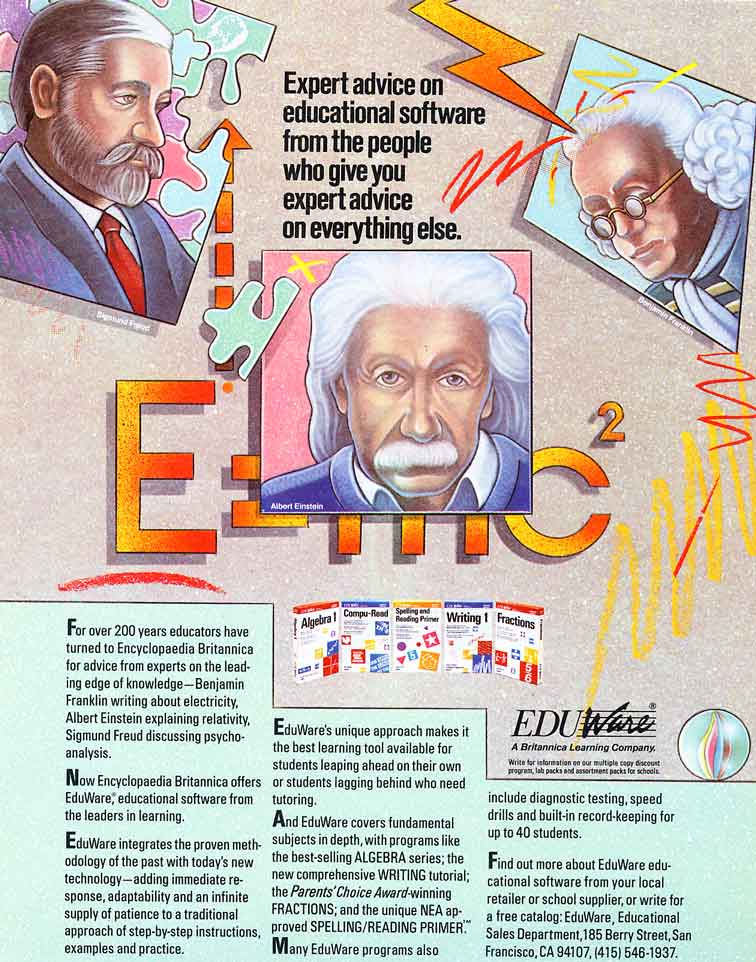
1986 EduWare Software Ad

1986 EB Blue Chip Software Ad