
Remembering Wilbert R. Hasbrouck (1931–2018)
A Memorial Celebration at The Cliff Dwellers · Chicago · March 2, 2018
Contents
Dragged to the Members’ Table 05:36
Twenty Years of Lunch Conversations 06:47
Augustine J. Bowe and the Garrick Theater 07:29
The Chicago Architectural Club and Marilyn’s Role 08:00
Kindred Spirits at the Prairie Avenue Bookshop 11:45
Preservation Pioneers in Tennis Shoes 12:56
Growing Up Under the Prairie School Review 30:05
Calligraphy, Cameras and a Darkroom 30:45
Muddy Waters and Eric Clapton 31:41
Summary
Editor’s Note: On March 2, 2018, family, friends and fellow Cliff Dwellers filled the club’s Kiva to remember Wilbert R. “Bill” Hasbrouck, who died on February 10 at 86. A restoration architect, preservation pioneer, publisher, teacher and book lover, he had joined the club in 1964, served as its president in 1984 and 1985, and spent his last night out at its annual meeting in January.
His son Charles Hasbrouck opened by honoring his mother, Marilyn, Bill’s partner of nearly 60 years and founder of the Prairie Avenue Bookshop. Bill Drennan recalled Bill’s seat at the head of the members’ table and his role in admitting women, then read a tribute from club president Eve Moran. Bill Bowe told of twenty years of lunches with Bill and of Keanu Reeves seeking him out while filming The Lake House. Scott Elliott described Bill and Marilyn as preservation pioneers and Bill as the club’s last living link to its founders.
Anne Sullivan credited Bill with her first preservation job and with inspiring the School of the Art Institute’s graduate preservation program. Bill Tyre traced his decades of work for Glessner House and the Clarke House. Mike Jackson recalled the Dana-Thomas House restoration. Bill’s sister, Judy, shared childhood memories of a homemade kite and a “spanking machine,” and his son John told how his parents steered him toward photography and music, reading Marilyn’s own tribute. Tim Samuelson closed by calling Bill his teacher and proposing that the club finish Bill’s unfinished biography of Dwight Heald Perkins.
Transcript
Lightly edited for clarity and readability; false starts and repetitions have been removed, with the substance of each remark preserved. Timestamps indicate where each section begins in the video.
1. Charles Hasbrouck
Welcome and Remembering His Father 00:07
Charles Hasbrouck: We’re here today to remember and celebrate the life of my father, architect Wilbert R. Hasbrouck, who lived from December 17, 1931, until February 10, 2018.
The Cliff Dwellers was one of his favorite places, not just because of the food or the view, but also because of the club’s history, its members, and the many conversations he enjoyed with them over the years.
He spent his last night out on January 8th of this year, sitting at the members’ table right over here, at his usual place, facing the door, in the chair that bears his name plate. It was his 54th consecutive annual meeting of The Cliff Dwellers, and that’s something he was very proud of.
Honoring Marilyn Hasbrouck 01:05
On behalf of his entire family, I want to thank all of you for your kind words and condolences.
I also want to take this opportunity to honor my mother, Marilyn Whittlesey Hasbrouck, who was my father’s partner in life for nearly 60 years. He always acknowledged her support and the fact that she contributed to all that he achieved, often sacrificing her own time and personal interests to do so. She accomplished a great deal in her own right, including establishing and operating the Prairie Avenue Bookshop.
I always looked up to my father, and I still do. It’s wonderful to see all of you here today, and to know that his life’s work, along with that of my mother, made a real difference in so many people’s lives.
And with that, I will turn the podium over to Bill Drennan, secretary and membership committee chairman of The Cliff Dwellers.
2. Bill Drennan
Bill’s Chair at the Members’ Table 02:09
Bill Drennan: Good afternoon. Over the past 50-plus years, anyone who spent any time involved with The Cliff Dwellers was certainly aware of Bill Hasbrouck.
Since his nomination to the club in 1964 by Ralph Fletcher Seymour, an original Cliff Dweller, Bill was a lunchtime regular in his seat at the head of the members’ table. Everybody knew Bill’s chair. Don’t sit there.
As far as we know, Bill is the last of our members sponsored by an original member from among the 1907 founders. And so in many ways it is most fitting that we gather here in our Kiva to remember and celebrate Bill.
The Admission of Women 03:06
I have been asked to share a letter from our club president, Eve Moran, who is currently traveling in South America. Interestingly, Eve is the fourth woman to be president of The Cliff Dwellers, and one of Bill Hasbrouck’s most significant and proudest achievements was the admission of women as members.
A Letter from Club President Eve Moran 03:33
Dear Marilyn, family, friends, colleagues, and fellow Cliff Dwellers,
When I began my term as president of The Cliff Dwellers, I was deeply aware and admiring of those who served before me. Looming large in this group was, of course, Wilbert R. Hasbrouck. Wil served as club president in 1984 and 1985.
Wil was a legend in his own time: a highly accomplished man in the architectural field, a man supremely devoted to his family, a man who in so many different ways nurtured the arts, a man of strong and talented leadership whose presence at the members’ table always lighted up the Kiva. In short, Wil was an inspiration to me, and he remains inspiring still.
When Wil’s son Charlie became president of the club in 2014, the legend took on new wings. For the first time in the club’s history, a father and a son would each, in their respective times and expert ways, lead the club. A proud father and his caring son would stand side by side in the photographs of past presidents taken regularly at the club’s annual meeting. These are the moments that we strongly cherish.
I honor you, Wil. The club honors you. As is The Cliff Dwellers tradition, we cling to memories, we tell stories, and in doing so keep vibrant the spirit of the best of us. You remain, dear Wil, one of the very best and beloved of The Cliff Dwellers.
Živio, Eve Moran, President of The Cliff Dwellers
3. Bill Bowe
Dragged to the Members’ Table 05:36
Bill Bowe: Like both Hasbroucks, I’m a former president of The Cliff Dwellers. I’m Bill Bowe, and I joined in 1997, two years after the club moved here from the top of Orchestra Hall next door.
My only goal when I joined was to get away from work. I worked nearby, and I didn’t really want to talk to anybody. It was a way to avoid seeing all my colleagues, whom I had, of course, up to here for the rest of the long day. So at first I came over here with my newspaper and sat reading at a table by myself.
That plan did not last long, because the longtime dining room manager, whose portrait graces our foyer, Bob Thiebout, saw me do this. I think it was the second time that he came over and, in a voice I couldn’t really deal with other than to follow it, said, “Mr. Bowe, please, you can’t sit by yourself. You must sit at the members’ table.” And with that, he dragged me over and introduced me to Wil Hasbrouck.
Twenty Years of Lunch Conversations 06:47
So over the next 20 years, more often than not, I’d be at that table sitting next to Wil, and frequently Marilyn as well. To say that Wil was an exceptional conversationalist doesn’t really do him justice. By that time he’d already had quite a diverse and successful set of careers, and he wasn’t by any means finished. There wasn’t once that I went back to the office after lunch without learning from Wil something new and interesting about Chicago architecture, history, or indeed life.
Augustine J. Bowe and the Garrick Theater 07:29
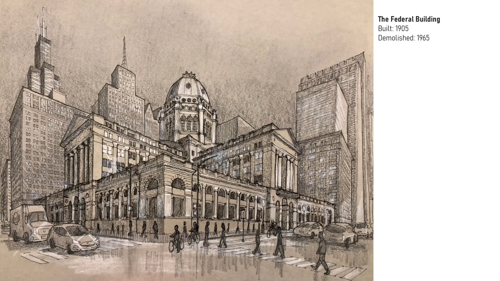
It even turned out that he knew my uncle, Augustine J. Bowe. At the time they knew each other, my uncle, my father’s brother, was head of the city courts and had also been appointed by Mayor Richard J. Daley as first chairman of the Commission on Chicago Architectural Landmarks. They had been thrown together in an ill-fated attempt to save Adler & Sullivan’s Garrick Theater, built, as we all remember, in 1891. Those of us who were around at that time, of course. (Laughter)
The Chicago Architectural Club and Marilyn’s Role 08:00
When I first met him in 1997, he had just started work on his grand scholarly achievement, the history of the Chicago Architectural Club. It wasn’t published for almost ten years, in 2005, and it was an amazing, nearly decade-long labor.
In the bibliographic note at the end of the volume, he gives full credit to Marilyn, not just for inspiring him to undertake the extraordinary effort it took, but as a collaborator, traveling all over to different research points and contributing the first draft of the extraordinary chronology that pulls the whole work together and serves as an appendix and the backbone of the entire volume. And this, of course, was all while she was working full time as president and manager of the bookshop.
Hollywood Comes to the Prairie Avenue Bookshop 09:06
The same year the book was published, I remember Wil explaining to me at lunch that they had had an extraordinary windfall at the bookshop, their most profitable time. I asked what happened. Did you get a convention of architects in town? He said, “No. Hollywood.”
Sure enough, he told me that location scouts for a movie called The Lake House, starring Keanu Reeves, Christopher Plummer and Sandra Bullock, had rented the entire bookstore at such a price you couldn’t possibly turn it down. They converted it into an architect’s office for one scene in which the father and son architects in the movie argue aesthetics as the “L” train rumbles by overhead.
I promptly accepted Wil’s invitation to walk around the corner to Wabash and visit the movie set. It was really something, because through the genius of the set decorators they had turned what was, of course, an amazing bookstore into an amazing architect’s office.
Lunch with Keanu Reeves 10:30
The next time I saw Wil, he told me he had accepted a nice luncheon invitation from Keanu Reeves at the Four Seasons. Apparently Reeves was playing an architect and thought it couldn’t hurt to actually talk to one. (Laughter)
The conversation was clearly of interest to both men, because Wil told me that when they had finished lunch, he invited Reeves to join him over a pot of Marilyn’s coffee at their apartment on East Delaware, and the conversation continued there.
Though I don’t know what they talked about, I’d bet my bottom dollar that Keanu Reeves left that lunch and that afternoon coffee knowing something new about Chicago architecture, history, or life, or all of the above. (Applause)
4. Scott Elliott
Kindred Spirits at the Prairie Avenue Bookshop 11:45
Scott Elliott: Charlie has told me that I have to condense two hours into under five minutes, so I had to write it down so I don’t ramble.
After almost 20 years working in bookstores and art galleries in New York and London, when I first walked into the Prairie Avenue Bookshop in 1980, I instantly knew I was in the presence of kindred spirits. They were Bill and Marilyn Hasbrouck.
Actually, I knew even before I walked in. The shop window was itself a work of art. The most memorable object on display was a plaster head of a sprite from Frank Lloyd Wright’s Midway Gardens, long since demolished. There was also a beautiful Teco pot and, of course, some wonderful books.
My first acquisition from them was a major one: a set of stained-glass windows from Wright’s Walser House, which had been removed by the owner. The house was badly neglected, and the windows were being vandalized.
Preservation Pioneers in Tennis Shoes 12:56
Bill and Marilyn were among the most important pioneering leaders of the architectural preservation movement in Chicago and the Midwest. In those days, architectural preservationists were often derided as little old ladies in tennis shoes. I wouldn’t be surprised if Marilyn is still wearing those tennis shoes.
Some years after I met them, I came across an old news clipping with a picture of them picketing in front of the Art Institute, protesting against the desecration of the Ferguson public sculpture trust by the museum’s trustees. Many years ago I was almost thrown out of this club for writing about the Ferguson scandal in the newsletter, but that’s a long story better told over several scotches by the fire.
The Last Living Link to the Club’s Founders 13:55
When Bill became a member in the early ’60s, as Bill said, his sponsor was the legendary etcher, printer and all-around bookman Ralph Fletcher Seymour, one of the founding Cliff Dwellers. I believe this made Bill the last living link to the club’s origin. And, of course, Ralph Fletcher Seymour goes back even farther than 1907, when the club was founded, to the group that met in Ralph Clarkson’s studio in the Fine Arts Building as early as 1905 or even earlier.
I remember my father, who was never a member himself but was frequently invited to lunch by architects and artists, talking glowingly at our dinner table about the somewhat seedy elegance of the old club rooms above Orchestra Hall. So it was a great thrill for me to become a member myself in the early ’80s.
An Ally on the Art Committee 15:00
I succeeded Joe Shapiro as chair of the Art Committee and Harry Mohlman as editor of the newsletter, and during those years Bill Hasbrouck was my most dependable inspiration, loyal ally and good friend.
Bill was not only the quintessential Cliff Dweller, but the most knowledgeable, erudite and passionate advocate of Chicago’s artistic, architectural and cultural history I have had the privilege to know. I use the word passionate, and yet he was much more than that. He was a realist and was rarely, if ever, merely sentimental about old buildings. His tennis shoes will be hard to fill.
Oh, and one more thing I’d like to mention: we did have more than a few good laughs along the way. Thank you. (Applause)
5. Anne Sullivan
A First Job in Historic Preservation 16:08
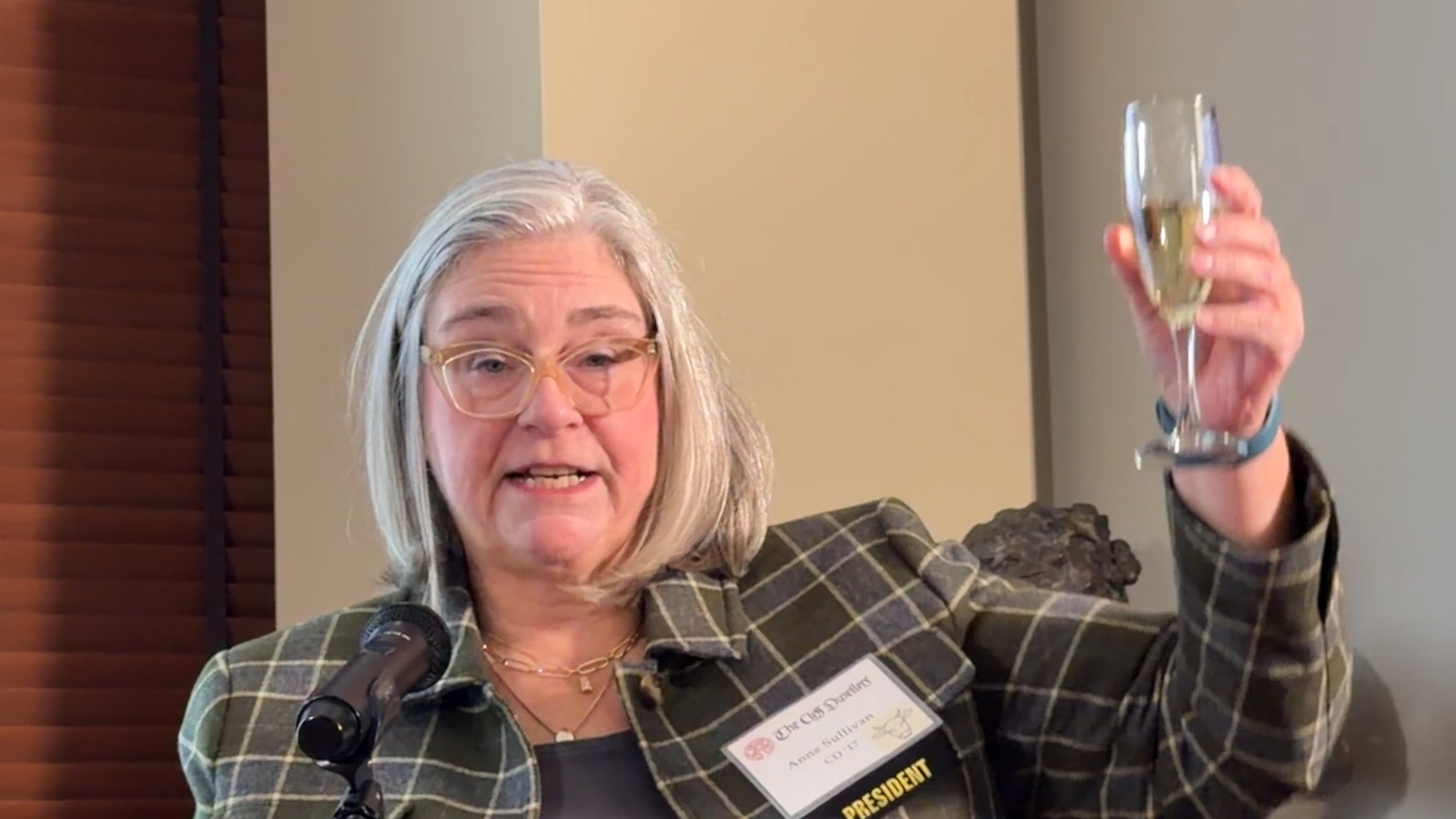
Anne Sullivan: My name is Anne Sullivan. I’m the John Bryan Chair of Historic Preservation at the School of the Art Institute of Chicago.
Bill gave me my first job in historic preservation. I was a college kid studying architecture, and I was curious about the field. He hired me for the summer, when I was exposed to amazing buildings like the Dana-Thomas House and the Rookery, and where I had the opportunity to work with colleagues who have gone on to be leaders in our field: Harry Hunderman, Deborah Slaton, Carl Giegold, Leslie Gilmore and, of course, Charlie Hasbrouck. From that point on, my career course was set as a preservation architect.
Founding Chicago’s Graduate Preservation Program 16:51
But I’m here this afternoon to talk about Bill’s influence on preservation education in this city. In the late 1980s, Bill felt that Chicago should have a first-class graduate program in historic preservation to rival the one at Columbia University in New York. So he approached Don Kalec, who had led the restoration of the Frank Lloyd Wright Home and Studio and was teaching full time at the Art Institute.
As a result, the master’s degree program in historic preservation was started at the school in 1992, with Don as its first director, then Vince Michael, and now myself.
Bill taught in the program for a number of years and personally influenced a generation of young people who have gone on to work in Chicago and throughout the country in historic preservation, many of whom are in this room. And for that legacy, we thank you, Bill.
6. Bill Tyre
“Mr. Hasbrouck” 17:56
Bill Tyre: My name is Bill Tyre. I’m the executive director and curator of Glessner House. My first encounter with Bill Hasbrouck was actually in the master’s program that Anne just talked about, at the Art Institute, 20 years ago.
One of the things I remembered as I was putting down my notes today was that we always referred to the other instructors in the program by their first names, but Mr. Hasbrouck was always Mr. Hasbrouck. Even after we became colleagues, I always had to pause for a moment, because my tendency was to say “Mr.” before I said “Bill.”
Saving Glessner House 18:40
My master’s thesis was on Prairie Avenue. As I was starting to research the topic, I was surprised and very pleased to find that Bill Hasbrouck had been deeply involved in founding Glessner House and the Chicago Architecture Foundation.
It was in November 1963 that he met with the owner of the building, along with Marian Despres of the Commission on Chicago Landmarks, and first learned that the house was going to be put up for sale. Although it had been designated a landmark, at that point the designation was purely honorary, so there was genuine concern about the building’s future.
At the time he was chairman of the preservation committee of the Chicago Chapter of the American Institute of Architects, and soon after that meeting he reported back to them, saying in part: “Regardless of what final use is made of this building, I feel the AIA must take a major advisory role in its disposition. The Glessner House is too important a structure to go the way of the Garrick.” That, of course, was a reference to the Garrick Theater, lost in 1961.
The Chicago School of Architecture Foundation 19:52
In April 1966, when the Chicago School of Architecture Foundation was formed specifically to purchase and maintain the building, Bill was one of the 20 individuals, 19 men and one woman, who organized officially for that purpose, and he became deeply involved over the next decade. By December of that year he was named the second president of the board, serving for four years.
In 1971 he became one of the scholars, both as architect and preservationist, who helped lead our first docent training program, teaching classes to several years of docents.
The Keith House and the Clarke House Move 20:33
His interest in the neighborhood extended beyond Glessner House. A few years later he and his wife purchased the Elbridge Keith House, one block to the south, which had also gone up for sale and was in danger of demolition. It became the home and namesake of the Prairie Avenue Bookshop, which operated there until 1978.
His additional work at Glessner House included the kitchen wing, the first interior restoration project at the house. A few years ago, as his office was being cleaned out, we were delighted to receive some of his original files and photographs, which showed the depth of research he undertook to make the project as accurate as possible.
Possibly his most visible project in the neighborhood was the relocation and restoration of the Henry B. Clarke House. He received the commission in 1975 and completed the move two years later. As he told Susan Benjamin, who interviewed him several years later, the Clarke House move was the one and only time he was ever asked for his autograph.
Honored as a Founder 21:47
In 2016 I had the privilege, along with Lynn Osmond of the Chicago Architecture Foundation, of honoring five of the founders of the organization at Glessner House. Bill was among that group, and I’m delighted that we had the opportunity then to acknowledge his services to Glessner House and CAF over 50 years and his lasting impact on the field of preservation in Chicago. Thank you. (Applause)
7. Mike Jackson
Restoring the Dana-Thomas House 22:21
Mike Jackson: Good afternoon. My name is Mike Jackson, and I had the privilege of working with Bill on the restoration of the Dana-Thomas House. The project took basically five years, from 1985 to 1990. Wil was selected to be the project architect.
I was part of a team whose head was a fellow named Jim Thompson; you might remember him. It was great to have the full support of the governor, and Jim Remar and I were the state’s point people, but Bill was the one who led the team and led the effort, and it was an excellent effort.
150 Drawings and 2,000 Specifications 22:53
The project speaks for itself, but I’ve always wondered about how we did it. Wright designed this house with a small team of people, a few drawings and a few specs. When the State of Illinois does something, we take a different approach. So 150 drawings and 2,000 specifications later, we got the job done, because Wil Hasbrouck was in charge of the project. The house speaks for itself as one of the best restorations of any Wright house, and Wil should be proud of that accomplishment.
Borrowing the Wasmuth Portfolio 23:25
Our story didn’t end there. I’ve never given up on the importance of the Dana House, and this last year we took on a project to re-photograph the interiors of the house to match the Wasmuth photographs. So we needed a copy of the Wasmuth portfolio.
I called up Wil Hasbrouck: “Wil, have you got a copy we can borrow to look at and scan?” He said, “Sure, no problem. I’ll leave it for you at The Cliff Dwellers. Come by and pick it up, and just give it back to me when you’re done.” And that we did.
So we re-photographed the house, still part of telling the story of this great achievement in preservation. It’s a legacy that will live on, and I’m very proud to have been part of the team that worked with him on it. Thanks, Wil.
8. Judy Hasbrouck
“The Kid” 24:27
Judy Hasbrouck: My name is Judy Hasbrouck Rafferty. I’m Bill’s sister. Bill was nine years old when I was born, and I was always known, with affection, as “the kid.”
I would like to share some fond memories and personal stories that made my brother such a unique and amazing person. He was creative, artistic and imaginative. When I remember Bill being 13 and me being a four-year-old little sister, I recall how much I absolutely adored him and wanted to be just like him in every respect.
A Homemade Kite and a Chemistry Set 25:30
Three instances of his creative and artistic ability come to mind. He was fascinated by anything that would fly: airplanes, gliders. He designed and built a homemade kite out of newspaper, wooden slats and scraps of fabric tied to string for the tail.
My mother, father, Bill and I trudged up a hill on the farm, and he released that homemade kite, and it soared off into the sky on the very first try. What a sight, and he was ecstatic. I will never forget how excited he was that his project literally got off the ground.
Then there was his chemistry set, and my parents hoping he wouldn’t burn the house down. But he was very careful, and it never happened. He did make some very interesting concoctions, though.
“That’s My Invention” 26:59
One of the most telling times I vividly remember was Bill sitting at the kitchen table with pencil and paper, drawing elaborate circles, squares and rectangles, wheels and cogs, riggings and pulleys. I sat down beside him. I was about five years old at the time, and I asked him, “What is that?” He continued to sketch, filling it in, and then he put his pencil down, looked at me and said, “That’s my invention.”
Advice Before Kindergarten 27:51
Oh yes, he was creative and artistic. But there was also the imaginative, sometimes teasing, storytelling side of Bill, especially with his little sister.
I was five when I started kindergarten, and the day before I was to enter that stage of my life, he gave me some very insightful and discerning advice: “Judy, no talking. No chewing gum. And do everything your teacher says, because Mr. Lillian Grimm, the superintendent, has a spanking machine in his office, and he will use it.” Needless to say, because of that sage advice, my year in kindergarten went very well indeed.
Bill lived life to the fullest and would want us to celebrate his accomplishments. I will miss my brother more than words can say.
9. John Hasbrouck
“See My New Book?” 29:20
John Hasbrouck: Hello, everybody. I’m John Hasbrouck, and I’d like to thank everybody for being here on behalf of my brother and the rest of my family.
Marilyn has a story she likes to tell about how I was born at basically the same moment that the Prairie School Press got off the ground. The way she tells it, my dad came to visit his wife and new baby at the hospital, and she said, “See my new baby?” And he said, “See my new book?”
Growing Up Under the Prairie School Review 30:05
My dad and I almost never discussed architecture; I can count the times on my hands. But I was very much under the influence of the Prairie School Review growing up. There are people here who tell me they grew up with the Prairie School Review. No, I grew up with the Prairie School Review. I was under its influence quite literally.
My earliest memory, at age two, is playing beneath the dining room table on which Bill and Marilyn laid out the Prairie School Review for the entire run of its publication. That dining room table is in my dining room now.
Calligraphy, Cameras and a Darkroom 30:45
When I was about nine, Santa Claus showed up with a calligraphy set for me and one for Charlie. Charlie didn’t take an interest, so I took his. Bill and Marilyn noticed my interest, and the next time Santa Claus came around, I got an Instamatic camera and, more important, a kid’s darkroom set. So now I had my whole graphic design shop going. I didn’t realize then who was directing this, but I know now.
Eleven months after I got that darkroom set, on my birthday, they brought home ten antique cameras they had bought for five and ten dollars apiece at antique shops. I still have those cameras. I did with them what any red-blooded American boy would do: I took them apart.
Muddy Waters and Eric Clapton 31:41
In my teenage years I developed other interests, one of which was music. I wanted to play rock and roll guitar, so I got myself a guitar. I was kind of a slow learner, but I eventually learned to play a three-chord blues progression. My dad was in the room at the time, and he got up out of his chair, walked over and said, “You can play.” I said, “Yeah, I can play the song.” And then he said the most incredible, profound thing I have ever heard him say before or since: “You know, I once bought Muddy Waters a beer.” Mind blown. I was 14, and to this day my mind is blown by that information.
Maybe a year later, he came home one day kind of grumpy. I think he’d had a bad day, and I was chattering about the afternoon’s band rehearsal, and he suddenly bellowed, “Well, you’ll never be Eric Clapton.” The relative merits of Mr. Clapton’s work notwithstanding, this was a little harsh for a 15-year-old up-and-coming rocker in the 1970s Midwest. I didn’t know what he meant. I still don’t really know.
A $45 Guitar and Northern Illinois University 33:09
A couple of years later, I graduated, barely, from high school. That summer I was working on my career of bagging groceries at the local grocery store, sitting in front of the TV and dutifully rehearsing my band, waiting for something to happen. One summer afternoon my dad came up to me and said, “John, you know, there’s a place where you can study guitar. It’s like a guitar school, and it’s at a university not far from here: Northern Illinois University.”
I was 17. It had never occurred to me to consider college, even though that was my parents’ biggest dream. He said, “Would you like to go there?” And without looking away from the TV, I said, “Sure.”
A couple of weeks later, he came home from work again. Let me tell you for a moment about our house in Palos Park, designed and built by my dad. It had a sloping stone driveway up to a two-car garage with a high brick wall next to our living room. If you were a kid home alone, you could see the headlights coming up the driveway when the parental units were coming home, and you had about a minute to hide any contraband. Then they would walk up to the front door. Tim, where’s the front door from? The Babson House. We had the front door from the Babson House at our house in Palos Park.
On this night, I saw my dad coming. There was a big window, so you could see who was going to ring the doorbell. My dad shows up at the door, and he’s got a guitar with no case. I was completely flummoxed. I later learned that to get into NIU’s classical guitar department, you needed a nylon-string guitar, and he had gone to a pawn shop and spent $45 on a beat-up nylon-string guitar that is the most wonderful thing anybody has ever given me.
So that’s pretty much the whole story of how I got two careers, guided by Marilyn and Bill. I didn’t do so hot academically at NIU, but because of the circumstances of my enrollment I was a sponsored student, and they placed me in a dormitory that was 100 percent music majors. I proceeded to have my first total-immersion educational experience, and I owe it all to my mom and dad.
Marilyn’s Tribute: “He Lived His Dreams” 36:16
At this time, I want to read something on behalf of Marilyn:
One Sunday morning, Bill received a phone call from Mrs. Presto. Her husband had worked for Louis Sullivan, and she wanted to sell some drawings. Bill offered her what we had in the bank after the usual quarterly publication of our magazine, and then offered his condolences on her husband. She replied, “Ah, hell, he was 78.” We wrote the check, and several months later a rolled-up package of drawings arrived. They were exquisite. Bill loved to tell this story.
Sometimes I think Mrs. Presto was onto something. An architect lives for his dreams, and then there comes a time when dreams evaporate. Bill lived his dreams, working on the masters’ buildings, discovering the followers’ massive output across the Midwest, and tracing the emergence of the American architectural profession in Chicago in the 1890s. He loved every minute of it. He lived his dream and was honored for both his restoration architecture and his scholarly work. I am proud to have known him.
And now I have the distinct pleasure of introducing our last speaker, a gentleman who has been helping me these past few weeks go through Bill’s papers. We know there’s at least one book in there, and a lot of family photos, which you can see on the wall over there. Ladies and gentlemen, the official cultural historian of the City of Chicago, a man who knows more about my family than I do, Tim Samuelson.
10. Tim Samuelson
A Teenager Discovers the Prairie School Review 38:10
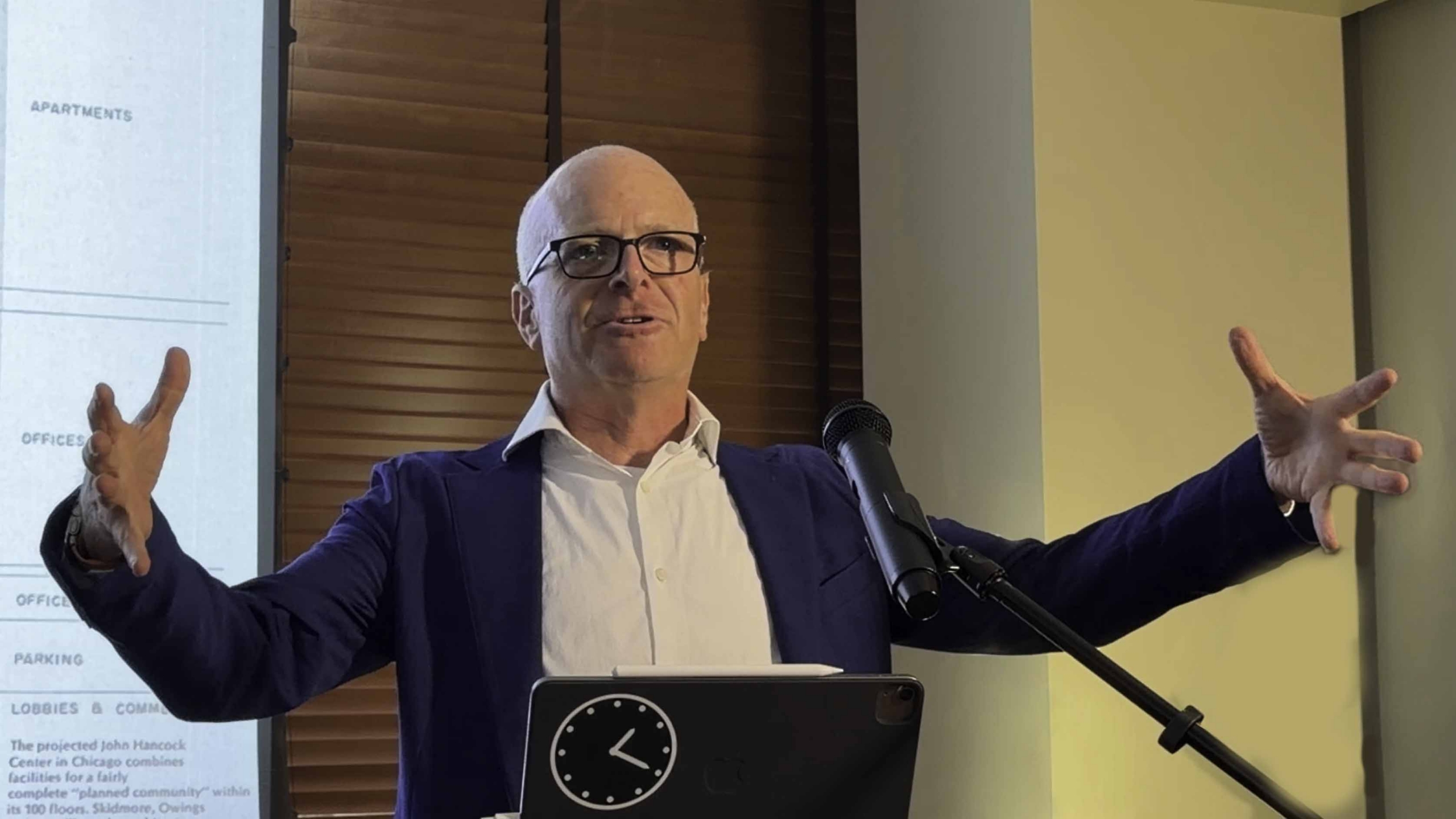
Tim Samuelson: Cultural historian. People wonder, what’s that all about? How do you get a job like that? Well, you have to have a good teacher, and that’s where Bill Hasbrouck comes into the picture.
I was just kind of a history nerd as a kid, especially about architecture, especially Chicago architecture. If you were interested in that topic in the 1960s, there weren’t any schools you could go to that specialized in it. I was just a teenager, and I would save up my allowance and go downtown to that late, great bookstore, Kroch’s & Brentano’s. Up on the second floor, in the days before the Prairie Avenue Bookshop, was the great muse to everyone seeking what was new in art and architecture books, Mr. Henry Tabor. And there would be this little white magazine, and Henry would say, “There’s a new copy here for you.” This was the Prairie School Review. I still laugh when I think how it seemed like a fortune to pay the cover price of $1.50, or $2.50 for a larger issue.
Reviving Forgotten Architects 39:37
At this point I knew Bill and Marilyn Hasbrouck only as names in the magazine. There would be stories about familiar architects like Louis Sullivan, Frank Lloyd Wright and Daniel Burnham, but with things you didn’t know about them at all. It was the only place you could find them. And there were essays about architects I had never heard of.
In many ways, the people who contributed to this magazine put before the world and revived the reputations of lost architects like Ernest Wood, Frederick Schock and Percy Bentley, and elevated them into the pantheon of architects to be studied. That was the legacy of the Prairie School Review, with its logo of the little drawing of the Prairie urn.
The Intrepid Hunter of Rare Books 40:43
But it wasn’t just that. Bill Hasbrouck was also the intrepid hunter of rare books. He could almost have worn a pith helmet. In his off hours from the Illinois Central Railroad, he went to the old bookstores, like Economy and ABC, gathering rare volumes before they disappeared altogether.
Things like Harriet Monroe’s biography of John Wellborn Root. I lusted for one of those as a kid. I asked for it for Christmas, but nobody could find one. Then Bill took the copy he had retrieved, probably at some dusty bookstore long ago, and reproduced it exactly. I had my copy. Thank you, Bill. I still have it, all marked up from carrying it around the South Side trying to find all the houses in the building list at the back, most of the time coming back with vacant lots. But that’s what happens.
Bill, the Answer Man 41:46
Then I got to meet Bill and Marilyn themselves, and this was part of my education, because Bill became my answer man. There was no question you could ask him about Chicago architects that he couldn’t answer. In many cases he had personally met the older practitioners of Chicago architecture or their families, rescued their papers before they disappeared into oblivion, and then published them in his magazine and shared them.
When I asked Bill a question, he would answer it, and if he couldn’t quite recall, he would come up with some rare volume or magazine that had the answer. And if I asked if I could borrow it: sure, take it home, and, as was said before, bring it back when you’re done. He always liked to lend me books because I always brought them back. I first met Bill when I was 17 years old, and this continued for literally 50 years.
The Scholar: The Chicago Architectural Club 43:05
The other interesting thing about Bill is that he was an amazing scholar. In addition to publishing in the Prairie School Review and gathering the work of architectural historians, giving them a forum for their scholarship, he was an incredible scholar himself.
Certainly at the top of that, sitting right on the table over there, is his history of the Chicago Architectural Club, one of the most definitive, detailed pictures of Chicago architecture in the late 19th and early 20th centuries you’ll ever find. Look in its index and you’ll find architects forgotten by history, documented with impeccable footnotes. All 640 pages of it. And it is not only a ready resource for me: when I have antique papers that have gotten folded and I want to flatten them, I set that book on them. It has saved many a historic document.
Finishing Bill’s Book on Dwight Heald Perkins 44:26
As for Bill the scholar, I have been helping John sort through Bill’s papers. One of his great passions was the life and work of the great architect Dwight Heald Perkins, who was also a member of The Cliff Dwellers and one of the fathers of modern school design. For years, Bill gathered material with the idea of creating the definitive biography of him. We have found the notes and gathered them up from the apartment. What is it now, John? Ten document boxes and counting.
There are chapters that are finished, and he got pretty close. His devotion to this book was so strong that as he realized the onset of illness, it became a race between his life and finishing the book. He got so close. We have the chapters in finished form. The hardest part for any author is the final summation, the last chapter, and going through to tighten things up. He almost got there, but didn’t.
This reminds me of a bit of history involving The Cliff Dwellers. In the late 1930s, one of the early members of this club, Thomas Eddy Tallmadge, one of the historians of Chicago architecture, was writing a book documenting that history and gathering the practitioners of the era. The book was nearing completion when he unexpectedly died in a train wreck. What happened? The members of The Cliff Dwellers and people from the architectural history community pooled together and finished that book, and that is the book we now know as Architecture in Old Chicago.
So if I think about what would be a great way to honor and memorialize Bill, I’d love to finish this book. I’m looking out at an amazing pool of knowledge and expertise, and we could do what people did for Thomas Eddy Tallmadge. And this will be an even bigger book, with a lot more pages.
In the end, as far as remembering Bill goes, Bill is still very much with us. Bill is in our hearts. Bill is in our minds, with what he taught us, and also, of course, with what he put on our bookshelves. Thank you.
Closing Thanks: Charles Hasbrouck 47:39
Charles Hasbrouck: Well, I want to thank all the speakers here tonight, and I want to thank all of you, too, for coming. I am completely overwhelmed by this crowd. The Cliff Dwellers was founded for artists and patrons of the arts to come together, enjoy each other’s company and engage in conversation. I hope you’ll all enjoy today, continue that conversation and have a good evening.